



New Delhi: The Black Sea has emerged as a major theatre in the Russian-Ukraine war, with events in that maritime region affecting the military balance on land, global food movement, and the security calculations of NATO states along its shores.
Its strategic importance comes from the fact that the Black Sea links Ukraine and Russia to Türkiye, southeastern Europe and, through two narrow straits, the Mediterranean.
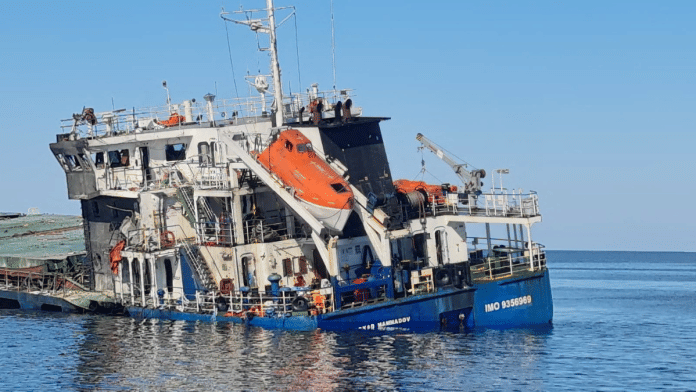
What has now drawn the world’s attention is the spate of attacks and incidents involving commercial shipping in this crucial maritime corridor. On 5 October, a Turkish-owned vessel carrying corn caught fire and sank outside Romania’s territorial waters after leaving the Ukrainian port of Izmail. Romanian authorities reported two deaths and eleven people rescued. The Ukraine president blamed Russian drones for the attack.
The next day, Bulgaria reported attacks involving two merchant ships in its exclusive economic zone. These incidents explain the importance of the Black Sea not just as a military theatre, but also as a gateway between Europe and the Mediterranean, and a working trade route on which civilian lives depend.
The four axes
The wider Russia–Ukraine war can be understood along four overlapping axes. First is the land battlefield, especially in eastern Ukraine’s Donbas. Second is the war of long-range strikes: Ukrainian strikes on Russian oil refineries and other infrastructure, and Russia’s targeting of Ukrainian power systems, cities and civilians.
Third is the Black Sea, where the war’s nature changes because ports, shipping, missiles, aircraft and unmanned craft operate in one maritime space. A fourth, less direct dimension reaches parts of Africa where a proxy war is being played out between two sides.
What makes it an interesting case to study is that the imbalance at sea was striking in February 2022. One open-source count put Russia’s Black Sea Fleet at 275 vessels of all types, including 58 combat ships, or 74 combat units if patrol boats were counted. It had a missile cruiser, frigates, submarines and landing ships. Ukraine, on the contrary, had a small conventional navy, and its sole frigate was under repair.
By early 2026, Ukraine’s defence ministry estimated that around 30 percent of the Russian fleet’s combat assets were either destroyed or seriously damaged. That said, it is Ukraine’s assessment but it does capture the scale of a transformation which not many expected in 2022.
The significance of the Black Sea region is explained in six parts in the following sections.
Also Read: Ukraine’s robotic army is already at work. India must rethink the next battlefield
Geography & the food route
Apart from Ukraine and Russia, Georgia, Türkiye, Bulgaria, and Romania have a direct coastline along the Black Sea. To its southwest, ships pass through the Bosphorus, the Sea of Marmara and the Dardanelles into the Mediterranean.
To the northeast, the narrow Kerch Strait connects it with the Sea of Azov. Ports such as Odesa, Chornomorsk and Pivdennyi carry Ukrainian trade; Novorossiysk is a major Russian port. Its geography makes every port, chokepoint and shipping lane strategically consequential.
Crimea projects from the northern shore into the sea. Its position gives Sevastopol a sheltered naval base and helps whoever controls the Crimean peninsula or threaten much of the surrounding water.
Crimea’s history is deeper than a simplistic story of its ownership. Existing from 1441 to 1783, the Crimean Khanate preceded the annexation by the Russian Empire. The Soviet Union transferred Crimea to the Ukrainian republic in 1954. When Ukraine became independent in 1991, Crimea was within its internationally recognized borders.
Agreements in 1997 divided the former Soviet Black Sea Fleet and allowed Russia to base its fleet at Sevastopol under lease. Russia seized and annexed the peninsula in 2014; the United Nations and most of the countries did not recognize that change of status.
There is an older image that fixes Crimea in world history: the 1945 Yalta Conference that brought together US President Franklin D. Roosevelt, British Prime Minister Winston Churchill and Soviet leader Joseph Stalin to discuss the end of the Second World War.
Today, Crimea’s military significance is more immediate. Russia uses it for naval basing, air defence and logistics; Ukraine attacks it for that very reason The Kerch Bridge, opened after the annexation and connecting the peninsula to Russia, has become another target.
Then there is the food angle. Before the full-scale invasion, Ukraine supplied more than 45 million tonnes of grain per year to international markets, according to the UN Food and Agriculture Organisation.
Russia and Ukraine together accounted for roughly three tenths of global wheat exports before the war. The Black Sea is indispensable to the movement of their harvests. In 2021, 36 of 55 countries experiencing food crises obtained more than 10 percent of their wheat imports from Russia and Ukraine, and some obtained almost all of it. North African and Middle Eastern buyers are especially exposed, alongside other importers. A disruption to a port in Odesa or a ship near the Danube can, therefore, raise costs far beyond the battlefield.
How naval battle changed after 2022
In the beginning, Russia blockaded Ukrainian ports, used ships to support operations along the coast, and fired cruise missiles at Ukrainian targets. Ukraine responded with coastal missiles, mines, air and missile strikes, intelligence, and eventually explosive unmanned boats.
The first major turning point came in March and April 2022. Ukraine struck the Russian landing ship Saratov at occupied Berdiansk in March. In April, Neptune anti-ship missiles sank the Black Sea Fleet’s flagship, the Moskva. Russia said a fire and ammunition explosion preceded its loss.
The cruiser’s disappearance reduced air-defence cover at sea and had an enormous symbolic effect. In June, Russian forces withdrew from Snake Island after sustained attacks, loosening their hold over the northwestern Black Sea.
The next stage showed that Russian vessels were vulnerable even in harbour. In October 2022, Ukraine launched a combined aerial and unmanned surface-boat raid on Sevastopol. In 2023, strikes spread across the peninsula and farther east. A July attack damaged the Kerch Bridge.
In August, an explosive boat damaged the Olenegorsky Gornyak landing ship at Novorossiysk, showing that relocation could not guarantee safety. In September, missiles hit the landing ship Minsk and the Kalibr-capable submarine Rostov-on-Don in a Sevastopol dry dock. In December, a strike destroyed the Novocherkassk landing ship at Feodosia.
In early 2024, Ukrainian unmanned surface craft sank the missile corvette Ivanovets, the landing ship Kunikov and the patrol ship Sergey Kotov in separate attacks.
Russia dispersed valuable ships away from Sevastopol, especially towards Novorossiysk, and strengthened harbour defences. The result was a reduction in the fleet’s freedom to operate close to Ukraine’s coast, but not the disappearance of Russian naval power. Submarines, aircraft, coastal missiles and surviving surface vessels could still threaten Ukraine and shipping. Nevertheless, Ukraine achieved substantial sea denial without acquiring classic control of the entire Black Sea.
Türkiye, the Straits & the grain corridors
Türkiye occupies an unusual position. It is a NATO member, has supported Ukraine’s sovereignty and supplied it with weapons, yet has kept diplomatic and economic channels to Moscow open and hosted negotiations, including talks in Istanbul. It has tried to mediate rather than simply sever its relationship with either side. Its geography gives that balancing act practical weight: Türkiye controls the Bosphorus and Dardanelles Straits, the only passage between the Black Sea and the Mediterranean.
Under the 1936 Montreux Convention, merchant ships generally retain freedom of passage, while warships face restrictions. After the full-scale invasion, Türkiye applied the convention’s wartime provisions to restrict belligerent warships passing through the straits, subject to an exception for vessels returning to their home bases.
It also urged restraint by other states. The closure limited Russia’s ability to reinforce the Black Sea Fleet from its other fleets, while also constraining naval access more generally.
These rules also affect Russia’s wider military logistics. For years, the so-called Syrian Express (Russia’s military maritime logistics network) linked Russian ports with its military facilities at Tartus in Syria through the Turkish straits. Wartime restrictions complicated that naval route and required alternatives and longer logistical arrangements.
Türkiye and the UN brokered the Black Sea Grain Initiative in July 2022. It allowed inspected commercial ships to carry food from designated Ukrainian ports despite the war. Before Russia ended its participation in July 2023, the arrangement moved about 32.9 million tonnes of food to 45 countries. Russia argued its own agricultural exports faced obstacles; the initiative’s collapse exposed ports and merchants to renewed pressure.
Ukraine then established a new maritime route without the old inspection agreement. Ships leaving its Black Sea ports traveled westward along the coast and near the waters of NATO members Romania and Bulgaria before reaching the Turkish straits. The proximity to those states made the route more viable, and allies provided maritime security assistance and monitoring, but it was a Ukrainian-operated corridor, not a NATO guarantee or an EU-run convoy. Separately, the EU’s Solidarity Lanes carried Ukrainian goods through rail, road and Danube connections.
The volumes show that the corridor was more than a symbolic workaround. By February 2024, the British government said the new sea route had moved 19 million tonnes of cargo, including 13.4 million tonnes of agricultural goods. The European Commission reported that in July 2026 roughly 80 percent of Ukraine’s grain, oilseed and related-product exports traveled through Black Sea ports, compared with about 20 percent by the Solidarity Lanes.
Cumulatively from May 2022 to July 2026, it put those exports through Black Sea ports and the Solidarity Lanes at about 60 and 40 percent respectively, out of roughly 255 million tonnes. As the cumulative figures span both the original grain initiative and the later Ukrainian corridor, these numbers should not be credited entirely to the post-2023 route.
Also Read: India seeks safe Black Sea shipping, grain exports & non-attack understandings in Ukraine-Russia war
A contest of tech & adaptation
The innovation most associated with Ukraine’s naval campaign is the Magura V5: an unmanned surface vessel (USV) that can be used for kamikaze missions against warships and other targets. Another USV, the Sea Baby, has been used for longer-range strikes and other payloads. Their military value lies more in how they are used with reconnaissance, communications and coordinated attacks.
Ukraine has further transformed these USVs into a mobile launch platform. Missiles launched from unmanned boats have downed a Russian helicopter in 2024 and a fighter aircraft in 2025 . In late 2025, Ukraine claimed an underwater Sea Baby variant was used to strike a submarine in Novorossiysk. Russia disputed the claim.
Underwater capability may complicate harbour defence, but the precise damage in contested operations is harder to verify independently. Russia, in turn, has added barriers, patrols, electronic warfare and new defensive tactics, which goes on to show that this is an innovation race.
And then, there is a Turkish innovation as well. In November 2025, Turkish defence company Baykar said a Kızılelma unmanned combat aircraft used its radar to identify a jet-powered target and launched a Gökdoğan air-to-air missile in a successful test off the coast of Sinop over the Black Sea.
This showed how the Black Sea region has become a battle testing ground for unmanned air and maritime systems. Its relevance to the conflict is technological and geographic. The strategic effect is to change the price of movement.
A fleet that once assumed it could approach Ukraine’s shore has had to spend more effort protecting ships, bases and logistics. Ukraine still cannot make the sea safe simply by pushing warships back. Mines, missile and drone attacks on ports, and threats to civilian vessels persist.
Why the story remains unfinished
The 5 October loss of cargo ship Royad Mammadov shows how the naval and commercial stories meet. A Turkish owner, a multinational crew, a Ukrainian port call, Romanian rescue services and a destination in Italy were all involved in one voyage.
Ukraine attributed the incident to Russian drones; independent findings on its cause were not yet established in the Romanian account. Bulgaria’s report of two merchant ships attacked the following day added to concern that danger was spreading into waters where NATO coastal states have rescue and security responsibilities. An incident in an exclusive economic zone can still have serious human and diplomatic consequences.
There is an economic cost even when ships continue sailing. Reuters reported Ukrainian grain exports in September 2026 were 36.6 percent lower than a year earlier, a figure that should not be attributed to naval attacks alone because harvests, demand and logistics all these factors also affect exports. However, It is an indication of why a functioning maritime corridor needs constant attention.
A regional war with global consequences
So the ready reckoner is this. Russia began the full-scale war with the dominant conventional fleet. Ukraine used missiles, unmanned systems and repeated strikes to deny that fleet easy use of the northwestern sea and its Crimean base.
Türkiye’s control of the straits limits naval reinforcement while allowing commercial passage under different rules. Ukraine rebuilt a route for its exports after the grain deal ended, and the sea remains central to food supplies abroad.
Yet neither side has made it a safe or settled maritime space. The most revealing question now is not simply how many Russian warships Ukraine has sunk but whether civilians, cargoes and coastal states can continue to use the Black Sea while a war is being fought across it.
Other navies are studying how inexpensive unmanned craft, shore-based missiles and air defence systems can constrain larger fleets. For the region, the stakes extend from Crimea and the Ukrainian coast through Türkiye’s straits into Mediterranean security and Russian logistics.
The global stake is more immediate for many households: ships carrying wheat, corn and sunflower oil link these shores to food prices and supply chains in North Africa, the Middle East, Asia and elsewhere.
And, then there is an India hook because it illustrates that wider reach. Reuters reported on 7 October that a 20,000-tonne cargo of Russian sunflower oil bound for India was cancelled after damage to Black Sea port infrastructure, while about 60,000 tonnes faced delays.
Reports also indicate that India has offered ideas on energy infrastructure and safe shipping, and Foreign Minister S. Jaishankar has held conversations with Moscow and Kyiv. The details and prospects of any Indian mediation are still uncertain.
But, a serious effort to protect commercial shipping and reduce attacks in Black Sea would answer a concern shared by many developing countries, whose interest is reliable food and energy supplies.
(Edited by Tony Rai)
Also Read: India’s Russia-Ukraine ceasefire proposal ‘broadest’ among four on table, says Kyiv