



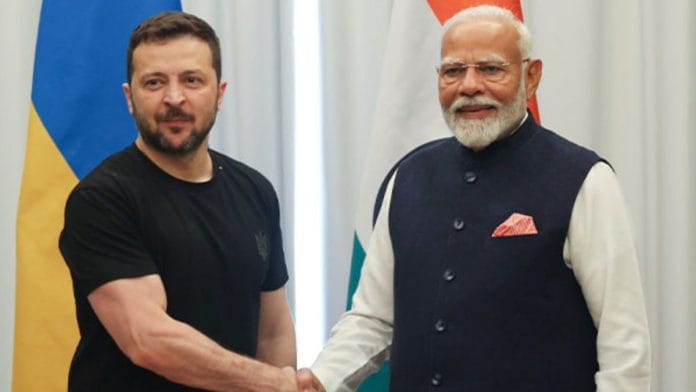
New Delhi: India’s proposal for a ceasefire between Russia and Ukraine is the “broadest” among four offers under discussion, Ukrainian Foreign Minister Andrii Sybiha has said. He has emphasised that Kyiv is ready for a ceasefire provided it covers not only combat operations but also strikes on energy infrastructure and in the Black Sea.
“We have four proposals. The broadest is India’s proposal. We are ready for an energy and Black Sea truce, but only in this combination. This is a complete energy truce, stopping the strikes on all energy facilities, including the port infrastructure,” Sybiha was quoted as saying by European Pravda, a Ukrainian news platform, on Friday.
European Pravda confirmed that the four proposals have been put forward by India, the US, Egypt and Turkiye.
India’s proposal was likely discussed during External Affairs Minister S. Jaishankar’s first standalone bilateral visit to Ukraine last month, as well as during his follow-up meeting with Sybiha on the margins of the United Nations General Assembly at the end of September.
The Turkish and Egyptian proposals also include reviving the Black Sea grain deal, from which Russia withdrew in July 2023. Mediated by Turkiye and the UN, the deal allowed Ukrainian grain exports to resume through the Black Sea.
After the deal expired, Ukraine established its own maritime corridor for exports following a series of successful attacks against Russia’s Black Sea Fleet. However, those exports have been heavily impacted as Russia intensified its operations in the Black Sea this summer.
This is the first proposal made by India with regard to the Russia-Ukraine war. New Delhi has long urged both sides to end the conflict through dialogue and diplomacy, particularly as the war has contributed to global food, fertilizer and fuel shortages.
Prime Minister Narendra Modi met Russian President Vladimir Putin at the end of August on the margins of the Shanghai Cooperation Organisation (SCO) Heads of State Summit in the Kyrgyz capital of Bishkek. At the meeting, Modi said it was time to move from “endless war to the end of war”, urging the Russian President to find a solution through dialogue and diplomacy. The two leaders met again on the margins of the BRICS Summit in the Indian national capital last month.
Between the two meetings, Jaishankar made a quick visit to Kyiv and Warsaw, where he called on Ukrainian President Volodymyr Zelenskyy and met Sybiha. Jaishankar met Sybiha again on the margins of the UNGA at the end of September, underscoring the intensifying diplomatic engagement with both sides over the past 45 days.
War intensifies
Sybiha’s statement came a day after Russian President Putin praised Modi during a speech at the Valdai Discussion Club. Putin said Modi “has very good ideas aimed at finding mutually acceptable solutions” to resolve the conflict.
Putin also thanked Modi for his efforts to facilitate a “peaceful end to the conflict”.
India has maintained its close partnership with Russia while remaining in regular contact with Ukraine. Modi visited Kyiv in August 2024, weeks after travelling to Moscow for the annual India-Russia summit.
New Delhi has been one of the largest purchasers of Russian oil and has faced pushback from the US over its energy purchases. Nevertheless, India and Russia are seeking to expand bilateral trade to $100 billion by 2030, despite Western sanctions targeting large sectors of Moscow’s economy.
The Russia-Ukraine war has intensified in recent months. Kyiv is reported to have informed its European allies of Russian plans to target its energy infrastructure this winter in an effort to further undermine Ukrainian morale. Ukraine has also heavily targeted Russian refineries and specific e-commerce companies over the summer as it has expanded its capability to strike deep inside Russian territory.
Most recently, Zelenskyy announced the successful launch of Ukraine’s own ballistic missile at Russia, indicating its growing military capabilities. Ukraine has also claimed to have recaptured around 100 square kilometres of territory from Russia in Donetsk in recent weeks.
Despite these gains, Russia has continued to strike Kyiv and other Ukrainian cities. Almost daily bombardments of Kyiv have left several neighbourhoods without power.
(Edited by Chingkheinganbi Mayengbam)
Also Read: Ukraine’s robotic army is already at work. India must rethink the next battlefield