



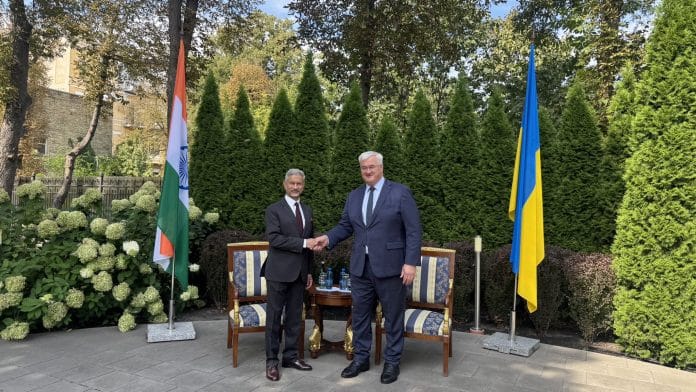
New Delhi: In a firm message to Ukraine, External Affairs Minister S. Jaishankar raised the issue of attacks on civilian merchant vessels in the Black Sea with his Ukrainian counterpart Andrii Sybiha in Kyiv Thursday.
Jaishankar, after meeting with Sybiha, said, “There were also some specific aspects of this conflict that came up in our discussion. Prominent among them was attacks on commercial shipping. Indian seafarers man ships of many flags and have been among the unfortunate casualties. The impact on shipping is also significantly affecting many nations of the global south in a variety of ways, leading to fuel, fertiliser and food shortages.”
He also defended India’s continued purchases of Russian oil. “Clearly the Ukraine side has its perspective, which we respect, and we have ours, which I would expect others to also respect. But let me just add this. You know, this conflict, which is today in its fifth year, will not be solved because somebody is buying or not buying oil or alumina or minerals or metals or fertiliser. This conflict will be solved by dialogue, by diplomacy, by negotiation. And that is why it is something we would encourage,” the Indian external affairs minister said.
It is important for Ukraine to “understand the challenges of providing energy for 1.4 billion people”, he emphasised.
Jaishankar’s visit to Ukraine comes over a year after Sybiha travelled to New Delhi. He is on a three-day visit to Ukraine and Poland. He is expected to call on Ukrainian President Volodymyr Zelenskyy later Thursday before travelling to Poland and holding discussions with his Polish counterpart Radoslaw Sikorsky.
An increasing number of strikes on Russia’s oil tankers in the Black Sea left many Indian seafarers dead earlier this year, in response to which India had summoned the Ukrainian ambassador and lodged a strong protest over the strikes on commercial shipping.
Russia has increased the intensity of its strikes across urban centres of Ukraine, as Kyiv’s stock of anti-aircraft weaponry continues to dwindle.
While remaining non-committal on a future visit by Zelenskyy to New Delhi, Jaishankar’s response was categorical to a question at the press conference, saying that any invite would be “communicated through diplomatic channels”. He refused to comment on whether an invitation had been shared or would be shared during his visit.
This is Jaishankar’s first standalone visit to Ukraine. The visit comes after a number of rounds of diplomacy between India and Russia in the last couple of weeks. Jaishankar was in Moscow at the end of last month for talks with Deputy Prime Minister Denis Manturov, and Prime Minister Narendra Modi met President Vladimir Putin on Monday on the margins of the Shanghai Cooperation Organisation summit in the Kyrgyz capital of Bishkek.
Modi had told Putin that it is important to move to the “end of war” from an “endless war”. The Russian President is expected to travel to New Delhi later this month to attend the BRICS Summit. The Russia-Ukraine war has entered its fifth year, with increasing intensity.
Jaishankar highlighted that while trade ties between India and Ukraine have been disrupted due to the war, there is scope for further engagement in different sectors. The External Affairs Minister highlighted the long-standing ties between the two countries that began before Ukraine’s independence from the Soviet Union.
Kyiv has long pushed for higher-level engagement with India. Prime Minister Modi travelled to Kyiv in August 2024. While the two leaders have met at the margins over international summits, the Ukrainian President has not come to New Delhi yet.
In the same period, Modi has travelled to Russia, Putin has visited India, and is set to make another visit later this year. Modi is expected to travel to Russia later this year for the annual summit.
Jaishankar shared his condolences on the loss of life during the conflict, mentioning the Indian national who was killed in a Russian strike a couple of days earlier.
(Edited by Nivedita Patil)
Also Read: India’s imports from Russia grow over 52% in first quarter of FY26-27, crude oil imports up 55%