



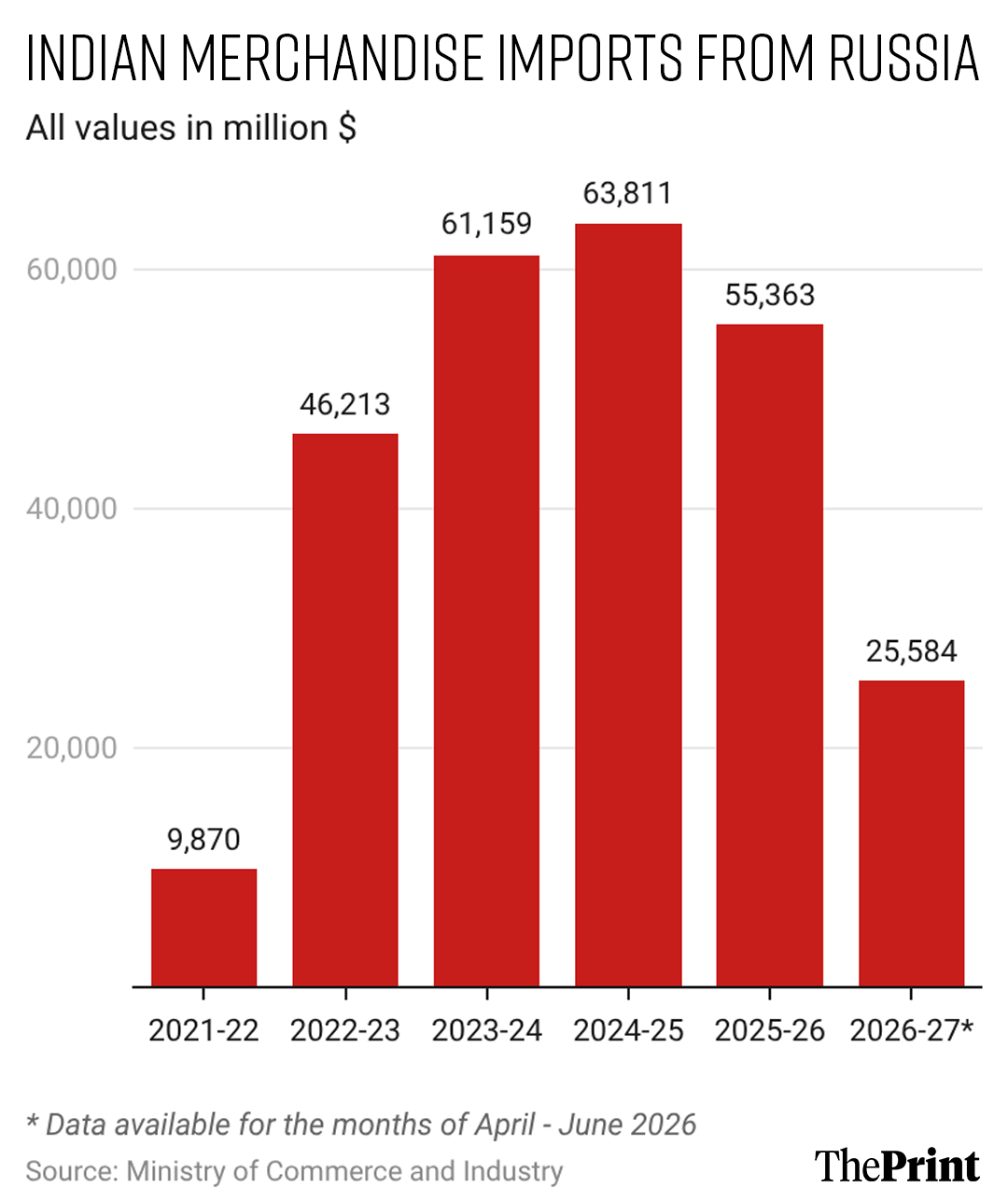
New Delhi: India’s merchandise imports from Russia grew by 52.59 percent in the first quarter of this fiscal compared to the same period last year, indicating New Delhi’s large-scale purchases of Russian oil in the last few months.
The growth in merchandise imports from Moscow was appreciated by Russian President Vladimir V. Putin Monday when External Affairs Minister S. Jaishankar called on him during a two-day visit to Moscow. Putin credited Prime Minister Narendra Modi with the substantial increase in trade between the two countries, amid American pressure to curb Russian oil purchases.
Jaishankar doubled down on the necessity of deeper economic engagement, while also highlighting the widening trade imbalance between India and Russia.
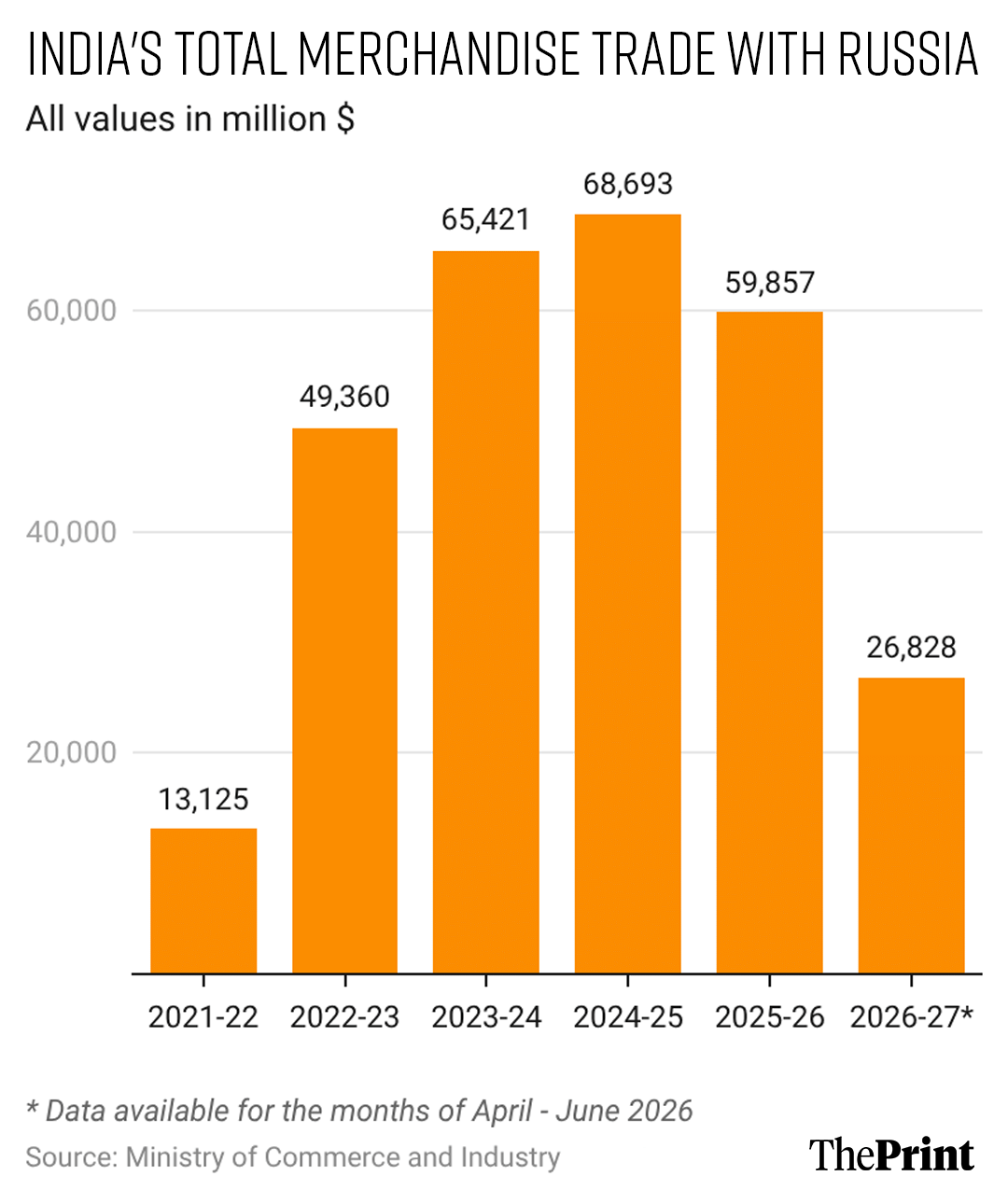
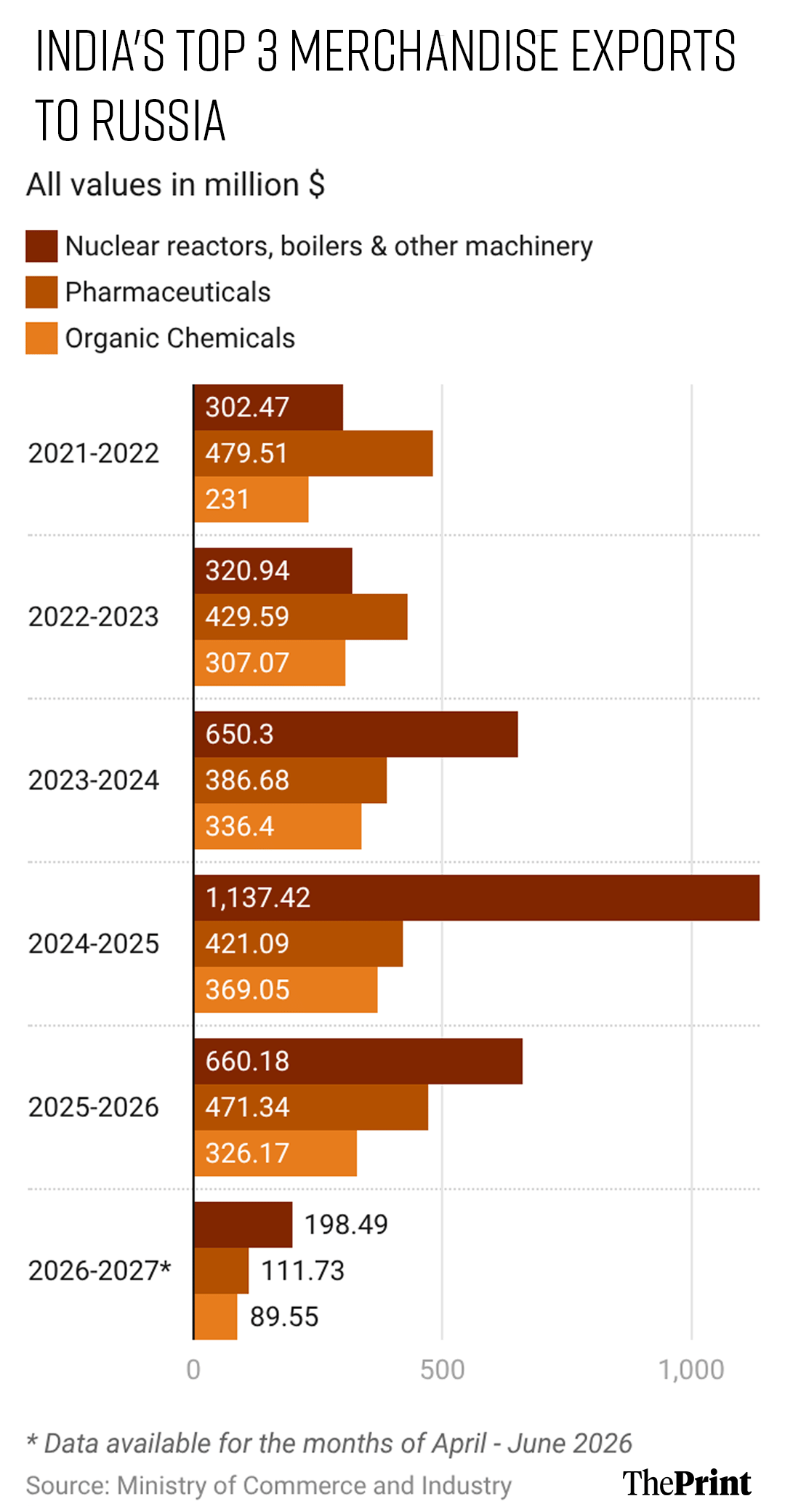
While India’s imports and total trade with Russia have grown almost four-fold in the last half-decade, its merchandise exports have grown by around 38 percent during the same period.
As the war in West Asia began in February this year with US-Israeli strikes on Iran, global oil prices surged to over $100 a barrel on the Brent crude index. As a measure to combat the surging prices, the US issued a waiver on purchases of Russian oil, allowing companies to pick up large quantities of crude from Moscow.
The waiver, which expired on 17 June, however, saw larger purchases of Russian crude by Indian refiners. In the first quarter of the current fiscal, Indian refiners bought roughly $23.61 billion worth of Russian crude, a 55 percent increase from the same period in the previous year. In the first quarter of 2025-2026, India imported roughly $15.14 billion worth of Russian crude.
India’s overall trade with Russia grew by 50.48 percent in the first quarter of the current fiscal, touching $26.82 billion, up from $17.82 billion from the same quarter in the previous fiscal year. However, Indian exports remain low, despite a nearly 17 percent increase in the first quarter of this financial year. Indian merchandise exports stood at $1.24 billion, up from to $1.061 billion quarter-on-quarter.
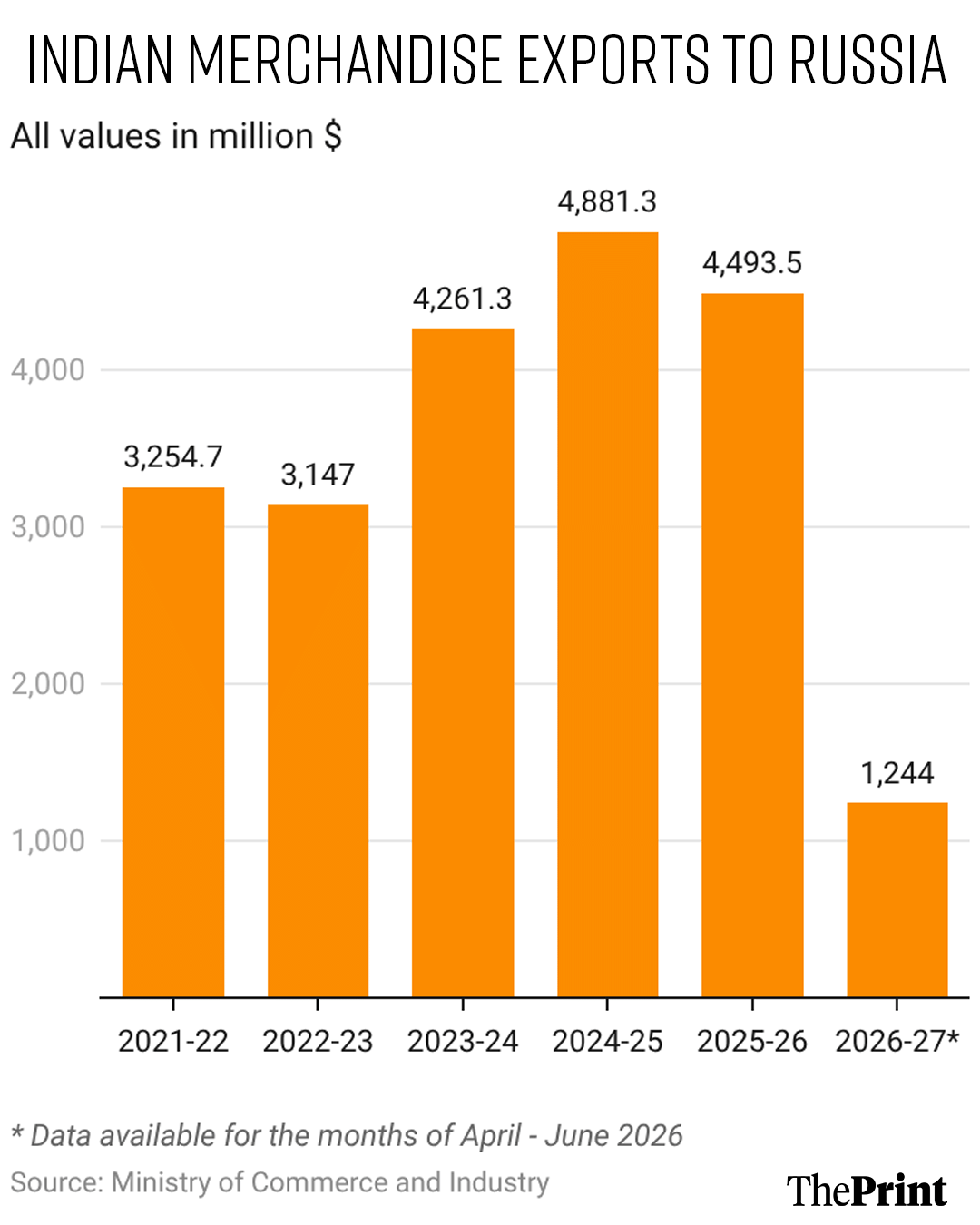
In 2021-2022, the last fiscal year before Russia’s invasion of Ukraine, total trade between the two countries stood at $13.1 billion. India’s exports to Russia totaled $3.25 billion, while its imports stood at around $9.8 billion—indicating a roughly $6.5 billion trade deficit in favour of Moscow.
However, Russia’s invasion of Ukraine in February 2022, and the subsequent economic sanctions imposed by the Western countries, specifically the members of the G7—the US, the UK, Canada, Germany, Japan, Italy, France and the European Union (EU)—led to fears of potential impacts on global energy markets.
The US, then led by President Joseph R. Biden, urged India to purchase Russian oil as a means to stabilise global markets. In 2022-2023, India’s total merchandise trade with Russia grew 276 percent to $49.359 billion, driven primarily by the large-scale imports of crude oil.
That year, India imported roughly $38.81 billion worth of Russian crude, up from $5.25 billion the year before—showcasing the scale by which Indian petroleum companies shifted to cheaper Russian oil.
Indian exports to Russia actually fell in 2022-2023, to roughly $3.1 billion, indicating the challenges faced by domestic firms to sell to Moscow. It should be noted that the G7 countries began imposing secondary sanctions on firms trading with Russia, with a few Indian companies facing Western sanctions for their ongoing trade with Moscow. Lokesh Machine Tools, which supplied arms to the Indian Army, was one of 19 firms originally sanctioned in 2024, and removed from the list in June 2026.
Also Read: India summons Russian Cd’A, lodges strong protest after four seafarers killed in Black Sea
Top non-petroleum imports
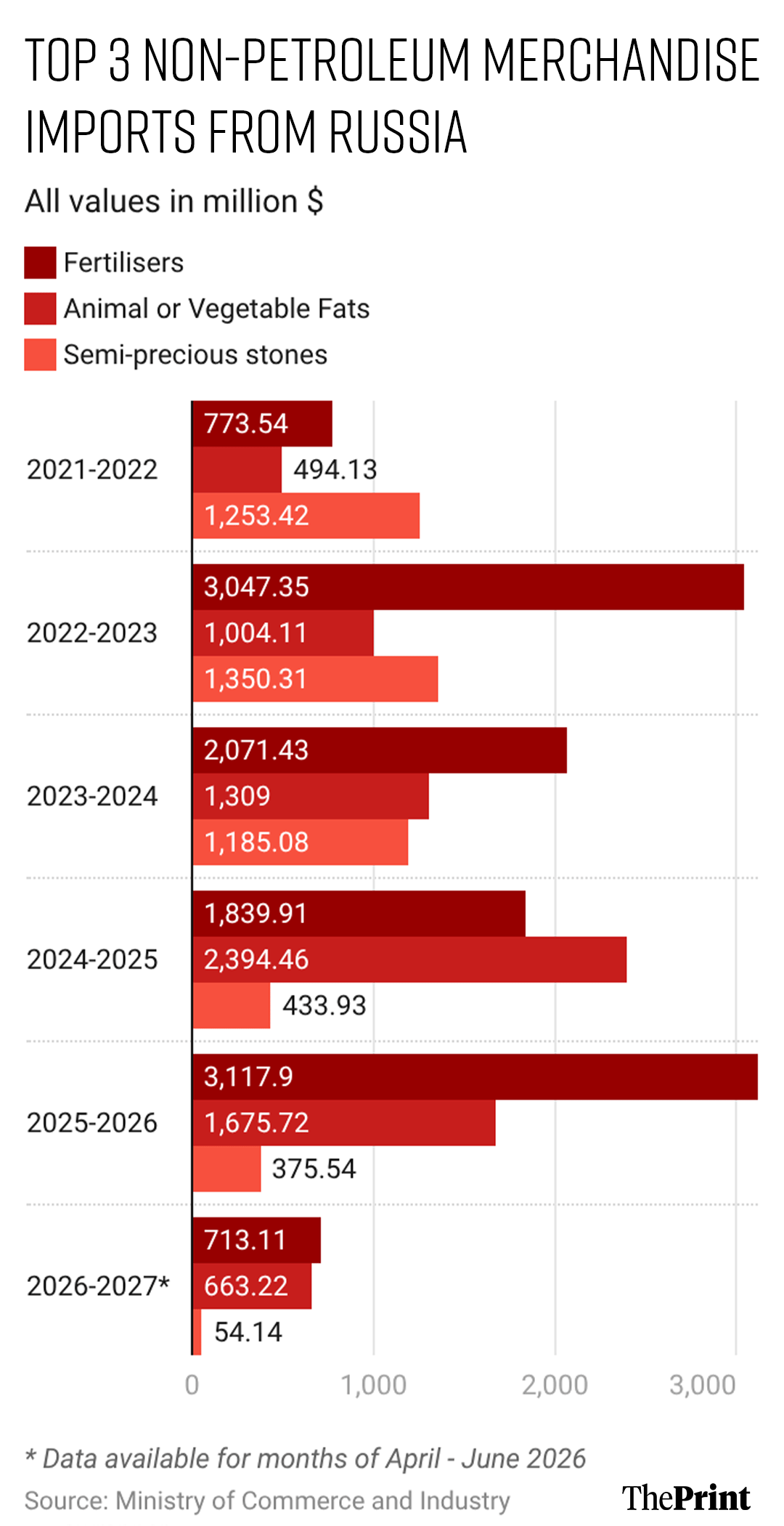
While India’s trade with Russia has heavily relied on crude imports, other major goods imported domestically include fertilisers, animal or vegetable fats, and semi-precious stones. In 2021-2022, India imported roughly $773 million worth of fertilisers, $494.13 million worth of animal or vegetable fats and $1.25 billion worth of semi-precious stones.
The following year, India imported over $3 billion worth of fertilisers from Russia, roughly $1 billion worth of animal or vegetable fats and roughly $1.35 billion worth of semi-precious stones. However, these sums were dwarfed by India’s crude oil imports from Russia. In 2023-2024 apart from crude, India’s imports of fertilisers touched over $2 billion from Russia. India’s other major imports (over $1 billion in value) that year included animal or vegetable fats and semiprecious stones.
In 2024-2025, India’s imports of fertilisers from Russia fell from over $2 billion in the previous year to $1.83 billion. In that year, India’s imports of animal or vegetable fats grew to $2.39 billion, while the imports of semi-precious stones fell drastically to roughly $435 million. The following year saw India’s fertiliser imports grow to $3.117 billion, while animal or vegetable fat imports fell to around $1.6 billion. Semi-precious stones fell further to around $375.54 million.
The fall in imports of semi-precious stones coincides with the G7 closing most loopholes related to the export of non-industrial diamonds from Russia. The sanctions imposed on the trade of Russian diamonds and gems has impacted the Indian diamond industry, especially the cluster located in Surat.
Trade crosses $50 billion on back of oil
In 2023-2024 and 2024-2025, India’s trade with Russia continued to grow, crossing $60 billion, as domestic oil refiners continued to expand their imports of Russian crude. In 2023-2024, India’s total trade with Russia touched $65.42 billion—a 32 percent increase from the previous year.
India’s merchandise imports from Russia stood at $61.15 billion, while its exports stood at a mere $4.2 billion—an almost $57 billion deficit in favour of Russia. India’s crude imports grew to $54.2 billion in 2023-2024, up from roughly $38.81 billion the year before.
The following year was the apogee of India’s crude oil imports from Russia. In 2024-2025, India imported $56.87 billion of crude oil from Russia. Indian merchandise imports that year stood at $63.811 billion, with total trade reaching $68.69 billion. Indian exports to Russia continued to grow, touching $4.881 billion.
The 2024-2025 financial year was the last one before Donald J. Trump became president. He began his second term in January 2025, and moved quickly to pressure India into curbing its purchases of Russian oil, as he sought to find an end to the Russia-Ukraine war.
Trump imposed a 25 percent penalty tariff on India in August 2025, which remained in force till February 2026. The total tariffs Indian exporters faced to enter the US markets touched 50 percent for the period between August 2025-February 2026, with the 25 percent penalty tariff, and another 25 percent base tariff.
The American administration’s swift change in posture from the previous administration’s encouragement of Russian oil purchases, impacted India’s imports of Russian crude. In 2025-2026, Indian imports from Russia fell by 13 percent to $55.36 billion, from the previous year’s $63.81 billion.
India’s crude imports from Russia fell 15 percent to $47 billion, as domestic refiners sought to diversify their dependence on Russian oil. Nevertheless, Russia remained the largest supplier of crude to India. The second biggest supplier, the UAE exported $24.2 billion worth of crude to India in the last fiscal, showcasing the gap between the top two sources of energy for India.
In 2024, at the height of the India-Russia growing trade in oil, Modi and Putin announced the goal of expanding bilateral trade to $100 billion. The ambitious target was coupled with the indication of signing a free trade agreement between India and the Eurasian Economic Union (EAEU), the common market that consists of Russia, Kazakhstan, Belarus, Armenia and Kyrgyzstan. The two sides signed a terms of reference last year, with the aim of concluding negotiations within the following 18-24 months.
(Edited by Nardeep Singh Dahiya)
Also Read: The most bombed McDonald’s reopens. Guess where it is