



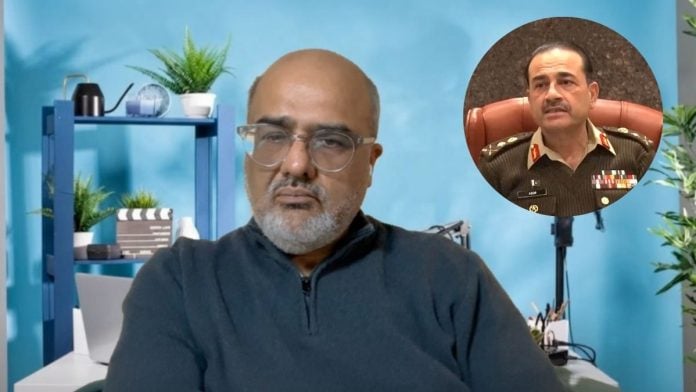
New Delhi: Pakistan’s military chief, Field Marshal Asim Munir, and the military-led political order pose the biggest threat to the country’s national security, former accountability minister in Imran Khan’s government Shehzad Akbar has said, accusing the military establishment of using emergency rule in Khyber Pakhtunkhwa to consolidate power and weaken provincial autonomy.
In an interview with ThePrint, Akbar described the imposition of emergency rule in the province, governed by Khan’s Pakistan Tehreek-e-Insaf (PTI), as an exercise in authoritarianism, arguing that the civilian government was being displaced by a military-backed administration.
“The real issue of Pakistan’s national security is Asim Munir and the current military regime,” Akbar said. “That’s the real risk to national security.”
Akbar served in 2020 as adviser on interior and accountability to jailed former prime minister Imran Khan. Before that appointment, Akbar served in the National Accountability Bureau (NAB) as a deputy prosecutor. He resigned as the prime minister’s advisor in 2022.
In conversation with ThePrint, he argued that the military’s approach to redrawing provincial boundaries and restructuring state institutions, coupled with the political exclusion of citizens, posed a fundamental threat to Pakistan’s stability. “It’s the disenfranchisement of the citizens, because if you look at the population, 250 million people without any political or economic rights, I think that’s a real national security issue for Pakistan,” he said.
Pakistan President Asif Ali Zardari declared an emergency in Khyber Pakhtunkhwa Sunday, suspending the PTI-led provincial government over what the federal government described as its failure to contain Islamist militancy. The move came as the party was mobilising supporters to demand the release of Khan, bringing the curtain down on the 13-year PTI rule in the region.
The PTI has described the intervention as a “coup disguised as an emergency”, while the government has maintained that it had run out of options to address the security situation. Akbar rejected the government’s justification, saying the military had played a leading role in counterterrorism operations in the province for nearly 15 years.
“The military has been in the leading role in fighting terrorism in Khyber Pakhtunkhwa for almost the last 15 years and now turning around and saying the civilian government is not cooperating, it’s an absolute lie,” he said. He described the emergency as a de facto imposition of military rule, despite the continued presence of civilian officials.
“It is an imposition of martial law in Khyber Pakhtunkhwa. The faces of it are civilian, but the people who are really running the show are the military,” Akbar said.
He alleged that the provincial assembly speaker and Chief Minister Sohail Afridi were in the custody of Pakistani intelligence, raising questions about whether any meaningful institutional checks would remain on the powers assumed by the governor and his administration.
Also Read: Pakistan’s elected PTI govt in KP is gone. Critics say democracy has been buried again
Munir’s provincial bargain
Akbar then linked the emergency to proposals to divide Pakistan’s provinces into smaller administrative units, arguing that the two developments could serve a common objective: strengthening the military establishment’s control over the country’s political and financial institutions.
He alleged that the PTI government in Khyber Pakhtunkhwa had become an obstacle to the military’s plans because it sought greater independence from the federal government and had questioned the objectives of military operations in the province. “PTI was an irritant in that process, and it wanted to assert its independence away from the establishment, military establishment,” he said.
The former minister also alleged that the provincial government had resisted proposals involving the extraction of mines, minerals and rare earth elements, which he said the federal government had been discussing with the United States.
Akbar argued that the proposed restructuring of provincial boundaries could make it easier for the military establishment to exercise control over resources and reverse the devolution of financial powers to the provinces. “It’s more of a convenience for them,” he said, referring to the military’s alleged interest in creating smaller provinces. “What lies with breaking up the provinces is actually the real thing that they want, and that is they want the reversal of the national financial award.”
The National Finance Commission (NFC) Award governs the distribution of financial resources between Pakistan’s federal government and its provinces. The 18th Constitutional Amendment of 2010 significantly expanded provincial autonomy.
Akbar alleged that the military leadership wanted to reverse that devolution and bring the distribution of resources under greater federal control. “Once he redraws the whole demography and geography of Pakistan, it will be easy in the constitutional frame of things to reverse the distribution of financial resources,” he said.
He added that the ultimate objective was to concentrate power around the military headquarters in Rawalpindi. The federal government’s proposals to create new provinces have raised questions about the relationship between administrative boundaries, ethnic identity and political representation in Pakistan. Provincial boundaries are particularly sensitive in Sindh and Balochistan, where questions of language, ethnicity and control over resources have long shaped politics.
Akbar warned that a military-led effort to redraw those boundaries could provoke resistance, particularly in Sindh, where the Pakistan Peoples Party (PPP), led by the Bhutto-Zardari family, draws much of its political support. “We cannot have another Sir Radcliffe in the form and shape of Field Marshal Asim Munir to say, I’m going to draw new boundaries with my pen,” he said, invoking the British lawyer who chaired the boundary commissions that divided British India in 1947.
Also Read: Why the Pakistani province of Khyber Pakhtunkhwa has defiance baked into its politics
PTI’s stand
Akbar then said the PTI government’s objections to military operations in Khyber Pakhtunkhwa did not necessarily amount to opposition to counter-terrorism efforts. Instead, he said, the provincial leadership had sought clarity on their objectives and duration.
“PTI is not necessarily totally against any military intervention to root out terrorism in Khyber Pakhtunkhwa, but it has been consistently asking the question, what is the end game? How long are these military operations going to go on?” he said.
He also criticised the PPP for not doing more to oppose the emergency, saying its decision could leave the party vulnerable to similar interventions in the future. “In my assessment, it’s political suicide for the PPP,” he said, arguing that the party had lost an opportunity to defend provincial autonomy by not standing firmly with the PTI.
He alleged that the military used corruption investigations to pressure political parties into accepting its demands. “The whole narrative of anti-corruption and accountability in Pakistan is driven by the army to compel the politicians to dance to their tunes,” he said.
The PPP’s position is significant because any attempt to divide Sindh into smaller provinces could threaten its political base, particularly given the province’s strong tradition of Sindhi nationalism.
For the PTI, meanwhile, Akbar said the challenge was not simply to oppose an elected government but to confront a powerful military establishment.
“The challenge for PTI right now will be to fight the military force,” he said. “It is a political power, it can fight, you know, an oppressive government, but how can it fight an oppressive army?”
He said Khan remained central to the party’s ability to mobilise mass support and argued that his continued imprisonment had limited the opposition’s ability to challenge the prevailing political order. “PTI is Imran Khan. The mass political movement, I have to say, only lies with Imran Khan,” Akbar said.
Despite the military’s growing political influence, Akbar argued that economic stagnation could ultimately prove to be the greatest challenge to the existing system. “This current system cannot sustain as it is operating, because in a society where you’re not letting anything grow, the economy doesn’t grow as well, and that’s the real challenge for Asim Munir,” he said.
(Edited by Nardeep Singh Dahiya)
Also Read: Pakistan’s terrorism crisis worsening as violence falls globally. TTP, BLA driving it