



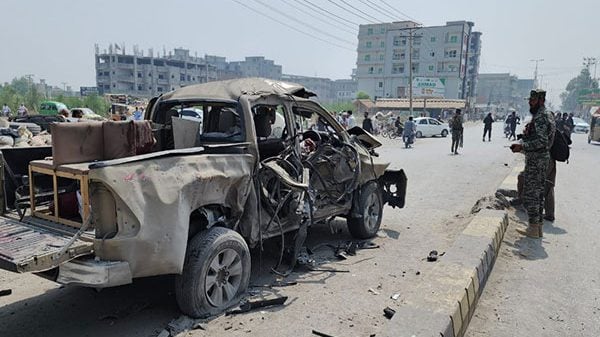
New Delhi: Pakistan ranks first as the country most impacted by terrorism, recording 1,139 deaths and 1,045 incidents in the global terrorism index. This is the first time Pakistan has claimed the top spot in the rankings, marking the highest number of terrorism-related fatalities in the country since 2013 and the sixth consecutive year of rising deaths. And Pakistanis are not surprised.
“This is what happens when you keep snakes in the backyard of your house: one day, the household members get bitten too. Pakistan began arming extremist jihadists fifty years ago. Now Pakistan is at the very top among countries targeted by terrorist attacks. Is there anyone willing to learn a lesson?,” former Pakistan ambassador to the US wrote on X.
According to the latest Global Terrorism Index, a resurgence in violence by the Pakistani Taliban and Baloch separatist militants pushed the country’s terrorism deaths to their highest level in more than a decade.
Pakistan has never failed to rank among the ten countries most impacted by terrorism every single year since the index’s inception in 2012.
The deterioration in Pakistan came against a broader decline in terrorism worldwide. Globally, 5,582 people were killed in 2,944 terrorist attacks in 2025, down nearly 28 per cent from the previous year, while the number of attacks fell 22 per cent. The deadliest attack killed 120 people, compared with 237 in 2024 and more than 1,000 in 2023, according to the report.
The contrast was particularly striking in South Asia. Pakistan was the only country in the region whose score on the index deteriorated. The region remained the world’s most terrorism-affected region, but deaths fell by nearly 4 per cent and attacks by more than 13 per cent.
The TTP tension
Pakistan’s worsening security picture has coincided with the return of the Taliban to power in Afghanistan in 2021 and the subsequent expansion of attacks by Tehrik-e-Taliban Pakistan, or TTP.
The TTP, commonly known as the Pakistani Taliban, was responsible for 595 attacks in Pakistan in 2025, up from 481 the previous year. The attacks killed 637 people, the group’s highest annual death toll since 2011. TTP was the only one of the world’s four deadliest terrorist organisations to record an increase in deaths in 2025.
The group has increasingly targeted Pakistan’s security forces. Of the 637 deaths attributed to the TTP, 416 were members of the military or police. Police deaths rose by nearly 38 per cent, while bombings increased by 32 per cent. The group also sharply increased its use of hostage-taking and assassinations.
Much of the violence has been concentrated in Khyber Pakhtunkhwa and Balochistan, the two provinces bordering Afghanistan. Together, the western border regions accounted for more than 74 per cent of terrorist attacks and 67 per cent of terrorism-related deaths in Pakistan in 2025, according to the index.
About 85 per cent of TTP attacks occurred in the former Federally Administered Tribal Areas, now incorporated into Khyber Pakhtunkhwa and North Waziristan. Only a small share took place immediately adjacent to the border, suggesting that the group’s operating environment extends well inside Pakistan rather than being confined to cross-border incursions.
Pakistan has repeatedly accused Afghanistan’s Taliban government of allowing the TTP to operate from its territory. Kabul has denied the allegations. The dispute has increasingly become a central source of tension between the two countries.
The deterioration in relations continued into 2026, when long-running tensions between Pakistan and Afghanistan escalated into open conflict.
Pakistan declared a state of war and launched airstrikes on Kabul and Kandahar in February, according to the index. The fighting has raised concerns about further displacement and the weakening of border controls — conditions that could create additional space for groups such as the TTP and Islamic State Khorasan Province, or ISKP.
The conflict has also highlighted the importance of border regions in the evolution of modern militant movements. The index identifies the Afghanistan-Pakistan frontier alongside the Colombia-Venezuela border, the Central Sahel and the Lake Chad Basin as one of the world’s persistent terrorism hotspots.
Islamabad has launched initiatives, including Operation Azm-e-Istehkam, but the index says those efforts have so far had limited success.
Also read: How Pakistan marked its ‘Queen of Melody’ Noor Jehan’s 100th birthday—by forgetting her
Balochistan adds another front
Balochistan has experienced a sustained increase in attacks by the Balochistan Liberation Army, or BLA, which opposes the Pakistani government and has increasingly targeted foreign investment and Chinese projects linked to the China-Pakistan Economic Corridor.
The BLA was responsible for Pakistan’s largest terrorist attack of 2025: the Jaffar Express attack — the seizure of a passenger train near Quetta. The incident became one of the year’s most significant examples of the increasingly complex security environment facing Pakistan.
The violence reflects two distinct but overlapping insurgencies. The TTP has primarily fought the Pakistani state from the country’s northwest, while Baloch militant groups have sought to challenge Islamabad’s authority in the resource-rich, restive southwestern province of Balochistan.
Pakistan’s position at the top of the index is particularly notable because the overall global picture improved in 2025.
The four deadliest groups — Islamic State, JNIM, TTP and al-Shabaab — were collectively responsible for 3,869 deaths, or about 70 per cent of all terrorism fatalities worldwide. TTP was the only one among them to record an increase.
Pakistan’s score on the index was 8.574, placing it ahead of Burkina Faso, Niger, Nigeria and Mali. Afghanistan, despite remaining a significant security concern, fell to 11th place after recording a fourth consecutive annual decline in terrorism’s impact.
Afghanistan recorded nearly a 50 per cent decline in terrorism deaths in 2025, while attacks fell by 29 per cent. Islamic State activity in Afghanistan also declined to its lowest level since the group became active there in 2015.
Elsewhere in the region, the trend was also toward improvement. Nepal recorded no terrorist attacks in 2025, continuing a period of relative calm that began after 2022. Bangladesh and India also recorded significant declines in terrorist attacks.
Pakistani analysts are raising critical questions. Former MP Asad Ali Shah said the country should focus on counterterrorism, instead of the creation of more provinces.
“At such a moment, the most urgent question for the Interior Ministry should surely be: Why has Pakistan deteriorated from 7th to 1st in just three years — and what is the strategy to reverse it? Instead, considerable political attention has been devoted to advocating new provinces or administrative units, with the Interior Minister arguing that they will eventually have to be created,” he wrote on X.
He further added: “Administrative restructuring can be debated through Parliament and the constitutional process. But when Pakistan has become No. 1 in terrorism, defeating terrorism should surely be among the State’s highest priorities.”
(Edited by Saptak Datta)