



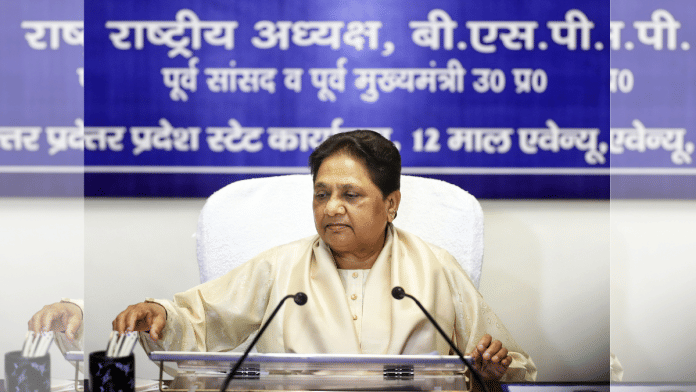
Lucknow: On Wednesday, Bahujan Samaj Party (BSP) supremo Mayawati appointed her younger nephew, Ishan Anand, the party’s new national coordinator, a post earlier held by his elder brother Akash Anand who was relieved from all party responsibilities. Mayawati had expelled Akash from the party earlier, in what BSP insiders call her autocratic way of running the party, quite unmindful of the existential crisis confronting the 42-year-old party founded by Kanshi Ram.
In two months from now, the BSP will have no presence in the country’s Parliament, a first in 37 years. The BSP currently has just one member in the Rajya Sabha, Ramji Gautam, whose term ends on 25 November. The party is not represented in the Lok Sabha.
In the biennial election for the 10 Rajya Sabha seats from Uttar Pradesh on 16 October, a candidate needs 37 first-preference votes of state legislators to be elected. The BSP has no Member of Legislative Assembly (MLA) in the state. It also has no member in the Legislative Council.
The BSP’s lone MLA, Umashankar Singh of the Rasra assembly constituency in Ballia, died in August at the age of 55. His death brought the party’s representation in the 403-member Uttar Pradesh assembly to zero.
National party status endangered
The loss of parliamentary representation will also turn the spotlight on the BSP’s national party status. The Election Commission’s current list continues to recognise the BSP as a national party.
The rules say a party can qualify for national party recognition through specified electoral criteria, including securing at least 6 percent of the valid vote in four or more states and winning at least four Lok Sabha seats, or winning at least 2 percent of Lok Sabha seats with parliamentarians elected from at least three states. Recognition can also be secured by being recognised as a state party in at least four states.
The BSP was founded by Kanshi Ram in 1984 and received national-party recognition in 1997. Its national status has survived previous electoral setbacks because of the rules governing periodic review of recognition. Following the 2014 Lok Sabha elections, when the party won no seat, the Election Commission’s 2016 amendment deferred the review of national and state recognition for 10 years. The BSP subsequently retained its national status after the 2019 elections.
The next round of assembly elections, including the 2027 Uttar Pradesh polls, could therefore become particularly important for the party’s national footprint.
Also Read: Mayawati expels senior BSP leader Ashok Siddharth, her close aide & nephew Akash’s father-in-law
From 4 in 1989 to 0 in 2024
The BSP first entered the Lok Sabha in 1989, when three of its candidates from Uttar Pradesh and one from Punjab won their seats. Its strongest performance came in the 2009 Lok Sabha elections, when the BSP won 21 seats—20 from Uttar Pradesh and one from Madhya Pradesh—with a national vote share of 6.17 per cent.
The party was reduced to zero Lok Sabha seats in the 2014 elections, when it polled 4.19 per cent of the national vote. In 2019, however, an alliance with the Samajwadi Party helped the BSP make a comeback, with 10 MPs winning Lok Sabha seats. Its vote-share that year was 3.66 per cent.
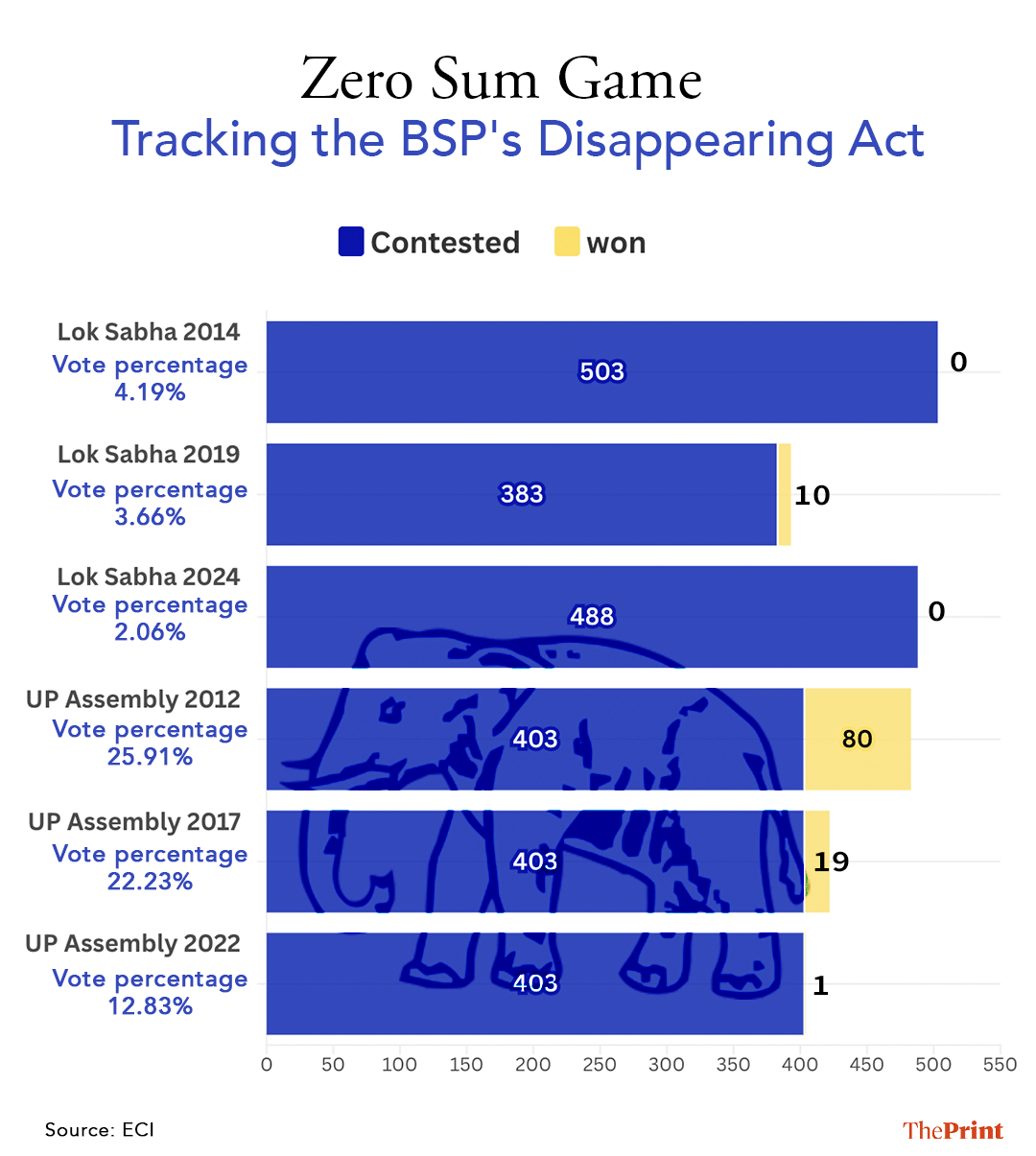
The alliance was not repeated in 2024. Contesting the Lok Sabha elections on its own, the BSP again failed to win a single seat, with its vote share falling further.
The party has also seen a steep decline in Uttar Pradesh. It won 80 of the state’s 403 Assembly seats in 2012, with a vote share of 25.91 per cent. Its tally fell to 19 seats in 2017, although it still polled 22.23 per cent. In 2022, the BSP won only one seat and its vote share fell to 12.88 per cent.
Over the past decade and a half, the BSP’s trajectory shows a steady decline in both seats and vote share, briefly interrupted by its 2019 alliance with the SP.
In the 2014 Lok Sabha election, the BSP contested 503 seats but won none, securing 4.19 percent of the vote. In 2019, it contested 383 seats, won 10, and secured 3.66 per cent. In 2024, it contested 488 seats but again drew a blank, with its vote share declining to 2.06 per cent.
In Uttar Pradesh, the decline has been even more pronounced. From 80 Assembly seats in 2012, the party fell to 19 in 2017 and just one in 2022. The death of Umashankar Singh has now left it without a legislator in the state.
According to Prof. Kavi Raj, a keen observer of Dalit politics in Uttar Pradesh, “The decline of the BSP over the past decade is one of the most significant political trajectories in recent times. A party that once stood for a movement is now losing its essence, which is disheartening for those who were associated with the movement. One of the key reasons for its decline is that the party has failed to adapt to changing times. And when elections became increasingly bipolar, the BSP chose to contest on its own, except in the 2019 polls. That strategy has not worked in its favour.”
Not just elections
The BSP’s decline has not been limited to its electoral performance. Several of its prominent leaders have also left the party over the years. ThePrint had earlier reported that a dozen of Mayawati’s ministers are now with the SP, as Samajwadi Party leader Akhilesh Yadav’s Pichda-Dalit-Alpsankhyak (PDA) plank woos leaders associated with the Bahujan movement..
The list includes Naseemuddin Siddiqui, Babu Singh Kushwaha, Sukhdev Rajbhar, Lalji Verma, Indrajit Saroj, Veer Singh, Daddu Prasad, Ram Achal Rajbhar, Anis Ahmad Khan, Badshah Singh, Akbar Hussain and Swami Prasad Maurya.
RK Chaudhary, a BSP co-founder who is now the Samajwadi Party MP from Mohanlalganj, said the movement of several BSP leaders, including Dalits, towards the SP was largely driven by the PDA plank. “Earlier, BSP politics was also based on a similar social combination , the unity of Dalits, extremely backward castes and Muslims. But the BSP has now deviated from its original path. Many leaders who were associated with Kanshi Ram’s Bahujan mission are now looking towards the Samajwadi Party as their new political home,” Chaudhary told ThePrint.
(Edited by Nardeep Singh Dahiya)