



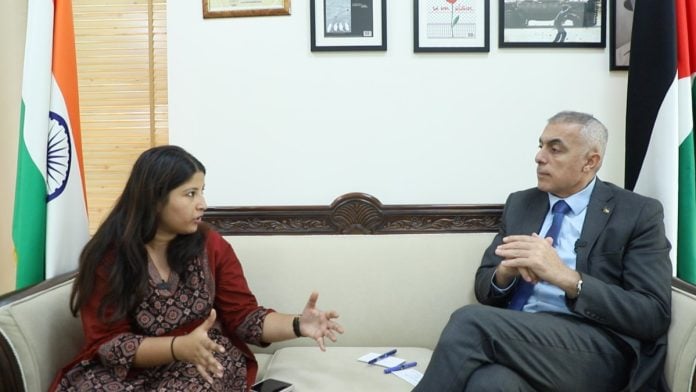
New Delhi: The 61st Cavalry regiment of the Indian Army observes 23 September each year as “Haifa Day” to mark the Battle of Haifa, fought in 1918 by soldiers serving in the British Indian Army. The event has increasingly become part of the narrative surrounding India-Israel ties. But Palestine’s Ambassador to India, Abdullah M. Abu Shawesh, now wants New Delhi to look afresh at the historical context surrounding “Haifa Day”.
In an interview with ThePrint, he said he has written to India’s foreign ministry, reached out to parliamentarians, and sent “more than 500 letters” to prominent figures in this regard.
He also objected to the use of the phrase ‘liberation of Haifa,’ arguing that the distinction mattered because at the time Indian soldiers were participating in a British ‘imperial’ campaign during World War I. “The soldier or the Indian or India at large at that time did not have the civilian right to take the decision to come to ‘liberate’,” the Ambassador said.
On 23 September, 1918, the 15th Imperial Service Cavalry Brigade, made up of Jodhpur, Mysore and Hyderabad Lancers—princely-states’ cavalry units within the British Indian Army—was ordered to take Haifa. At least “44 Indian soldiers” were killed in the military campaign remembered as one of the last successful cavalry charges in modern warfare.
India and Israel have jointly commemorated the battle since 2018. In January that year, Israeli PM Benjamin Netanyahu began his six-day visit to India by joining PM Narendra Modi in New Delhi for the renaming of the Teen Murti Chowk to “Teen Murti Haifa Chowk”.
Abdullah M. Abu Shawesh, Palestine’s Ambassador to India, told ThePrint, “The Battle of Haifa took place 30 years before the establishment of Israel. If there’s a shared history with India, it’s with the Palestinian city of Haifa.”
“How come we just move a few thousand miles far away from India, this coloniser became a liberation for us and enlightenment for us? There is no logic in that,” he added.
The Palestinian diplomat said India’s own official historical material did not, in his view, support the “liberation” terminology. He pointed to the 2014 publication ‘Indian War Memorials Around the World’, which describes Haifa as having fallen “to a cavalry charge by the Jodhpur Lancers” and says the brigade “broke through and took the town”.
“The British themselves call it occupation,” he said. “The United Kingdom called it the British-occupied Palestine since the beginning of the First World War up to 1922 when they became the mandatory power over Palestine. This period of approximately five years, according to the British themselves, is called the Occupied Enemy Territory Administration (OETA),” he said.
“So I discovered that the Israelis (are) trying to falsify this narrative and to say that the Indian soldier came to Palestine, to Haifa, and liberate Haifa and this is a shared history between Israel which come to life 30 years after the battle itself. So it’s a shared history between Israel and the Republic of India,” he argued.
In June, the Palestinian diplomatic mission in India had officially challenged the use of the term “liberation” to describe the Battle of Haifa, in a position paper titled, “Rewriting of India-Palestine history: The Battle of Haifa: liberation or occupation?”
“The Teen Murti Memorial itself provides enduring evidence of this historical reality: ‘Palestine and some of its cities’ are inscribed among the places associated with the campaigns in which these Indian soldiers served. The memorial therefore preserves tangible historical evidence of an Indian connection with Palestine, not with Israel, which did not exist at the time,” read the position paper.
Also Read: Saudi Arabia textbooks remove anti-Israel lines like ‘Muslims will never give up Jerusalem’
‘India voted against Haifa going to Israel’
In conversation with ThePrint, Palestine’s Ambassador to India also pushed back against the idea that Palestine did not exist as a geographical or historical entity because it was not recognised as an independent sovereign in 1918.
“The geography was there—Palestine. But you cannot talk about identity as if this geography was a state, just as Syria was not a state or Jordan was not a state. After the Ottoman Empire was defeated, there was a political partition that created Palestine, Jordan, Syria and other entities in the region,” he added.
“If you visit the Teen Murti Memorial, you will see references to Palestine, Gaza, Haifa, the Suez Canal and other places,” he said. Adding, “There are still Indian soldiers buried in these places. In Gaza, there are Indian soldiers buried in the Commonwealth cemeteries. In Ramleh, another Palestinian city before 1948, approximately 900 Indian soldiers are still buried there. So the shared history is there. If you ask whether this was Palestine, yes, it was Palestine, and it will continue to be called Palestine.”
Shawesh pointed out that even the 1947 UN partition plan was called the “United Nations Partition Plan for Palestine”.
“Even the United Nations partition plan was called the United Nations Partition Plan for Palestine. If you look at Resolution 181, India at that time stood strongly against it and voted against the partition plan. Under that plan, Haifa was designated to be part of Israel, and India voted against it,” he said. “How, then, can India, having opposed the allocation of Haifa to a Jewish state ‘Israel’ in 1947, now present the alleged ‘liberation’ of Haifa by its own soldiers as a foundation for historical ties with Israel?”
The Ambassador emphasised that he is not objecting to honouring Indian soldiers who fought and died in World War I. “We all should stand strong to commemorate the memory of every single Indian person who was sacrificed,” he said.
He argued, however, that their sacrifice should be remembered in the context of the colonial system under which they served. “Every single soldier who sacrificed, all of them deserve to be remembered, their memory should be commemorated, but in a suitable way and using the same, the exact wording that we should use,” said Shawesh.
Identity, existence and assertion
In the early 1900s, Palestine was a region within the Ottoman Empire, split among provinces and districts, with no separate sovereignty or government. While Ottoman officials sometimes used the term Palestine informally, the region was never granted any administrative status. The Palestinian Embassy’s position paper says Palestine, “like the rest of the Levant,” was under Ottoman rule, and calls Haifa a “Palestinian city”.
Palestinian-American professor Beshara Doumani, in Rediscovering Palestine: Merchants and Peasants in Jabal Nablus, writes that when the Ottomans took over, they largely retained the administrative structure the previous Mamluk Sultanate left behind.
The broader Syrian region became an eyalet (province) governed out of Damascus, and within it, Palestine was split into five sanjaks (districts): Safed, Nablus, Jerusalem, Lajjun, and Gaza. Each sanjak was further broken down into smaller subdivisions called nawāḥī.
While the Ottomans did not use ‘Palestine’ as the formal name of any administrative unit, since their convention was to name provinces after their capital cities, the name persisted informally and carried a kind of semi-official status, turning up repeatedly in documents from the 16th through 18th centuries, according to the works of Haim Gerber, Emeritus Professor of The Hebrew University of Jerusalem in Israel.
(Edited by Amrtansh Arora)