



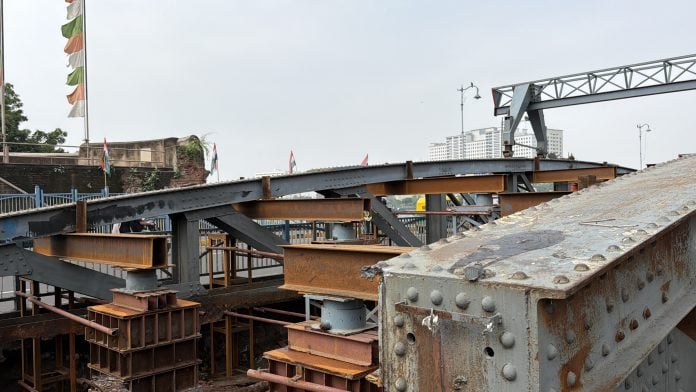
Ahmedabad: At Ahmedabad’s 134-year-old colonial era Ellis Bridge, workers are racing against a deadline that has already passed 365 days ago. For 14 hours a day, irrespective of day or night, heat or cold, around 35 workers are repairing steel beams and replacing old sections while standing precariously on iron pillars. Their only protection are safety glasses and a handkerchief to cover their face and head. But there are no harnesses to protect them, in case they slip.
What was supposed to be an 18-month-long restoration process, when the Ahmedabad Municipal Corporation (AMC) undertook it in 2024, is still far from completion. Engineers say they have found about 40 per cent more work than originally estimated — much of it visible only after sections of the structure were dismantled. Corroded beams, floor beams and stringers have to be replaced, even as shortage of materials and manpower are adding to the delay.
Although the project to repair the bridge began in March 2024, AMC provided the first blueprint only six months later, in September that year. The bridge’s restoration was slated to be completed in 18 months, i.e. by September 2025. However, the original deadline was missed, extended by six months, and missed again.
At the same time, the project cost has also climbed by nearly 60 per cent — from Rs 26.8 crore to nearly Rs 42.9 crore — as the restoration has thrown up structural challenges in renovating a century-old iron and steel arch bridge. The restoration required additional work, including repairs to the main-truss joints, replacement of bottom girders and stringers, reconstruction of the dilapidated bottom deck, and strengthening of the bridge’s pier structures.
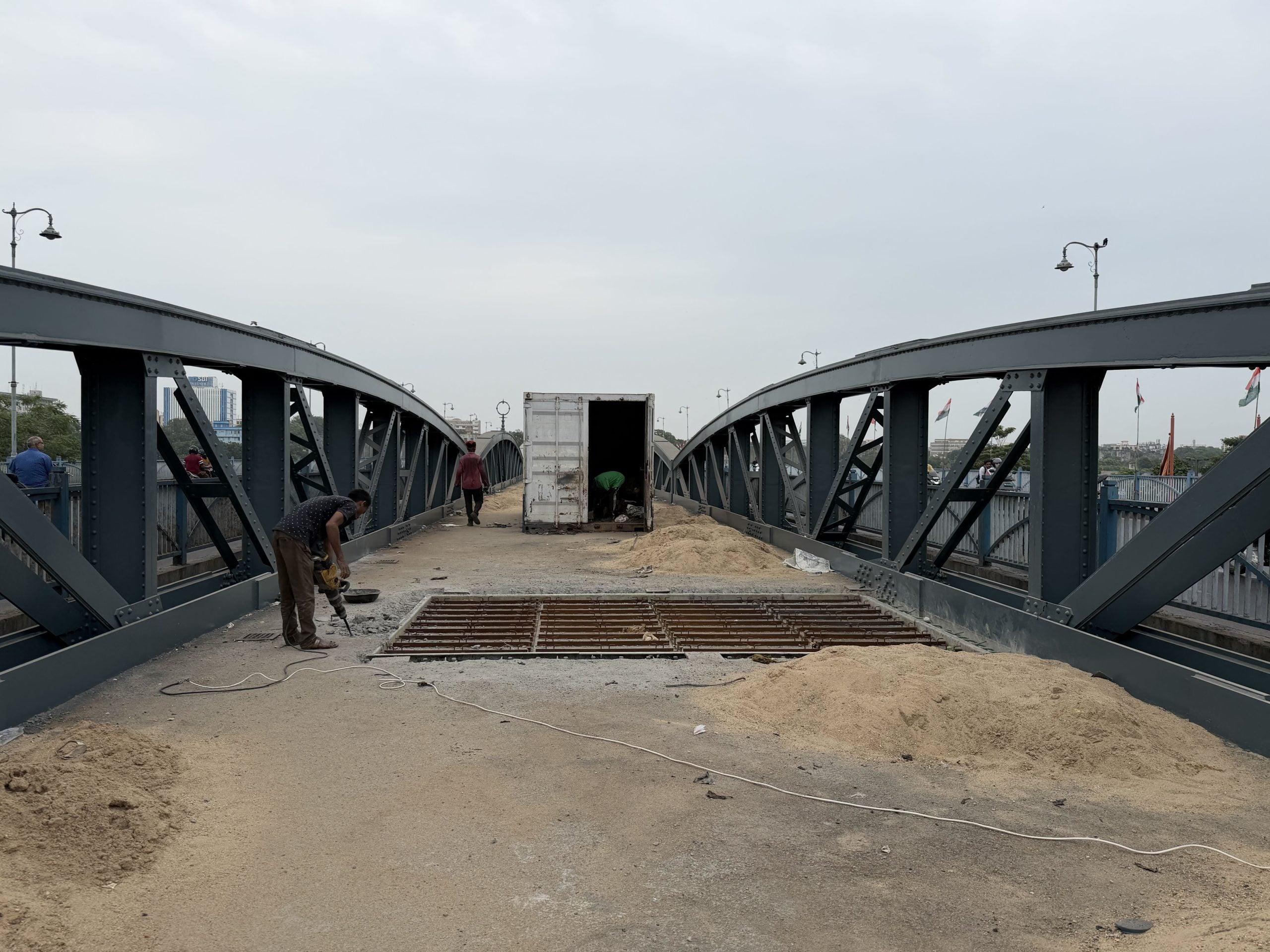
“Restoration and strengthening work is complicated, and one cannot specifically say when the work will be over. We spend day and night here just to complete it. But what we have done is almost like building the bridge anew,” said Dipak Bakshe, project engineer for Rajkamal Builders Infrastructure Pvt. Ltd, a private firm which has been assigned the responsibility to renovate and reinforce the bridge.
The delay and cost increase is a striking contrast to the story of how the Ellis Bridge was built. In 1892, engineer Himmatlal Dhirajram Bhachech constructed the bridge for about Rs 4.07 lakh, less than the five lakh rupees that was actually sanctioned for it. The British authorities, suspicious that such a large structure could have been built for less than the estimated cost, ordered an inquiry into its construction. The bridge passed the test.
Now, more than a century later, the challenge is no longer to build the bridge but to preserve and strengthen it.
Ellis Bridge is not an isolated case. Several of AMC’s major infrastructure projects, including the Naroda Patiya-Galaxy Junction flyover and Pallav Junction flyover, have struggled to meet their deadlines. A February 2026 report in The Times of India found that 10 civic projects worth Rs 396 crore had missed their deadlines, while a separate report in March 2025 found that all nine flyovers and one underpass, which were then under construction, were running behind schedule.
The delay, AMC officials said, is due to factors such as shifting underground utilities, land acquisition and coordination issues. Contractors, meanwhile, have cited execution delays, utility shifting and disputes over forest land as the reasons behind the delay.
“Restoring Ellis Bridge is not simply about repairing an old bridge. We have to replace the portions that have deteriorated over the years, strengthen the structure and at the same time ensure that its original 130-year-old character and appearance remains unchanged. That makes the work very different from building a new bridge,” said Jignesh Shah, civil engineer with the AMC.
From demolition to conservation
Ellis Bridge is not just a steel structure. It has seen Ahmedabad change around it decade after decade. Its construction in 1892 helped open up the western bank of the Sabarmati river for residential neighbourhoods and public institutions.
The bridge became a vital link as the city expanded beyond its walled eastern core. By the early 20th century, it was no longer just a crossing but also part of the city’s growing social and political life. From the 1921 Sardar Patel-led boycott of foreign goods (Swadeshi movement) to the gatherings around Mahatma Gandhi’s Dandi March in 1930, the bridge has witnessed India’s freedom struggle. For generations, it has captured slices of everyday Ahmedabad, with a Sunday bazaar operating under it and prabhat pheris (morning processions) passing over it.
“There used to be a Sunday bazaar under the bridge until 2014, on the banks of the Sabarmati. Gandhiji’s Salt March passed through here, and during the freedom struggle, prabhat pheris used to be held on the bridge. Earlier, when there were no side bridges, Ellis Bridge used to look stunning. Now it is surrounded by these additional bridges,” said Dr Manek Patel , an Ahmedabad-based historian and author of Amdavad-Katha and Aa Chhe Amdavad.
By 1997, the original bridge had become inadequate for increasing vehicular traffic. As a result, two new concrete bridges were constructed on either side of the Ellis bridge while the old structure was retained. 15 years later, AMC commissioned a conservation assessment report for the bridge to Darr Consultants. Although the report had suggested demolishing the bridge, the AMC subsequently explored whether the heritage structure could instead be saved through modern strengthening techniques.
“It was the pride of our city, it was heritage. Demolishing it would mean killing its spirit. We wanted to keep its century-old aesthetic and yet strengthen it,” said Shah.
In 2012, when news of the proposed demolition surfaced after the Darr Consultant’s report, Ahmedabad residents and heritage activists strongly opposed the move, with the campaign continuing into 2013.
This is when the idea of retaining the historic structure gained ground. The final push towards a systematic assessment of the bridge came in 2017, when the AMC set up a committee to inspect older bridges and flyovers. The committee was tasked with identifying structures that needed repairs and suggesting appropriate repair schemes.
“A tender was assigned to CASAD Consultants Pvt Ltd in December 2019 to conduct a survey of Ellis bridge to know what all repairs are required, how much restoration and restrengthening is needed. The stated objective was not simply strengthening—the civic body was also planning to turn the bridge into a heritage gallery,” said Shah.
The findings effectively changed the question facing AMC—from whether Ellis Bridge should be demolished to how much of the original structure could be saved.
AMC had earmarked Rs 71 lakh for conducting the structural survey of the bridge. The 2019 survey found that the main deck had corroded beyond repair; floor beams and stringers supporting the deck were also corroded and needed replacement.
“After a detailed chemical analysis of the bridge pillars or piers, we have found that through the latest technology, the base of the metal pillars can be strengthened,” said Shah.
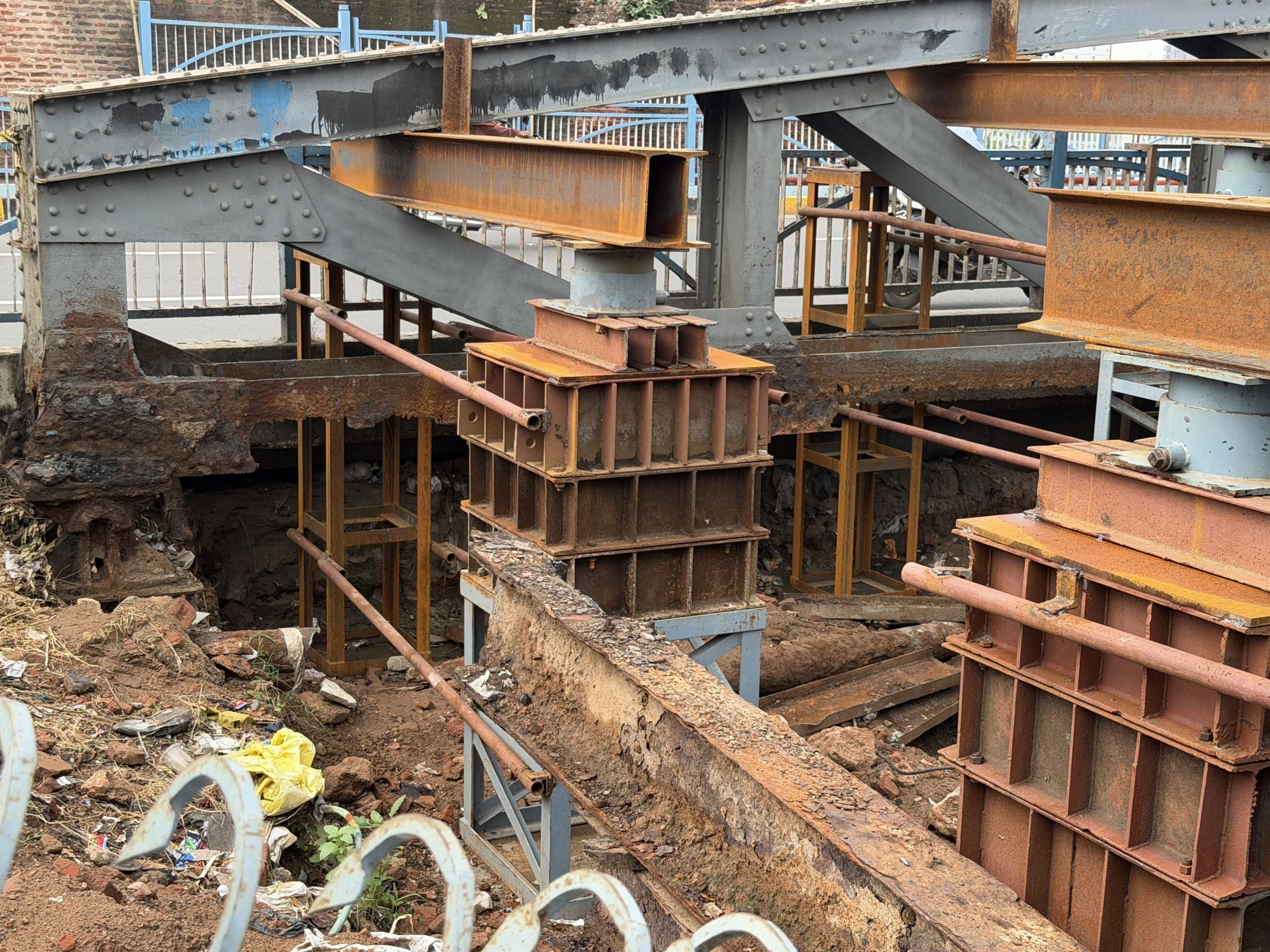
The first engineering advice leaned towards demolition because of corrosion in the foundations and steel structure. Later, investigations found that at least parts of the structure could be strengthened with newer technology. That is what eventually shifted the project from demolition to conservation.
“Then Covid-19 hit the country, which delayed the process. In 2023, we floated a global tender, but we did not receive any bids. We floated the tender again, and the work was eventually awarded to Rajkamal Builders,” said Jignesh Shah. Rajkamal Builders Infrastructure Pvt Ltd, an Ahmedabad-based infrastructure firm, has more than two decades of experience in bridge and flyover construction, including the CTM Cross Road and Thakkar-Bapunagar flyovers, and the Shahibaug railway overbridge in Ahmedabad.
Challenges in restoration
Preserving a 130-year-old steel structure comes with challenges that are very different from building a new bridge.
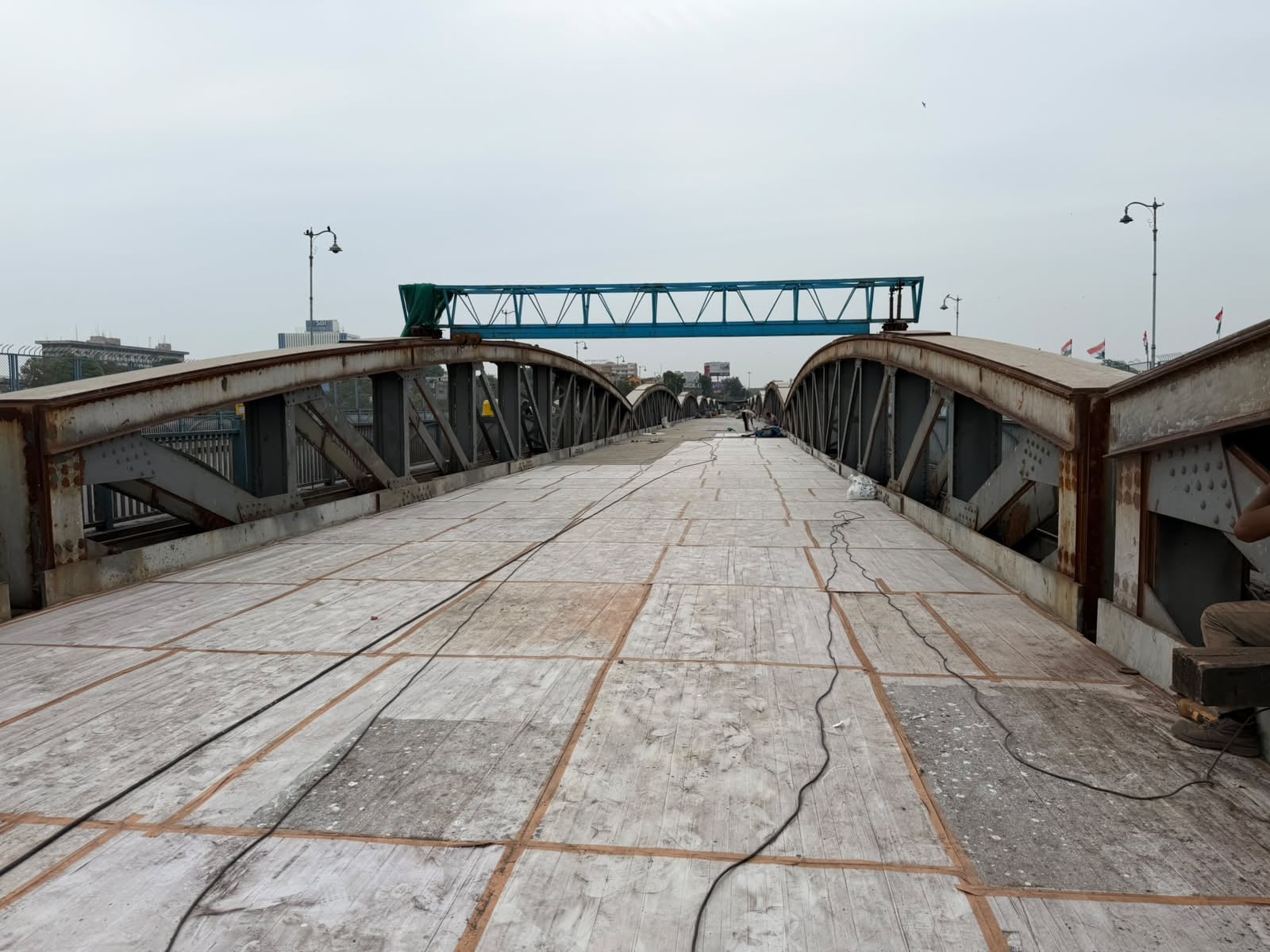
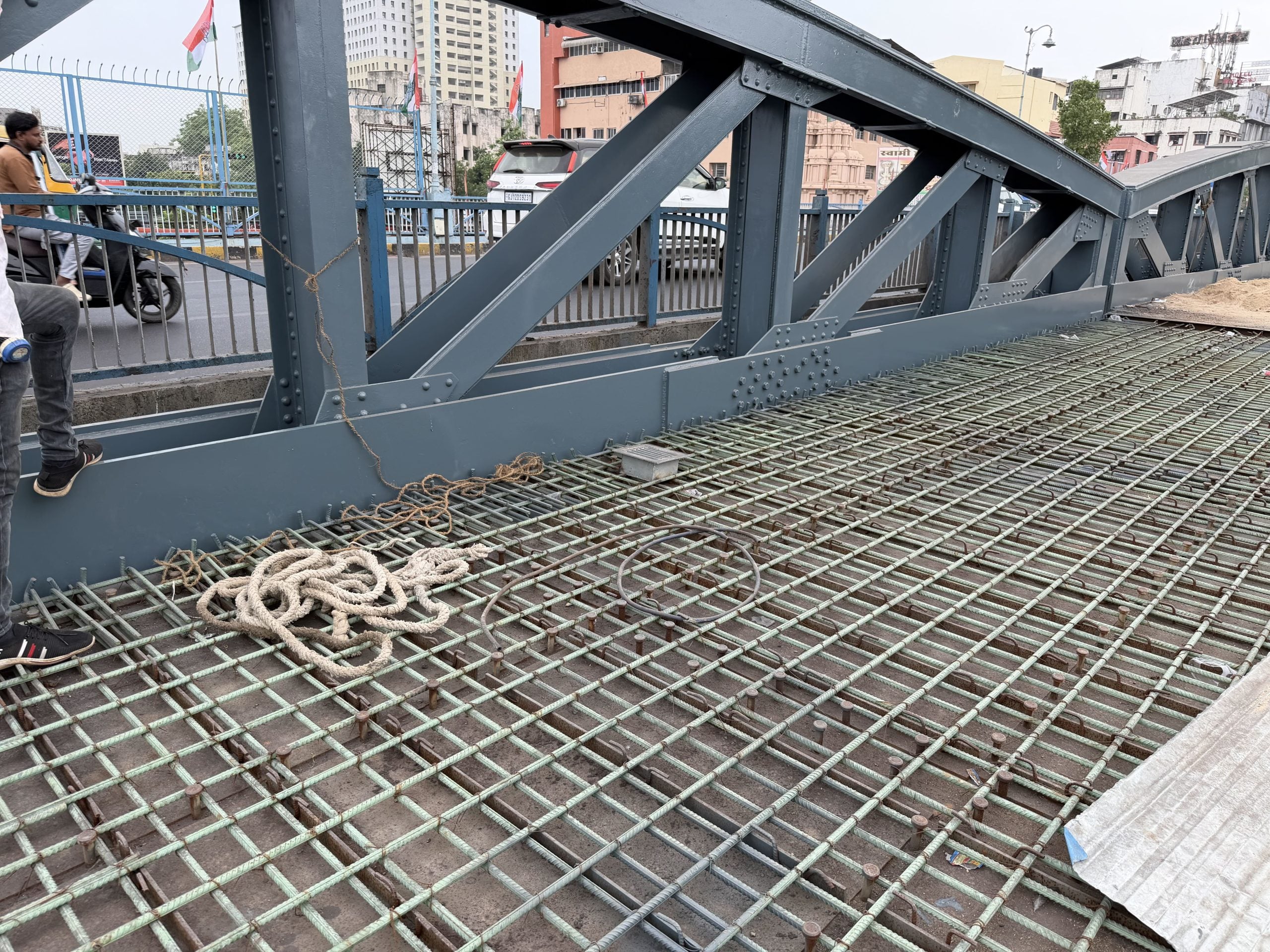
Today, the original steel bridge is closed to traffic and sits between the newer concrete bridges that carry Ahmedabad’s daily rush. Scaffolding covers parts of the structure, while workers continue to repair its joints, girders, stringers and deck.
But restoring a 130-year-old bridge has proved far more complicated than simply replacing its ageing parts. The work has faced delays as engineers uncovered the extent of deterioration only after dismantling sections of the bridge.
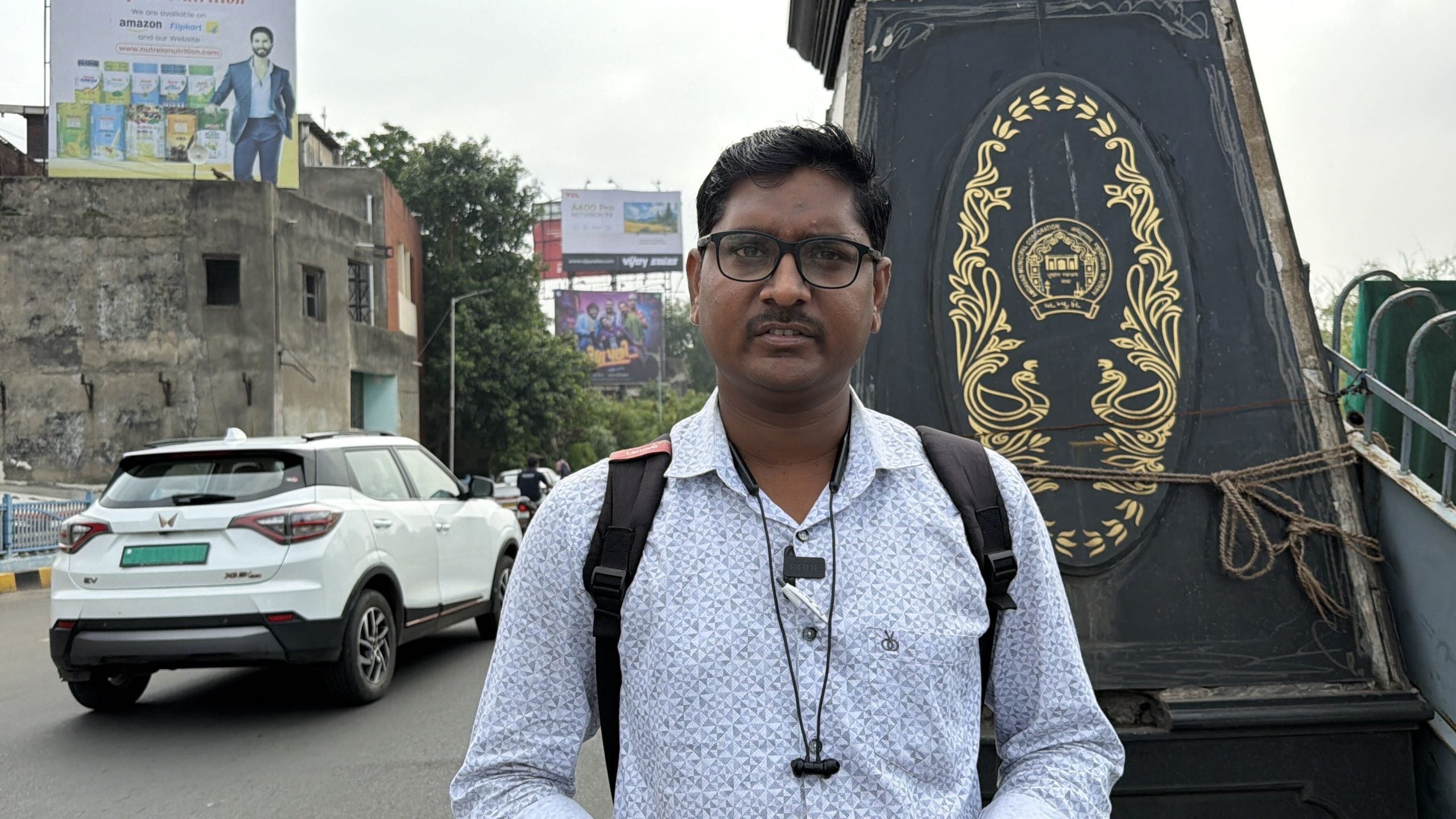
“There were multiple reasons that contributed to this delay. The work increased by around 40 per cent when we started working. The survey can’t find what we find as we begin removing the iron plates. And then the US-Iran war delayed the supply of parts. At the same time, AMC gave us the repair work for another bridge, so the workforce was divided,” said Bakshe, the Project Engineer of Rajkamal Private builders.
Meanwhile, AMC said the scope of the project itself had expanded as the restoration progressed.
“Several things have been added to the project as the work progressed. We are now also putting in a lift, lighting and seating arrangements so that the bridge can be used as a pedestrian space. It is an iconic structure, so we want to restore it while also making it a beautiful public space,” said Jignesh Shah, civil engineer with AMC.
At the bridge site, workers are cutting, grinding and fixing steel sections inside the narrow trusses. A gantry above the deck is being used to move material, while compressors, welding equipment and hand tools lie around the work area. Some sections show shining steel girders reinforced on the old, rusted structure.
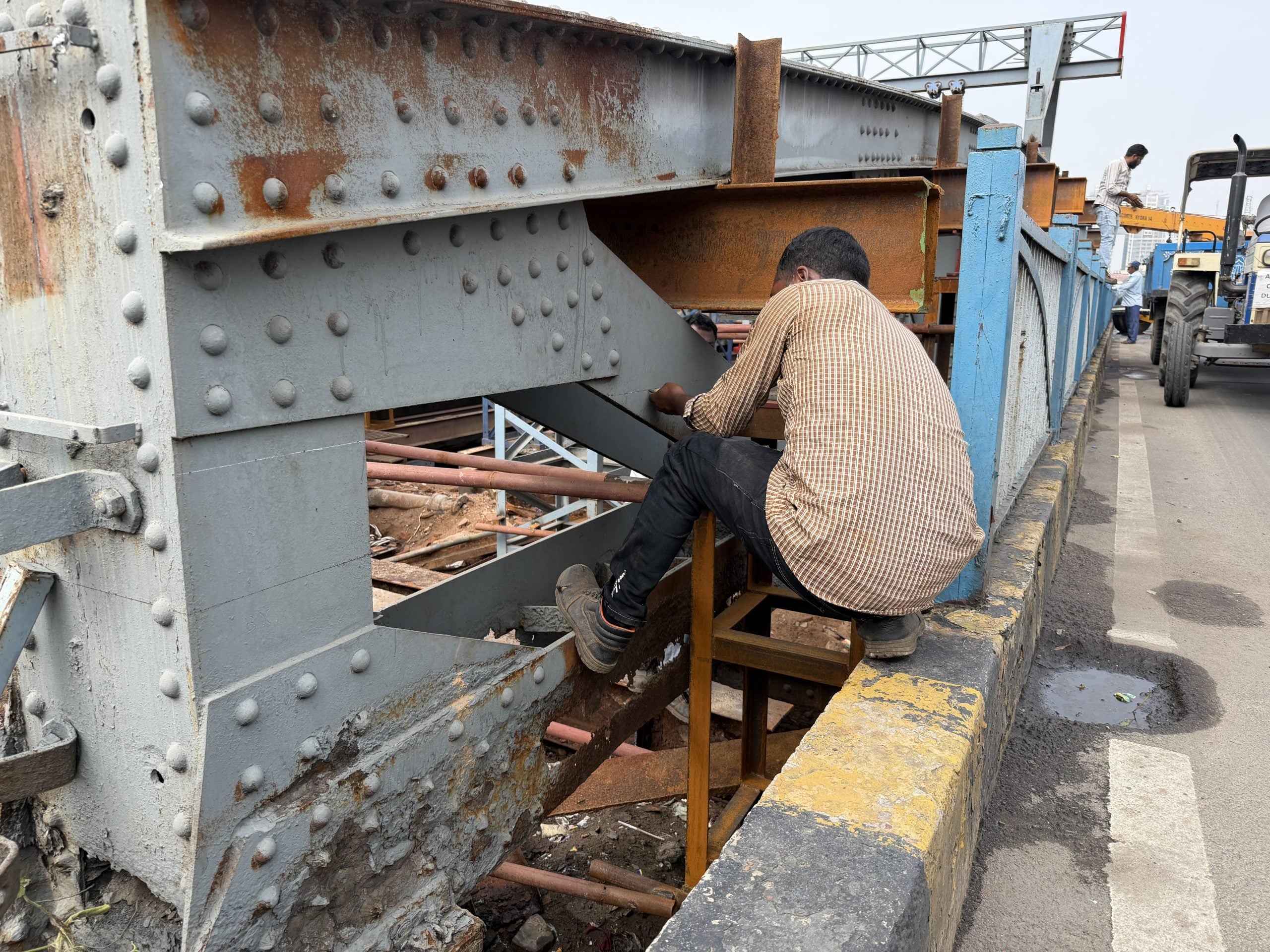
For workers, the challenge is replacing damaged portions without disturbing the original structure. “The problem occurs when new things keep adding in the project, that stretches the deadlines and our work too,” said a worker who migrated to Gujarat from Jharkhand for work.
Since the Ellis bridge has been closed for vehicular movement in 1997, there is no traffic diversion. The restored structure is being planned as a pedestrian-only heritage space.
For residents, therefore, the impact is less about commuting and more about access to a part of Ahmedabad’s history. The bridge has remained closed even to pedestrians for roughly 10 years; its delayed reopening means people are still waiting to use the space again.
“It’s not like anything is being compromised. It’s just that the bridge holds historic and emotional value for us. It’s been so long since the common man has used it. It should open at the earliest now,” said 26-years-old Jayant Bhatt, who has heard stories about the historic bridge from his father.
Historic value
The history of the Ellis bridge goes beyond its steel structure. According to the Gujarat-based historian Rizwan Kadri, the original bridge was built in 1869-1870. It was made of wood and it came to be popularly known as “Lakkadiyo Pul” or the wooden bridge.
The first bridge did not survive for long. The great flood of September 22, 1875, destroyed the structure. The floodwaters of the Sabarmati battered the bridge and carried away parts of it, leaving Ahmedabad in need of a new crossing over the river.
“The construction of the new bridge was undertaken by engineer Himmatlal Dhirajlal Bhachech. He completed the work at a relatively low cost. It led to suspicions that cheap materials had been used. An inquiry was conducted, but Bhachech was cleared of any wrongdoing. His work was recognised by the authorities and he was later honoured with the ‘Rao Bahadur’ title,” said Dr Manek Patel.
The bridge was named in honour of Sir Barrow Helbert Ellis, the commissioner for the North Zone of Gujarat in 1892. The steel was imported from Birmingham.
The bridge also became part of Ahmedabad’s collective memory. Patel notes that “Ellisbridge” and “1892” were inscribed on the bridge, while older residents continued to refer to it as Lakkadiyo Pul.
Patel has also written about the attempt to rename the bridge in one of his books. In 1997, when the AMC added concrete extensions to the steel structure, the bridge was renamed Swami Vivekanand Bridge by the then BJP government led by Chief Minister Keshubhai Patel.
The AMC’s own heritage website continues to list it as “Ellis Bridge which has been renamed as Swami Vivekanand Bridge.” Patel, however, opposed the change because of the sentimental value attached to the name, and took up the matter with the civic body.
“I had written a letter to the corporation and even met the commissioner. He assured me that they would remove the new nameplate that said Vivekanand Bridge, but it never came off. But everyone knows it as Ellis Bridge. Even the corporation and newspapers refer to it as Ellis Bridge,” Patel said, while showing a photograph of the bridge on his laptop.
(Edited by Aakriti Handa)