



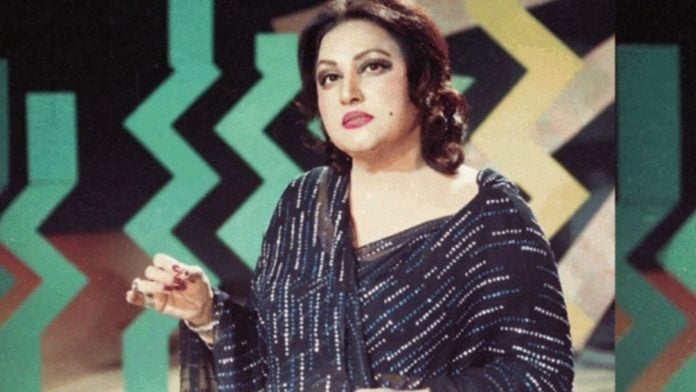
New Delhi: Pakistan seems to have forgotten its national icon, legendary singer Noor Jehan. There was no official commemoration on 21 September, which marked the 100th anniversary of the ‘Queen of Melody’.
Pakistanis have expressed their dismay at this attitude.
Journalist Sadiq Saleem was among the first to point it out, calling it “a concern”. In an Instagram post, he wrote, “100 years of a national icon and almost nothing to mark it. And that is bigger than a missed celebration. It raises a larger question about how we preserve, honour and pass on our cultural legacy to the generations that come after us.”
He then added: “A centenary is not just a birthday. It is an opportunity to turn a legend into legacy. But there was no major national celebration, no PTV retrospective, no documentary or exhibition, no book/museum initiative by the family, not even a stamp. The 100th birth anniversary of Pakistan’s greatest female voice passed almost like an ordinary day. And that’s a concern.”
Taking examples from Egypt and India, where icons like Umm Kulthum and Raj Kapoor were commemorated through grand events, Saleem called it Pakistan’s loss.
“Because if we cannot use a once-in-a-lifetime milestone to properly document, preserve and celebrate the legacy of Noor Jehan, what exactly are we doing to preserve our cultural history? This is how you lose legends and we have also been good at it.”
Actors such as Hina Khwaja Bayat and Mahira Khan agreed. Mahira called it “sad”. Bayat, a veteran actress, said: “Pakistan does not acknowledge its national icons, rather erases them.”
Three days later, Noor Jehan’s grandson, Ahmed Ali Butt, went on a rant on Instagram: “No show on PTV network, not even a poster at Liberty to wish you a 100th birthday… if it weren’t for your songs that people still listen to… the state would have forgotten you yesterday.”
He further said: “This is how we have always honoured our legends… by making sure not to document their work, illegally hijack their work and copyright, by making sure the artist and their legacy are never protected. It’s a shame how we have forgotten our own identity and culture and the people who contributed their lives to it. Other countries preserve and make biopics on their artists, teach their work at universities and celebrate their achievements… it’s sad and heartbreaking to see Pakistan losing its own identity.”
However, many were also quick to criticise him for not having spoken up earlier. Borrowing from the Hindi idiom nani yaad dilana, Saleem jokingly remarked: “Mein ne waqai aaj ek shakhs ko uski nani yaad dila di.”
Also read: Pakistani legend Noor Jehan is called a ‘kofta’ by Junoon popstar Ali Azmat. Fans are fuming
Mallika-e-Tarannum, Madam Noor Jehan
Madam Noor Jehan was born in 1926 in Kasur, Punjab, and began performing as a singer and actor in the 1930s. Over a career spanning more than six decades, she recorded around 10,000 songs across Urdu, Punjabi and Sindhi.
In 2017, on what would have been her 91st birthday, Google honoured her with a doodle modelled on her likeness from a televised performance of “Dildar Sadqay Lakh Waar Sadqay” on PTV — a tribute that caught even many Pakistanis off guard.
What she is perhaps best known for is her rebellious nature. Noor Jehan once defied Pakistani dictator Ayub Khan himself, singing “Mujhse Pehli Si Mohabbat” at a government-organised charity event despite the then-president’s objections. The nazm’s creator, Faiz Ahmed Faiz, listening from his jail cell as her voice came through the radio, is said to have remarked that the poem no longer belonged to him — it belonged to Noor Jehan now.
In India, she is often described as Pakistan’s answer to Lata Mangeshkar, while across the border, her fans simply called her Malika-e-Tarannum, the Queen of Melody.
Lata Mangeshkar herself, amid the comparisons that followed them both throughout their careers, named Noor Jehan as her role model. After Noor Jehan’s death, Mangeshkar reflected: “Everyone has role models. And I have no qualms in admitting that Noor Jehan was mine. We listened to Noor Jehan in childhood and grew up with her notes in mind.”
She also became the first woman in Pakistan to direct a film, helping lay the foundations of the country’s film industry in the process. Chan Wey, which she directed, starred in and sang for, became one of Pakistani cinema’s earliest major hits. Google also identifies her as Pakistan’s first female director, noting her role in Chan Wey in 1951.
In 1982, she made her only trip back to India since Partition and, by her own account, broke down in tears the moment she landed. Speaking with Dilip Kumar on Doordarshan, she reminisced about their years filming together in the 1940s.
With around 10,000 songs across British India and Pakistan, she was respectfully called Madam Noor Jehan. As Bayat rightly remarked, “we have forgotten them. Yet, they remain alive through their work. The honour that God bestowed on you is bigger than any honour anyone could have given.”
(Edited by Prashant Dixit)