





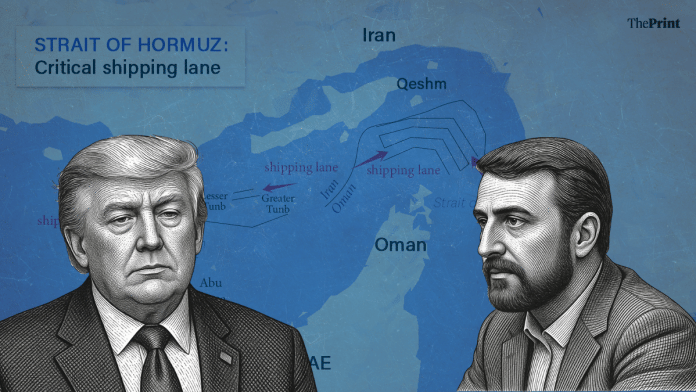


New Delhi: US President Donald Trump announced Tuesday that under the peace agreement reached with Iran three days ago, the Strait of Hormuz would be “permanently toll-free”. Iran, however, indicated Monday that it was considering charging service fees for commercial ships transiting through the Strait.
The US-Iran peace deal, first announced Sunday by Pakistani Prime Minister Shehbaz Sharif, marks a major breakthrough in a complicated negotiating process that lasted roughly two months. The formal signing of the agreement, which seeks the permanent cessation of military operations, will be held on 19 June in Switzerland.
The agreement includes an end to the US naval blockade imposed in mid-April and the reopening of the Strait to all commercial shipping, after it had been effectively closed for the duration of the conflict, which began on 28 February.
The Strait of Hormuz is a critical maritime chokepoint, through which roughly a fifth of the world’s seaborne oil and liquefied gas passes. It acts as a natural transit passage between the Persian Gulf and the Gulf of Oman.
“The Strait of Hormuz is very important for us, and we have adopted certain procedures according to international law in order to protect Iran’s national security and the Islamic Republic of Iran,” Iran’s foreign ministry spokesman, Esmaeil Baghaei, told reporters Monday. He added that Tehran is “not seeking to levy transit tolls; however, fees will be charged in exchange for the services that are provided”.
While the specific details surrounding the service fees are yet to be announced, Iran has indicated that such fees would go towards environmental protection and other maritime services. He noted that Iran required time to carry out discussions about the fee proposal with other involved parties.
Also Read: India has options beyond choked Strait of Hormuz. But conditions apply
Toll vs fee debate
Under the United Nations Law on the Convention of the Sea (UNCLOS), the legal framework governing maritime sovereignty, bordering countries charging tolls on ships passing through an international waterway is illegal. Iran has not ratified the UNCLOS, despite signing the agreement in 1982. Tehran has maintained that it is not bound by UNCLOS.
Yet, the fair imposition of fees on commercial vessels is legal under certain circumstances. Experts contend that while Tehran can legally impose fees for services rendered during commercial ship passage—such as providing waste services at a port—it cannot simply charge a fee for the safe passage of commercial vessels through the Strait of Hormuz. In legal terminology, the semantic difference between a toll and a fee proves to be crucial.
Iran’s proposed fee imposition on commercial ships transiting the Strait would not only be unprecedented, but it would also prove to be costly in more ways than one. It would likely add millions in expenses and significant complications for vessels transiting, while also setting a dangerous precedent more broadly for commercial transit through international waterways.
Iran has maintained that any plans to charge a service fee will be decided along with Oman. Last month, while in New Delhi for the BRICS Foreign Ministers’ Meeting, Iran’s Deputy Foreign Minister Kazem Gharibabadi said Iran is working out a new “transparent protocol” with Oman to levy fees on the transiting vessels. He also said the necessity for such a charge arises from navigational support both countries are providing to the vessels.
International pushback
In initial reactions, the proposal has been widely seen negatively. “We defend international law and we will do everything we can so that there isn’t a toll,” French President Emmanuel Macron stated in an interview Monday. Trump has previously dismissed ideas of Iran charging tolls in the Strait of Hormuz, while simultaneously proposing that the US itself could charge money for commercial transit through the Strait.
“What about us charging tolls? I’d rather do that than let them have them. Why shouldn’t we? We’re the winner. We won,” he said in April when asked whether he would accept an arrangement allowing Iran to collect fees from vessels passing through the Strait.
While several key details remain unresolved ahead of Friday’s formal signing of the peace agreement, one immediate outcome appears settled: Iranian state media says that, under the memorandum of understanding agreed to Sunday, the Strait of Hormuz will remain open to toll-free transit for a 60-day period.
Kyra Menon is an intern with ThePrint
(Edited by Vidhi Bhutra)
Also read: As US-Iran deal announcement paves way for Hormuz reopening, what lies ahead for India & oil markets