





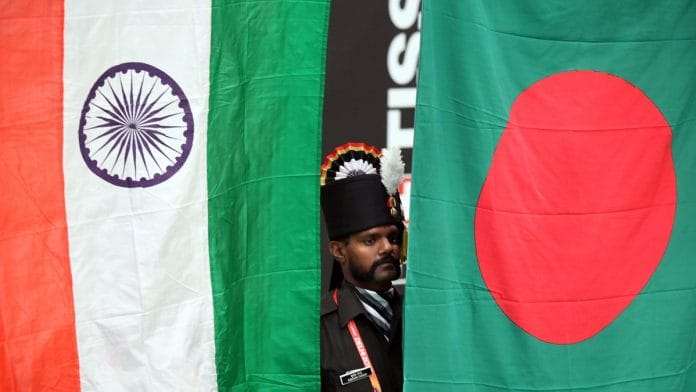


New Delhi: Two years since student-led protests toppled Sheikh Hasina and changed Bangladesh’s political landscape, New Delhi and Dhaka are still navigating an uneasy reset. Even as Dhaka deepens engagement with China and Pakistan, India and Bangladesh remain bound by strategic, economic and geographic interdependencies that neither side can afford to ignore.
Despite the so-called end of a golden era in India-Bangladesh ties, Bangladesh’s foreign policy is historically seen to have oscillated between pro-India and pro-Pakistan positions. Dhaka has also strived to secure strategic autonomy over the years.
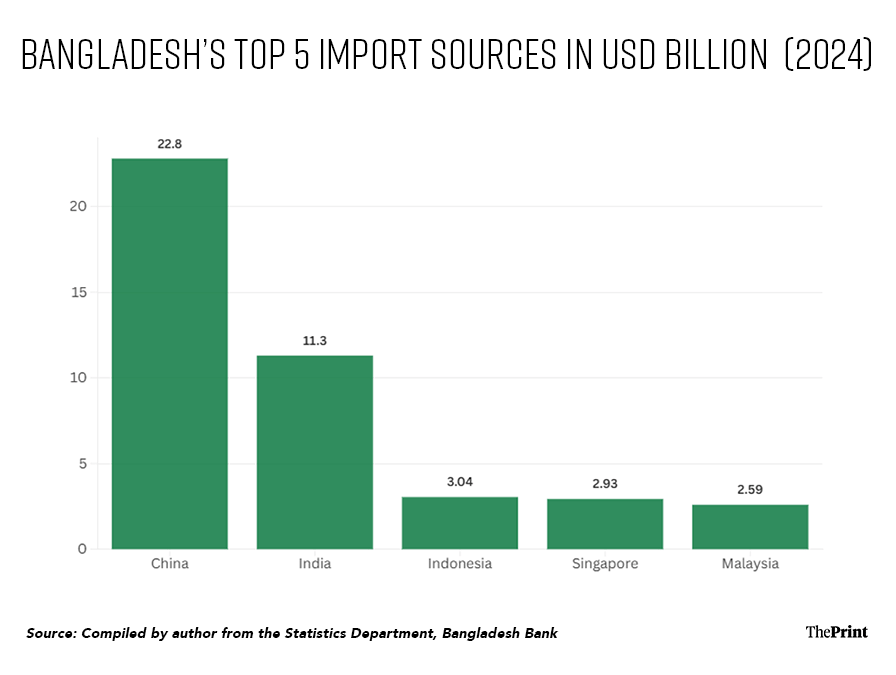
While China has emerged as Bangladesh’s largest trading partner and military supplier, New Delhi is still Dhaka’s second largest trade partner and Bangladesh remains the largest recipient of Indian developmental assistance.
Within this geopolitical calculus, India and Bangladesh’s mutual interdependencies in terms of regional security, trade, and connectivity, continue to underpin bilateral ties. The recent tension over Hasina’s speech shows that both countries are navigating a delicate diplomatic phase.
Bangladesh’s political evolution
Since its liberation in 1971, Bangladesh’s foreign policy has alternated between the relatively “pro-Indian” positions of Awami League governments (between 1972-1975, 1996-2001 and 2009-2024) and the “pro-Pakistani” outlook of both successive military rulers (1975-1990) and Bangladesh Nationalist Party (BNP) governments (1991-96, 2001-06, and 2026 onwards).
These foreign policy oscillations also reflect Bangladesh’s volatile and polarised political evolution characterised by bitter political rivalries, coups, and assassinations.
Given India’s support in the 1971 liberation war when Pakistani forces engaged in large scale atrocities, Sheikh Mujibur Rahman’s Awami League government (1972-75) nurtured a close relationship with New Delhi. However, after his assassination in 1975, Bangladesh fell under 15 years of military rule, first under Ziaur Rahman (1975-1981), and later under General E.M. Ershad (1982-1990), when Dhaka reestablished ties with Islamabad.
After a popular uprising against military rule in 1990, the BNP won the 1991 general elections, with Khaleda Zia serving as the PM between 1991 and 1996. However, it was only after Hasina’s Awami League came to power between 1996 and 2001 when the India-Bangladesh ties improved, especially after both countries signed the 30-year Ganga Water Sharing Treaty in 1996.
Bilateral ties were again strained when the BNP returned to power between 2001 and 2006, when India accused Bangladesh of sheltering Northeast insurgent groups.
In 2009, Hasina returned to power, ushering in the “golden era” (2009-2024) of ties with India. Over the next 15 years, the two neighbours signed multiple agreements on trade, connectivity, energy co-operation, and people to people exchanges.
Most significantly, both countries managed to successfully resolve their longstanding land and maritime boundary dispute—the 2015 implementation of the Land Boundary Agreement and Bangladesh’s acceptance of the 2014 international arbitration award on the maritime boundary—now considered a model for successful dispute resolution.
Also Read: Dhaka requests talks, Delhi bides time as Ganges Water Treaty emerges as latest irritant in ties
Hasina’s ouster & recalibration of ties
Hasina was finally ousted in August 2024 following widespread student protests against her government’s policies. India’s ties with the Awami League government and New Delhi’s decision to provide her with safe passage contributed to an anti-India sentiment in Bangladesh.
After Hasina’s exit, relations with Bangladesh were temporarily strained, with both countries engaging in rhetorical exchanges, tit-for-tat trade restrictions, and heightened border tensions. In contrast, the new interim government under Muhammad Yunus pursued closer co-operation with China and Pakistan.
The recalibration in ties was reinforced by Prime Minister Tarique Rahman’s first official overseas visit to Beijing this June, when 11 Chinese firms proposed to invest over $9.2 billion in Bangladesh. Both sides reportedly discussed a Chinese plan for the comprehensive management of the Teesta River, which has potential strategic implications for New Delhi.
India responded to these developments with a careful mix of restraint, realpolitik and recalibration, which has since been matched by the BNP government’s expression for a pragmatic and mature relationship. While New Delhi and Dhaka initially restricted cross-border trade, public transportation, and tourist visas, both sides have gradually eased these restrictions to normalise ties.
Bangladesh foreign policy
Bangladesh’s foreign policy strategy reveals a challenging balancing act between the US, India, and China, aimed at maximising Dhaka’s strategic interests, while reducing the influence of major powers.
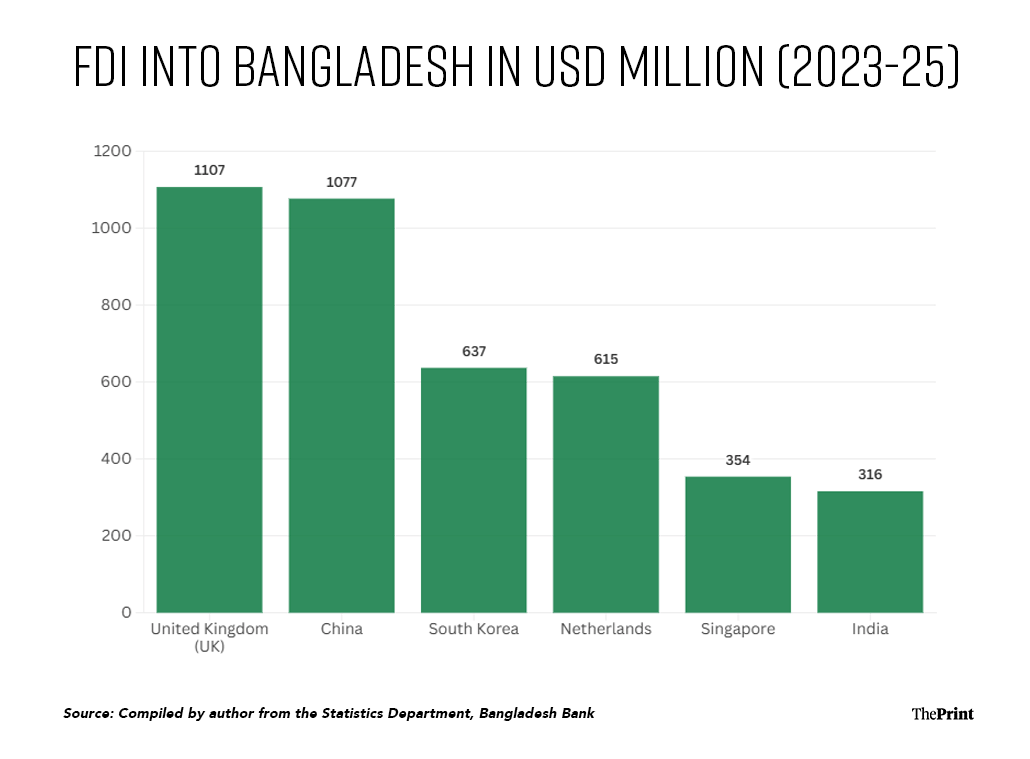
The country has sought to balance its foreign policy, trade, and investment vis-à-vis the three major partners and other important players (Pakistan, Japan, and Turkey). China is currently Dhaka’s largest trading partner and military arms supplier, according to the Observatory of Economic Complexity, and the second biggest source of FDI (between 2023 and 2025).
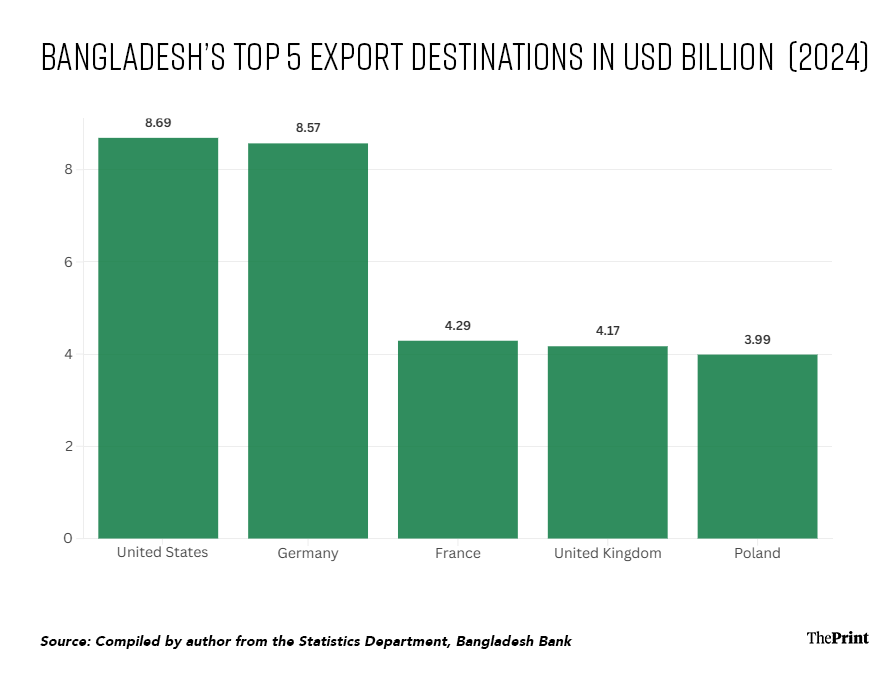
India is Bangladesh’s second largest trading partner, and a major development partner (after Japan, China, and Russia), according to government data. The US is Bangladesh’s largest export market.
Despite Hasina’s “pro-India” credentials, it was under her leadership that Bangladesh entered into a “strategic partnership” with China in 2016. The same year, Bangladesh joined the Belt and Road Initiative (BRI) resulting in Chinese investments of over $38 billion.
While China’s footprint is growing, Bangladesh’s largest development partner continues to be Japan, which is financing critical projects including the Matabari port and the Dhaka Mass Rapid Transit System. Both Russia and China are also important partners in Bangladesh’s push for energy security.
Bangladesh’s first 2,400 MW nuclear power plant at Rooppur is being built by Russia’s state-owned nuclear company Rosatom. Bangladesh has also cultivated closer defence ties with Türkiye, raising concerns over how Ankara’s rising geostrategic ambitions might further complicate and threaten regional stability.
Hasina’s ability to play multiple sides to Dhaka’s advantage now finds echoes in the Tarique Rahman government’s stated “Bangladesh first policy”. While Dhaka’s foreign policy strategy reveals a shrewd sense of diplomatic realpolitik, it also highlights the nation’s larger challenge of maintaining strategic autonomy in a volatile region.
Trade profile
Bangladesh’s trade profile reveals a map of growing global and regional interdependence. For instance, while Bangladesh’s massive $39 billion garment industry is built on exports to the US and EU, the key inputs for the industry (i.e. cotton and synthetic fabrics) are supplied from India and China.
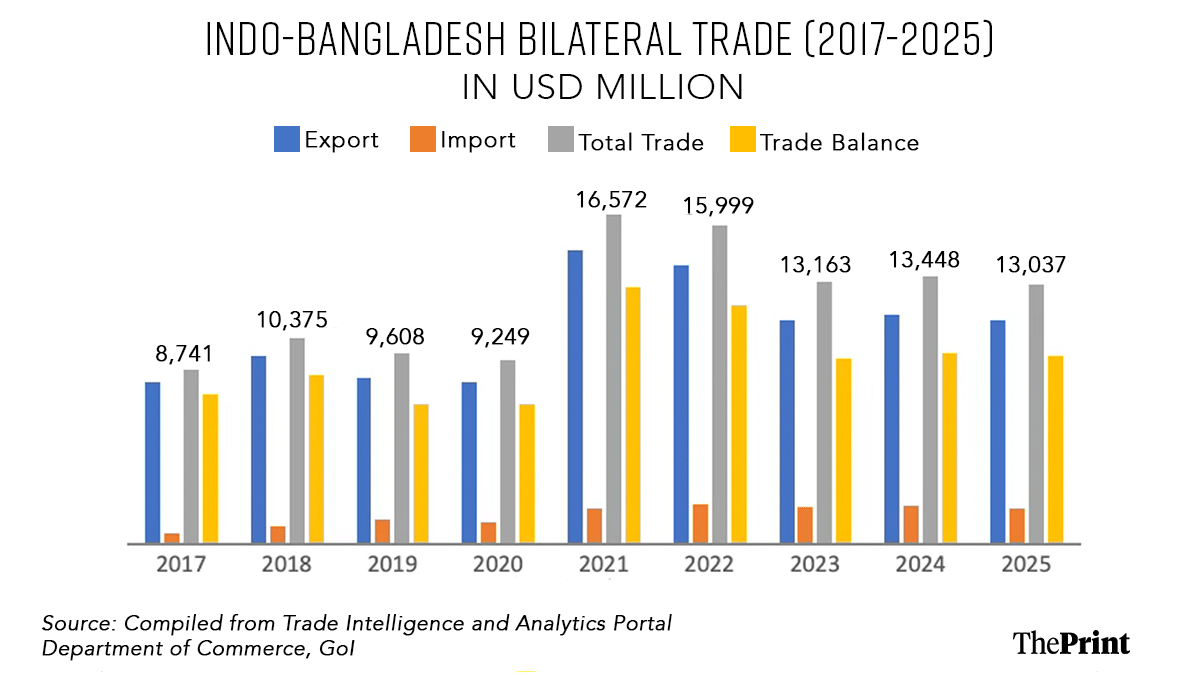
Despite the recent strain in India-Bangladesh relations, bilateral trade reveals an upward trend over the last 10 years; with a relative decline since 2022, much before Hasina’s ouster in mid-2024.
Development projects
Bangladesh has been the largest recipient of India’s infrastructure development assistance, with New Delhi extending several Lines of Credit amounting to $8 billion to Dhaka between 2009 and 2019 for regional connectivity and energy projects, according to data from the Ministry of External Affairs.
An Asian Confluence report on connectivity between Northeast India and Bangladesh noted that as of 2020-21, a total of 31 development projects had been taken up in the neighbouring country, including 17 rail projects (with 9 completed), 8 road projects (3 completed), 5 ports (1 completed), along with 1 telecom project and 2 power transmission line projects.
Roads & railways
The India-Bangladesh railways routes, which were disrupted during the 1965 India-Pakistan war, have gradually upgraded in recent decades.
By 2023, India had five operational broad-gauge routes with Bangladesh operating through West Bengal. Three passenger trains operated services along the Kolkata-Dhaka, Kolkata-Khulna, and New Japaiguri-Dhaka routes.
While the Agartala-Akhuara rail-link meant to connect the North-Eastern states with Bangladesh was inaugurated in 2023, it has not yet been fully operationalised. Important road projects include the four-lane upgradation between the Ashuganj and Akhaura land ports, and the inauguration of the Maitri Setu bridge over the Feni river connecting Tripura with Bangladesh.
Land ports
The majority of India-Bangladesh trade (almost 75 percent) takes place over land routes (road and rail), the bulk of which is facilitated through ‘Land Ports’ or Integrated Check Posts (ICPs), which facilitate and regulate both trade and passenger flows at border-crossings.
Major land ports on the border include Petrapole (in West Bengal), Agartala (Tripura), and Dawki (Meghalaya). The Petrapole land-port is the largest land-port in South Asia, accounting for 30 percent of total trade and 22 lakh annual passengers between India and Bangladesh.
Energy cooperation
The energy ties reveal deep cooperation, with India now supplying 15.6 percent of Bangladesh’s electricity requirements. Since 2013, India has been supplying electricity to Bangladesh via a High-Voltage Direct Current (HVDC) line. New Delhi has also financed the construction of the 1,320 MW Maitree thermal power plant in Khulna division of Bangladesh, operationalised in 2022.
Reports indicate that Adani’s coal-fired power plant in Jharkhand increased its electricity exports to Bangladesh by 38 percent in 2025. More recently, the India-Bangladesh Friendship Pipeline has served as a route for energy diplomacy, with India supplying high-speed diesel from its Numaligarh Refinery to Bangladesh during the global energy crisis.
BBIN & BIMSTEC
Both New Delhi and Dhaka are part of the BBIN (Bangladesh-Bhutan-India-Nepal) sub-group and the BIMSTEC (Bay of Bengal Initiative for Multi-Sectoral Technical and Economic Cooperation) which seeks to improve regional trade and connectivity.
Regional power co-operation is rising with Nepal exporting 40 MW of electricity to Bangladesh via India’s power grid in June, 2025. This signals an emerging regional electricity market, with India serving as a potential facilitator between Nepal, Bhutan, and Bangladesh.
Future challenges
While most Indo-Bangladesh projects have either resumed or remained operational, others have remained stalled after the strain in ties in 2024-25. There are stalled railway projects worth Rs 5,000 crore, including the Khulna-Mongla Port Line, to be developed through a $388 million line of credit from India.
In 2024, India discontinued its transshipment arrangement which previously allowed Bangladesh to export goods via Indian ports and airports to other ‘third’ countries. However, New Delhi continues to allow for the transshipment of Bangladeshi exports to Bhutan and Nepal via Indian land routes.
During PM Tarique Rahman’s recent visit to Beijing, the two sides announced plans for China to develop the Mongla Port special economic zone; a project which was initially handed to India, but later scrapped after delays. Given China’s increasing regional presence, it becomes imperative for India to ensure better execution of upcoming projects in Bangladesh.
Given the conservative turn in both India and Bangladesh’s domestic politics, bilateral ties will also be increasingly influenced by the treatment of religious minorities in each other’s countries. Finally, while New Delhi will have to accommodate Bangladesh’s desire for greater strategic autonomy, it will also draw red lines in terms of potential security threats along its sensitive north-eastern border.
(Edited by Nida Fatima Siddiqui)
Also Read:‘Pushed’ into year-long Bangladesh nightmare, 4 from Bengal’s Birbhum are finally returning home