



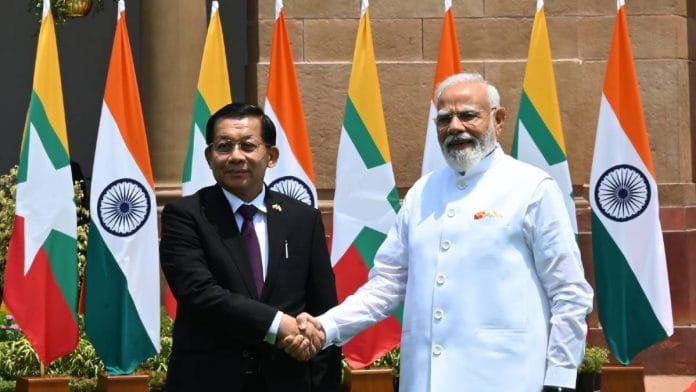

New Delhi: With Myanmar’s Min Aung Hlaing in New Delhi for his first official foreign visit since assuming the presidency this April, the nation’s immense geopolitical significance has once again come into focus—not just for India, but also for China.
For both nations, Myanmar is more than just a troubled neighbour going through civil war: it is a strategic gateway linking South Asia, Southeast Asia and the Indian Ocean, making stability, connectivity and influence in the country critical to any regional ambitions.
A theatre of regional competition, rich in natural resources including natural gas, rare earths, precious gems, and timber, it is key for India and China’s foreign policy, national security, regional trade and energy requirements.
For India, Myanmar provides strategic access to South East Asia, with New Delhi pursuing the Kaladan Project and the India-Myanmar-Thailand Highway in an apparent bid to balance China’s influence in the region.
For China, Myanmar provides direct access to the Indian Ocean, which Beijing is exploring through a series of energy pipelines and transport corridors to reduce its dependency on the Malacca Strait.
Despite the emphasis on regional connectivity, both India and China have also sought to strengthen their border security mechanisms to check Myanmar’s illicit trade in drugs and arms.
ThePrint examines how New Delhi and Beijing are pursuing their respective security and trade interests in Naypyidaw by engaging with different sides in the country’s ongoing civil war (2021-present). While China seems to have greater influence over Myanmar, India can nonetheless serve as a reliable partner for both the junta and its opponents eager to reduce their growing dependency on Beijing.
Also Read: Myanmar wants to distance from China. India offers a relationship without domination
Myanmar’s political evolution
Since independence from the British in 1948, Myanmar has experienced a constitutional democracy (1948-1962), military coup and socialist rule (1962-1988), a junta regime (1988-2010), a quasi-democracy (2010-2020) and a civil war, from 2021 onwards.
Myanmar’s political evolution has been shaped by three groups. The first, the military (known as Tatmadaw), seeks to preserve a strong centralised state and its dominant political role, often through the suppression of democratic opposition and ethnic minority movements. The second group is the democratic opposition led by Aung San Suu Kyi’s National League for Democracy (NLD) which has spearheaded the democratic movement since 1988.
The third group consists of Myanmar’s ethnic armed organisations (EAOs) which have continually fought for greater autonomy. While the junta and the NLD are largely from the dominant Bamar ethnic group which inhabits Myanmar’s Irrawaddy Basin, the country’s ethnic minorities are spread across the country’s peripheral highlands.
Despite the massive pro-democracy uprising of 1988 and the NLD’s subsequent electoral victory in 1990, the Tatmadaw conducted a violent crackdown which kept the military junta in power for the next two decades. The junta’s crackdown resulted in western sanctions, which were only eased between 2010-2020 when the military finally held popular elections, while reserving 25% assembly seats for itself.
The NLD won national elections in 2015, after which it pursued both economic reforms (leading to substantial FDI inflows) and a political dialogue with the country’s ethnic minorities. The NLD’s tenure was nevertheless overshadowed by the military’s 2017 campaign against the Rohingya community, which led to mass displacement and drew international criticism.
In February 2021, the Tatmadaw seized power in a military coup and deposed the NLD after it won a majority in the 2020 elections. The coup triggered armed resistance from pro-democracy groups and several EAOs, leading to a nationwide conflict. The civil war has since led to an estimated 50,000 deaths till the end of 2024.
To take on the Tatmadaw, NLD leaders allied with other anti-junta protestors and ethnic groups to form a National Unity Government (NUG) along with an armed wing, People’s Defence Force (PDF).
By 2024, the junta controlled 21% of the country (including key cities) while the PDF and EAOs held a firm grip over 42% of the territory, with the remaining areas fiercely contested.
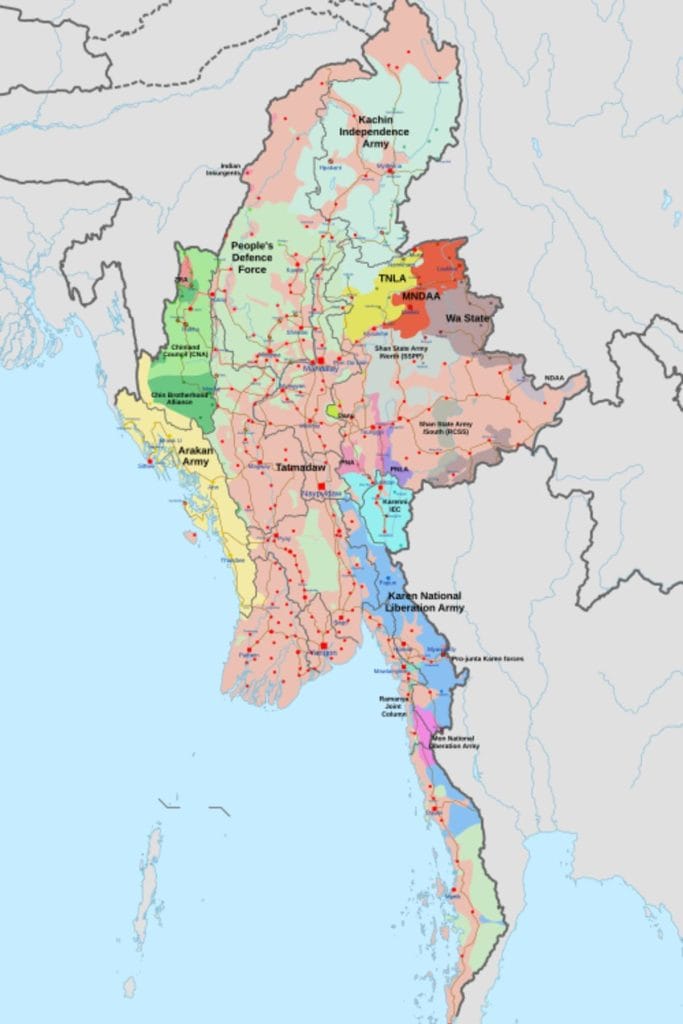
In a bid to retain legitimacy, the military regime held “tightly controlled elections”, with Min Aung Hlaing (former commander of the Tatmadaw) elected president this April.
Strategic diplomacy
India and China have adopted different strategies to engage with Myanmar’s turbulent political evolution.
In the 1950s, India and Myanmar enjoyed close relations based on shared ideas of anti-colonialism and non-alignment. In the later decades, however, ties became strained, especially after the 1988 pro-democracy protests when India publicly criticised the junta.
When the west imposed sanctions on Myanmar’s junta in the 1990s, China filled the vacuum to build close military and economic ties with the junta. Beijing subsequently emerged as Myanmar’s largest trading partner, according to international trade statistics, and was reported as the second largest weapons supplier (behind Russia) in 2023.
Since the 2021 civil war, China has been quick with engagement, providing vital military assistance to ensure the junta’s survival, while also maintaining ties with rebel groups to secure Beijing’s strategic investments.
Despite its more limited influence, New Delhi is similarly engaging with both the junta and the ethnic armed groups.
Unlike China, whose influence is concentrated through large infrastructure projects, arms transfers and ties with the military establishment, India maintains channels with both the junta and several actors operating in Myanmar’s border regions. This gives New Delhi a degree of flexibility at a time when many groups inside Myanmar appear to be wary of becoming overly dependent on Beijing.
Trade with Myanmar
China, the ASEAN countries, and India are Myanmar’s largest trading partners.
China’s willingness to engage with Myanmar’s junta has apparently provided Beijing with preferential access to the country’s natural resources and investment projects, in highways, pipelines, and ports. China was a major recipient of Myanmar’s natural gas and rare earths exports in 2024, according to OEC (Observatory of Economic Complexity) data.
Given China’s growing influence, India has gradually sought a more pragmatic relationship with Myanmar. India’s Look East Policy (reframed as ‘Act East Policy’ in 2014) seeks to foster closer economic ties with South East Asia.
India has emerged as Myanmar’s fourth largest trading partner, with trade valued at $2.1 billion in FY25. Unlike China, however, India has not been able to gain significant access to Myanmar’s energy resources and New Delhi’s largest imports from Myanmar continue to be agricultural and forest products.
While Singapore previously accounted for the bulk of Myanmar’s FDI, China has since emerged as the single largest investor in the country after the 2021 coup.
India is presently the 11th largest investor in Myanmar with an approved investment of $782.8 million by 39 Indian enterprises last year.
A 2024 World Bank report highlighted how Myanmar’s total debt stood at $12.1 billion, with the bulk of loans coming from Japan and various multinational agencies.
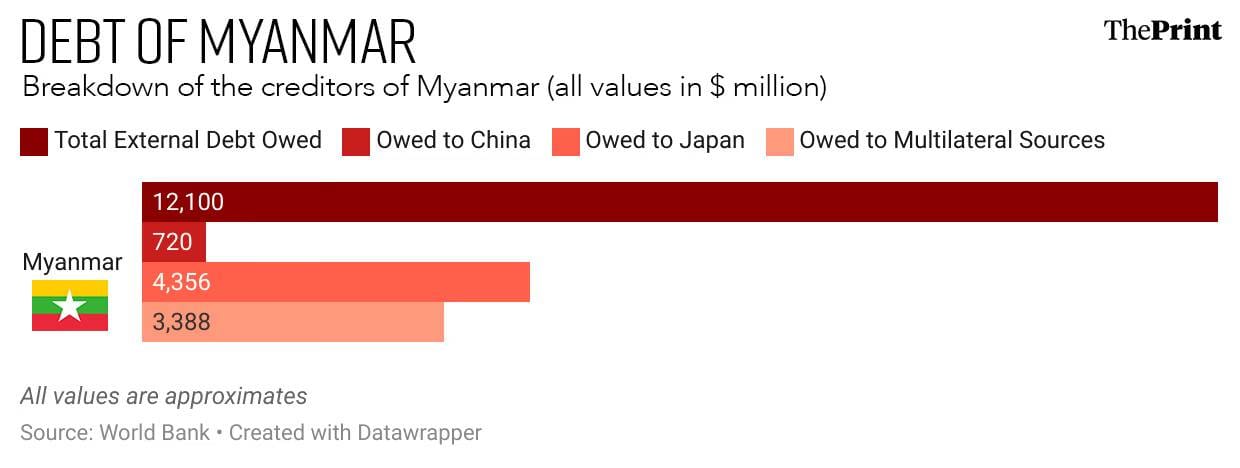
India and China are also investing in strategic trade and energy corridors in Myanmar.
Also Read: Myanmar is the missing link in India’s Act East policy. Delhi must boost rail-road network
India’s push for regional connectivity
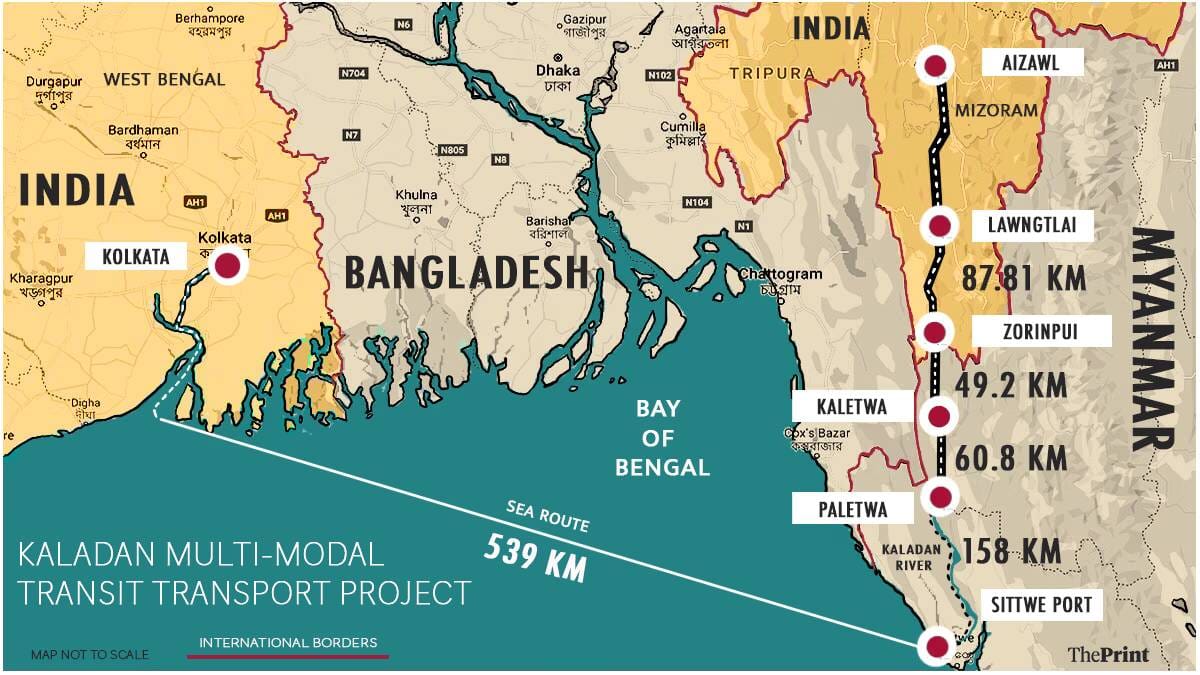
The Kaladan Multi-Modal Transit Transport Project (KMMTP) is an under-construction corridor which seeks to connect Kolkata by sea to the Sittwe port (in Myanmar), and further upstream along the Kaladan river (through Rakhine state) to Paletwa (in Chin State), and northwards by road to Lawngtlai (in Mizoram).
Apart from providing India with access to Southeast Asia, the Kaladan project also secures a shorter alternate route between the North-East and mainland India which bypasses the narrow and vulnerable Siliguri corridor.
India has completed most of the project. Since the Arakan Army controls most of the territories along the Kaladan transport corridor, India has initiated dialogue with the outfit to secure the project.
India’s other major connectivity project is the 1,360-km India-Myanmar-Thailand Trilateral Highway which seeks to connect India’s Northeast from Moreh (in Manipur) across the border to Tamu, and further to Mandalay and Yangon in Myanmar, and onwards to Mae Sot and Bangkok in Thailand.
However, key segments of the highway remain incomplete owing to the civil war.
China-Myanmar pipelines
Completed in 2013, the 793-km Myanmar-China natural gas pipeline connects the offshore Shwe Gas Fields near Kyaukphyu port in Myanmar to China’s Yunnan region. The Myanmar-China oil pipeline (771 km) similarly connects the Kyaukphyu to Kunming (in China).
Announced in 2018, the China Myanmar Economic Corridor is a 1,700-km under-construction transport and industrial corridor connecting Kunming to Myanmar’s ports in Kyaukphyu and Yangon. However, most projects along this corridor have been stalled due to the civil war.
To protect these investments, China has reportedly maintained unofficial ties with the EAOs.
Beijing and the junta have also agreed to establish a China-Myanmar security company to protect Chinese investments, leading to criticism that Myanmar’s sovereignty has been compromised.
Border issues
Despite its emphasis on better connectivity, India’s ‘Act East Policy’ is constrained by border security concerns.
Both the porous 1,643 km Indo-Myanmar border and the remote 2,129 km Sino-Myanmar borders have long facilitated cross-border movements of insurgent groups, arms smugglers, and drug traffickers. In 2019, New Delhi and Naypyidaw launched coordinated action against insurgent groups within Myanmar.
India’s challenges have further intensified with Myanmar’s civil war, as both EAOs and north-eastern insurgent groups have apparently leveraged the cross-border drug trade to finance their armed operations.
While New Delhi has announced a major $3.7 billion border fencing initiative, the new restrictions on cross-border movements have angered local communities which have long-standing ethnic ties across the border.
Rahul Saikia is an alum of ThePrint School of Journalism, currently interning with ThePrint.
(Edited by Nida Fatima Siddiqui)
Also Read: Mizoram MP meets Myanmar militants in push to speed up work on key connectivity project