






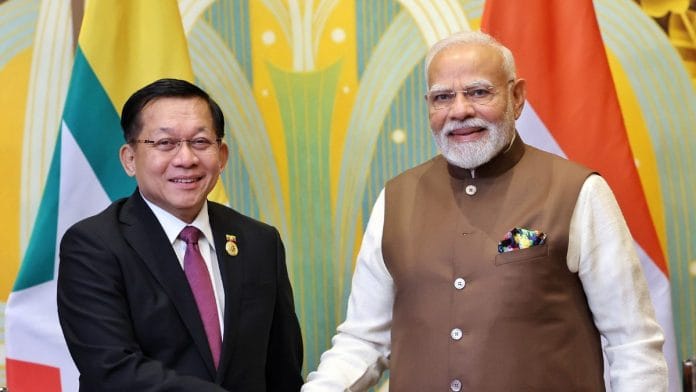


Myanmar President Min Aung Hlaing landed in India today for his four-day official visit. Choosing India as his first foreign visit after assuming the presidency is rich in symbolism and strategic meaning. Hlaing is set to visit Bodh Gaya, hold talks with Prime Minister Narendra Modi in New Delhi on 1 June, participate in a business forum, and visit Mumbai for industry interactions.
Many Myanmar watchers would have expected China to be Hlaing’s first destination. Beijing remains Naypyidaw’s most powerful external partner, having protected Myanmar diplomatically, invested heavily in infrastructure, maintained leverage over several ethnic armed organisations, and is deeply embedded in its border economy.
Hlaing’s choice of India suggests that the country wants strategic space. It may need China, but it does not wish to be trapped by China. The visit is a message—to India, to China, to ASEAN and to Myanmar’s own people—that Myanmar seeks alternatives.
Distancing from China
Myanmar’s military junta and people have always viewed China with a mixture of dependence, suspicion and resentment. China is useful because it provides diplomatic cover, investment and strategic support. But it is also feared because its influence reaches deep into Myanmar’s borderlands, ethnic armed groups and resource corridors. The old Burmese nationalist instinct has never been comfortable with excessive Chinese control. The military leadership, despite its present international isolation, remains deeply conscious of its sovereignty, which is why it does not want Myanmar to become a client state of China.
This unease has been sharpened by recent reports from Myanmar’s Northern Shan State, which borders China and where Beijing’s writ runs large. The Irrawaddy (an independent news organisation covering Myanmar) recently reported that Myanmar’s regime has pressured media outlets inside the country to take down stories alleging that China has erected border fences inside Myanmar territory. Local reporting has referred to possible encroachments near Chinshwehaw and Kyukok-Pansai, both Myanmar National Democratic Alliance Army (MNDAA)-influenced areas, and Namtit, in United Wa State Army (UWSA) territory.
The MNDAA and the UWSA are ethnic armed groups widely viewed by geopolitical analysts as China’s primary proxies in Myanmar. While they operate with significant autonomy, both groups maintain deep political, economic, and military ties to Beijing, which uses them to secure its borders and strategic interests.
According to reports in Myanmar, in Namtit (Shan State), a stream that reportedly marked the boundary is said to have disappeared behind new Chinese fencing. Villagers have claimed that the fences have advanced at least 15 metres into Myanmar territory and, in some places, more than 100 metres.
MNDAA and UWSA are seen as China’s proxies because they trace their lineage to the collapse of the Communist Party of Burma in 1989.
The MNDAA emerged in the Kokang region of Shan State, where the population is largely ethnic Chinese with historical links to Yunnan, in China. The UWSA emerged from the Wa region of Shan and is now one of Myanmar’s most powerful ethnic armed organisations. The Wa are a Mon-Khmer-speaking people, more closely linked to groups such as the Palaung. This distinction is important because China’s influence over these groups is not uniform. In Kokang, ethnicity, language and geography make Chinese influence more direct. In Wa areas, China’s leverage is strategic, economic and logistical rather than purely ethnic.
For Naypyidaw, therefore, the China-Myanmar border is not only an international boundary. It is a zone where ethnicity, insurgency, cross-border trade, narcotics, rare earths, cyber-scam networks, armed autonomy and Chinese geopolitical influence overlap. If Chinese fencing is indeed being built inside Myanmar territory, or even perceived as such, it becomes far more than a local boundary dispute. It becomes a reminder that China’s involvement in Myanmar can turn intrusive. It follows the pattern of what Beijing is universally blamed for—salami slicing of its neighbours’ territories. That is why the regime’s discomfort with media reporting is telling. It does not want to offend Beijing, but it also cannot ignore the domestic implications of appearing weak on sovereignty.
Also read: Min Aung Hlaing’s rise in Myanmar matters to India—he is closer to New Delhi than Beijing
Why Myanmar is important
This is where India becomes relevant. India does not offer Myanmar the same scale of money, infrastructure or coercive leverage that China does. But India offers something China cannot easily provide: A relationship less burdened by domination.
India does not share China’s history of deep involvement with Myanmar’s armed border actors. On the contrary, India has religion and spiritualism to offer, which is evidenced by the President’s scheduled visit to Bodh Gaya, he has made the trip during his previous visits as well. Further, India has no interest in carving out zones of indirect influence through ethnic groups. It has an interest in a stable, sovereign Myanmar because instability in Myanmar directly affects India’s Northeast.
India and Myanmar share a 1,643-km land border across Arunachal Pradesh, Nagaland, Manipur and Mizoram. Communities on both sides have shared kinship, clan, tribal, linguistic and religious ties. Instability in Chin, Sagaing, Kachin or Rakhine (states bordering or in the immediate vicinity of India) do not remain confined to Myanmar. It spills into Mizoram, Manipur and Nagaland through refugee flows, arms trafficking, narcotics, insurgent movement and social tensions. India is said to have carried out a few drone-based attacks in Myanmar territory against Indian insurgent groups. It shows the importance of having the Myanmar military on board.
For India, Myanmar is therefore not an optional diplomatic theatre. It is central to internal security. The violence in Manipur since 2023, refugee inflows into Mizoram, the presence of Indian insurgent groups in Myanmar’s borderlands, and the flow of weapons and narcotics from the Golden Triangle all show that Myanmar’s instability becomes India’s security challenge. A fractured Myanmar weakens India’s Act East Policy. A stable Myanmar strengthens India’s Northeast.
The strategic value of Myanmar is also tied to connectivity. It is estimated that India has already spent well over Rs 1,000 crore on its two flagship projects—Kaladan Multi-Modal Transit Transport Project and the India-Myanmar-Thailand Trilateral Highway. Both have suffered because of Myanmar’s security situation. These projects are not merely economic. They are instruments of strategic transformation. When completed and secured, they can reduce the Northeast’s landlocked nature, expand trade, provide alternatives to the Siliguri Corridor, and link India more directly with Southeast Asia.
Thus, India’s engagement with Min Aung Hlaing must be judged not only through the lens of regime legitimacy, but through the hard realities of geography and security.
Also read: China wants to create new order in Myanmar. India must switch gears or be dealt out of the game
A balancing act
This does not mean India should ignore the political and humanitarian crisis inside Myanmar. Hlaing’s presidency remains deeply contested. Western governments and Myanmar’s democratic opposition continue to question the legitimacy of the political process. India must therefore walk a careful path. It cannot appear indifferent to the suffering of Myanmar’s people. At the same time, it cannot afford a policy of isolation that leaves the entire field open to China. A balanced Indian policy should rest on realism with principle. India should engage the regime because it controls the state machinery, border forces, official institutions and formal channels of cooperation. But India should also maintain lines of communication with ethnic groups, civil society, border communities and democratic actors. This is not duplicity; it is prudence. A country as fragmented as Myanmar cannot be understood through one capital or one power centre alone.
Hlaing’s visit therefore carries meaning beyond protocol. For Myanmar, it is a search for balance. For India, it is an opportunity to shape events in a country whose instability directly affects the Northeast. For China, it is a reminder that influence does not automatically translate into trust.
India has thus placed this visit within the framework of its Neighbourhood First, Act East and MAHASAGAR policies. India should neither exaggerate nor waste this opening. It must engage Myanmar patiently, protect its own security interests, support humanitarian stability, and accelerate connectivity projects that benefit both sides. A peaceful Myanmar is essential for a peaceful Northeast. A sovereign Myanmar is in India’s interest. And a Myanmar with options beyond China is good not only for New Delhi, but for Naypyidaw and the world.
The author is the former Director General of Assam Rifles. He is currently the Vice Chancellor of St Mary’s Rehabilitation University, Hyderabad. Views are personal.
(Edited by Theres Sudeep)