



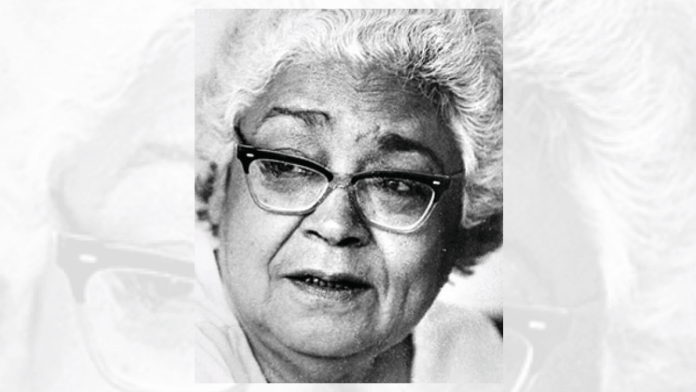
Ismat Chughtai liked Diwali more than Bakrid. It often sparked a discussion between her parents. Why celebrate Diwali, her father would ask. Why would goddess Lakshmi visit a Muslim household?
Her mother’s response was something Chughtai never forgot.
“How would Lakshmi know which house belongs to a Hindu and which to a Muslim? She would simply see light and enter,” Chughtai’s mother would respond.
Perhaps in this simple idea lay the beginnings of Chughtai’s own understanding of the world—one that placed humanity above religious boundaries.
“Bakre kate toh mujhe bahut bura laga, Eid pe achha lagta tha (I didn’t like it when a goat was slaughtered. Eid-ul-Fitr I enjoyed)”, she told poet and novelist Padma Sachdev in an interview with Doordarshan. Uploaded to YouTube in 2019, the interview was recorded sometime in the 1980s.
Chughtai carried two identities. She was ‘Aapa’, or elder sister, for those who loved her, and a ‘buri aurat’, bad woman, for those offended by her writing. She enjoyed both in equal measure.
“Naam se jyada me badnaam thi (More than fame, I got infamy)“, she said in the interview.
Female sexuality, the suffocation of marriage, the hypocrisies of respectable middle-class families, and the inequalities deeply rooted in society—Chughtai wrote about all of it without worrying about the hate or criticism she would have to face.
Her writing resonates even today. Conversations about women’s freedom, their desires, and their right to live on their own terms still make society uncomfortable.
“People often say that someone was ahead of their time. But if that statement truly applies to anyone, it is Ismat Chughtai,” said lyricist and writer Javed Akhtar.
An indomitable spirit
Chughtai was a feminist long before many people around her even knew what feminism meant. She encouraged young women to put themselves, their education, and their careers first, rather than treating marriage as the ultimate goal of their lives.
“When I meet young women, I always tell them one thing: to hell with marriage, become independent first,” she told Sachdev in Hindi.
But Chughtai’s rebellious spirit did not emerge overnight, nor did it begin with pen and paper. It was visible from the time she was a young girl.
Born on 21 August 1915 in Badayun, Uttar Pradesh, Chughtai was the ninth of 10 children born to her parents, Mirza Qaseem Beg Chughtai and Nusrat Khanam. Her father was a government official, and the family moved between various cities, including Jodhpur and Agra. The writer first began challenging the rules imposed on girls in her own household.
She wanted to play with boys her age and refused to accept that being a girl meant she had to stay within certain boundaries. When her family tried to stop her education after the eighth grade, she fought back.
She even threatened to convert to Christianity so she could attend a missionary school and continue studying. She refused to cover herself with any kind of burqa or hijab.
Chughtai pursued higher education at a time when few Indian women had the opportunity to do so. She studied at Isabella Thoburn College, Lucknow, and later at Aligarh Muslim University, earning her BA and BEd in the 1940s.
Her understanding of women’s oppression went beyond the restrictions placed on their education or freedom. She also questioned the virtues that society had long demanded women uphold: beauty, fidelity, and silent suffering.
“I hated moaning women, who bore illegit children. Fidelity and beauty, which are considered a woman’s virtues; I condemn them. Love is a burden on the heart and nothing else,” she famously remarked.
Also read: Kader Khan wrote for Bollywood’s biggest stars. His son says the industry didn’t value him
‘Lihaaf se badnaam’
Chughtai began writing stories in her early teens, though she initially kept them from the public eye.
In 1939, her first published story, ‘Fasadi’, appeared in the journal Saqi. Its authorship sparked curiosity, with many suspecting that her brother, Azeem Beg Chughtai, had written it under a pseudonym. Later that year, stories such as ‘Kafir’, ‘Dheet’, ‘Khidmatgar’, and ‘Bachpan’ established her as a bold new voice in Urdu literature. Her collections Kaliyan (1941) and Chhotein (1942) further strengthened her reputation.
But it was Lihaaf, published in 1942, that made Chughtai impossible to ignore.
One of the most controversial books of her career, Lihaaf explores the suppressed desires and loneliness of Begum Jaan, a neglected wife who finds intimacy with her female attendant, Rabbu.
Its daring subject challenged the silence surrounding female sexuality in Urdu literature. Accused of obscenity, Chughtai faced a legal case in Lahore in 1944. She refused to be intimidated, and the case was eventually dismissed.
“Lihaaf se badnaam bahut hui, lekin usi ne mujhe saari shohrat dila di (I became infamous because of Lihaaf but it also gave me renown),” she said in the Doordarshan interview.
Speaking about progressive writers at a literary festival, Akhtar recalled Chughtai and her fearless approach to literature.
“She wrote about lesbianism back in the day. She was really a feminist. The kind of literature she produced, only she could write. No man could understand the middle class women like she did,” he said.
Chughtai’s remarkable contribution to Urdu literature earned her the Padma Shri in 1976, along with honours such as the Ghalib Award and the Iqbal Samman.
She died in Mumbai on 24 October 1991 and was cremated at Chandanwadi Electric Crematorium, in accordance with her wishes.
Also read: Poet Jan Nisar Akhtar wrote 150 film songs. His great love story survives in 500 letters
Meeting Manto
Beyond the stories in her books, Chughtai’s own life was no less dramatic, filled with unexpected turns, unconventional choices, and controversies.
After graduating from IT College and working as a teacher, she moved to erstwhile Bombay as a School Inspector, where she reunited with Shahid Latif, a screenwriter she had met in Aligarh. Their romance led to marriage, but Chughtai made it clear that love would never mean surrendering her independence. Latif, she later reflected, gave her something rare—a relationship of equals.
Their partnership also opened the doors to cinema. Chughtai wrote stories and dialogues for films such as Ziddi (1948), Aarzoo (1950), and Sone Ki Chidiya (1958), continuing her film work even after Latif’s death.
She also contributed to Garm Hava (1978), the acclaimed film exploring the trauma of Partition, and wrote for and appeared in Shyam Benegal’s Junoon (1978).
Chughtai’s life soon became a subject of gossip and speculation after she met author Saadat Hasan Manto at a party in Bombay. Their growing friendship and outspoken personalities fuelled rumours about their relationship, despite both being married to different partners.
Both Chughtai and Manto repeatedly dismissed the speculation, maintaining that their bond was rooted in friendship and literary companionship. When Manto wrote about Chughtai in an essay, it was with a mix of admiration and amused exasperation.
“Ismat is very stubborn. Obstinacy is her second nature. In this she is almost child-like. She will never accept any view or even a natural law without a show of resistance. First, she refused to get married; when she somehow agreed to that, she refused to become a mother. She will suffer and face troubles but will not give up her stubbornness. I think this is her strategy—to test life’s truths through her conflicts with them,” Manto wrote.
The author of ‘Toba Tek Singh’ could see that Chughtai’s writing would endure long after she was gone.
“A lot has been said about Ismat and continues to be said. Some will like her, some won’t. But her creativity stands much above people’s liking or disliking. Good, bad, naked, covered—whatever, it must endure.”
(Edited by Prasanna Bachchhav)