





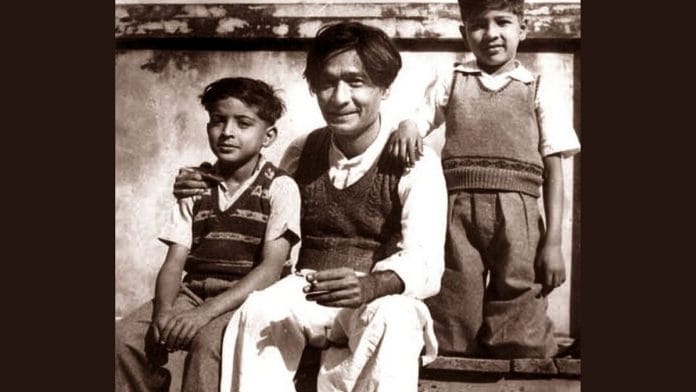

Jan Nisar Akhtar was one of the leading voices of progressive Urdu poetry, a Bollywood lyricist who wrote more than 150 songs, and the father of poet-lyricist Javed Akhtar. But one of the most remarkable parts of his literary legacy was written not by him, but to him.
While Akhtar struggled to establish himself as a film lyricist in Bombay, his wife Safia remained in Bhopal, raising their two young sons and supporting the family through her work teaching Urdu. Then she fell gravely ill and returned to her parents in Lucknow. Eighteen days before she died at just 37, Safia wrote asking her husband to come home. She also thanked him for a poem he had sent her.
“I have always had your love, care, friendship, affection, confidence and warmth,” she wrote. “Now I feel that I am in your poetry too. What more could I desire?”
Akhtar arrived in Lucknow two days after her death. On the journey from Bombay, fearing that he would not reach her in time, he composed Khaak-e-Dil, or Ashes of the Heart. In it, he mourned not just a lover but an intellectual partner and fellow traveller through years of struggle:
Ye mere pyaar ka madfan hi nahin hai tanha
ek sathi bhi tah-e-khak yahan soti hai
(It is not merely my love that lies buried here
Here, too, rests my companion, reduced to ashes)
More than two decades later, Khaak-e-Dil would give its name to the collection that won Akhtar the Sahitya Akademi Award in 1976—shortly after his own death on 19 August that year at the age of 62.
But well before that he had made sure his wife’s words were preserved as well in two volumes of her letters published in 1955: Zer-e-Lab and Harf-e-Aashna. “Zer-e-Lab” literally means “under the lips,” suggesting whispered, intimate conversations.
Also Read: Partition child Sunil Dutt fought for Hindu-Muslim unity, from marriage to peace marches
A romantic revolutionary
Poetry permeated Jan Nisar Akhtar’s life. By Javed Akhtar’s account, his father was the archetypal shayar—absent-minded, dreamy and frequently lost in his own imagination.
Born Syed Jaan Nisar Hussain Rizvi on 18 February 1914, he came from a family steeped in literature. His father, Iftikhar Hussain, known as Muztar Khairabadi, was a prominent Urdu poet, as was his paternal uncle, Bismil Khairabadi.
After completing his schooling in Gwalior, he earned a BA and MA in Urdu from Aligarh Muslim University. Financial difficulties interrupted his doctoral studies, and he returned to teaching, eventually moving to Bhopal, where he became deeply involved in the Progressive Writers’ Movement. He became a leading voice in this left-wing literary current, which also counted luminaries such as Faiz Ahmed Faiz, Ismat Chughtai and Kaifi Azmi among its ranks.
Akhtar wrote of love and social justice, but also of a Ganga-Jamuni ideal of India that transcended religious divisions. His Hum Ek Hain gave the refrain awaaz do hum ek hain — “raise your voice, we are one” — which became a rallying cry at multiple protests. A famous stanza goes:
Sangam hamaari aan hai/ Chittor apni shaan hai
Jamuna ka tat Gokul ka ban/ Ganga ke dhaare apne hain
Keh do koi dushman-nazar/ Utthe na bhuule se idhar
Keh do ki hum bedar hain/ Keh do hum tayyaar hain
Awaaz do hum ek hain
(The Sangam is our pride, Chittor our glory
The banks of the Yamuna, the forests of Gokul, the currents of the Ganga are ours
Tell every enemy eye not even to think of turning this way
Tell them we are vigilant, tell them we are ready
Raise your voice—we are one).
Jawaharlal Nehru commissioned Akhtar to curate three centuries of poetry about India. The result was Hindustan Hamara (Our Hindustan), a two-volume anthology later released by Indira Gandhi. Hum Ek Hain was among the works included.
The romantic and revolutionary strains in Akhtar’s poetry were not always separate. After visiting Safia’s grave on a cold January night, he wrote Khaamosh Awaaz, or “Silent Voice”, imagining her speaking to him from beyond the grave. His private grief opens out into a call for collective strength, reminiscent of the Progressive Writers’ tradition.
Mere gham ko mere shair/ saare jag ki aag bana lo
Mere gham ki aanch se saathi/ chaunk uthega ‘azm tumhara
Aaj hamare lakhon saathi/ saathi himmat haar na jaao
Aaj karodon haath badhenge/ ek zara tum haath badhao
(Take my grief, my poet, and make it a fire for the whole world
The heat of my sorrow, my companion, will stir your resolve
Today we have comrades in their hundreds of thousands, do not lose courage
Millions of hands will reach out, if only you extend yours).
Also Read: SP Balasubrahmanyam was irreplaceable in Bollywood. Asha Bhosle wondered what he ate
‘If that’s not love, what is?’
It was two years after Safia’s death that Jan Nisar got his big break in Bollywood with AR Kardar’s Yasmin (1955). He went on to write more than 150 songs, including “Aankhon Hi Aankhon Mein” from CID (1956) and “Meri Neendon Mein Tum” from Naya Andaz (1956).
In “Yeh Dil Aur Unki Nigahon Ke Saaye” from Prem Parbat (1973), even the landscape is swept up in romance: “Pahaadon ko chanchal kiran chumati hai” (Playful rays of sunlight kiss the mountains).
At the time of his death in 1976, Akhtar was working on Kamal Amrohi’s Razia Sultan. The film would not be released until 1983, seven years after his death, allowing his final lyrics to be heard, including the Lata Mangeshkar classics “Aye Dil-e-Nadaan” and “Khwab Bankar Koi Aayega”.
But the Bollywood years also meant long spells away from his wife and children. In Salman Akhtar’s telling, that separation yielded some 500 letters from Safia between 1943 and 1952.
“Those letters brought immortality to my mother’s name. She would have become a forgotten figure of a poet’s wife and a minor footnote. Now she has acquired the status of a liberated, independent woman and writer. Who published those letters, who made her immortal? This man who kept every single letter, hand-scribed each of the 500 letters and convinced a publisher to publish it,” his son Salman Akhtar, a US-based psychiatrist, said at a 2014 talk. “His contribution to Urdu poetry may be controversial, maybe debatable, but his having made his beloved wife immortal is what speaks to me at the deepest level… If that is not love, what else is?”
(Edited by Asavari Singh)