




Welcome to The First Metro. I am Manasi Phadke, a thoroughbred Mumbaikar, and once every fortnight, I try to bring you a glimpse of India through Mumbai-tinted glasses. Trust me, the hues seem different.
For the past ten days, there’s been a new flashpoint in Mumbai. It’s not the city’s frustrating traffic, negligible footpaths, or uncleared garbage, but the simple, innocuous white lines that had cropped up in a few parts of the city.
The lines were drawn by the Jain community for their monks who walk barefoot. Jain leaders have since explained the significance—the white paint prevents the growth of algae and moss, and allows the monks to walk without inadvertently harming any living thing, which is an important tenet of Jainism. In this extended summer, where every surface radiates heat, the white paint also keeps the road surface cooler, they said.
However, the white paint quickly snowballed into a full-fledged tussle between the Jain and Marathi communities in the city, with Raj Thackeray’s Maharashtra Navnirman Sena (MNS) also jumping in, taking it up a notch. The controversy, rather unnecessary, gave us a glimpse of how the two communities can behave when they are at their worst.
It all started in a Ghatkopar-based housing society, where a Marathi social media influencer took an objection to a white line painted for Jain monks, asking why residents of the society were not consulted. Those who had painted the line had apparently taken permission from the society management, which may not have necessarily informed all its members about it. There was also an argument that the white stripes were never exclusively for Jains, and it’s not like other pedestrians or motorists were prohibited from stepping on them.
Questioning why something was done on a common road or pavement is not entirely incorrect, but the episode took an ugly turn, defying any semblance of logic, sensitivity or basic respect for each other in a secular, multicultural society.
Social media was full of comments about “Jain jihad” and the Jain community allegedly dominating over the “sons of the soil Marathis”, vitiating the local culture by imposing their practices and so on.
There were an equal number of xenophobes on the other side too, calling for exclusive Jain housing conclaves without Marathi-speaking people, and advising Mumbai’s Jain residents to not donate a single paisa for Marathi festivals, including the beloved Ganpati festival, which usually unites almost all communities in the city.
Someone questioned if it would be okay if they drew a saffron or a green line on public space, while someone else suggested the society should focus on another minority, alluding to Muslims, instead of the supposedly benign Jains.
I had called an advocate who I have known for many years, and who is a very involved member of the Jain community, to understand what the community is making of all this. He said, “It’s so trivial. Why are you focusing on it?”
And I agree. It is trivial, and unnecessary. But then, the relationship between the two communities has been so fraught with some deep-rooted insecurities, shaped by history and politics, that even a trivial incident like this one can rip open the scab, oozing blood.
I had talked about this insecurity in one of my earlier pieces immediately after the BMC election, and promised to elaborate on it some other time. Well, this is the time.
The white stripes brought to the fore all the accumulated problems that Mumbai’s Marathi and Gujarati speakers, particularly Jains, have clashed on—developers refusing to sell houses to Marathi speakers in Jain dominated societies, landlords refusing Marathi tenants, the many heated arguments over food choices that I had talked about in one of my earlier pieces, Marathi-speaking people allegedly not finding employment in Jain-owned businesses, this fear that Gujarati Jains want Mumbai to be part of Gujarat and so on.
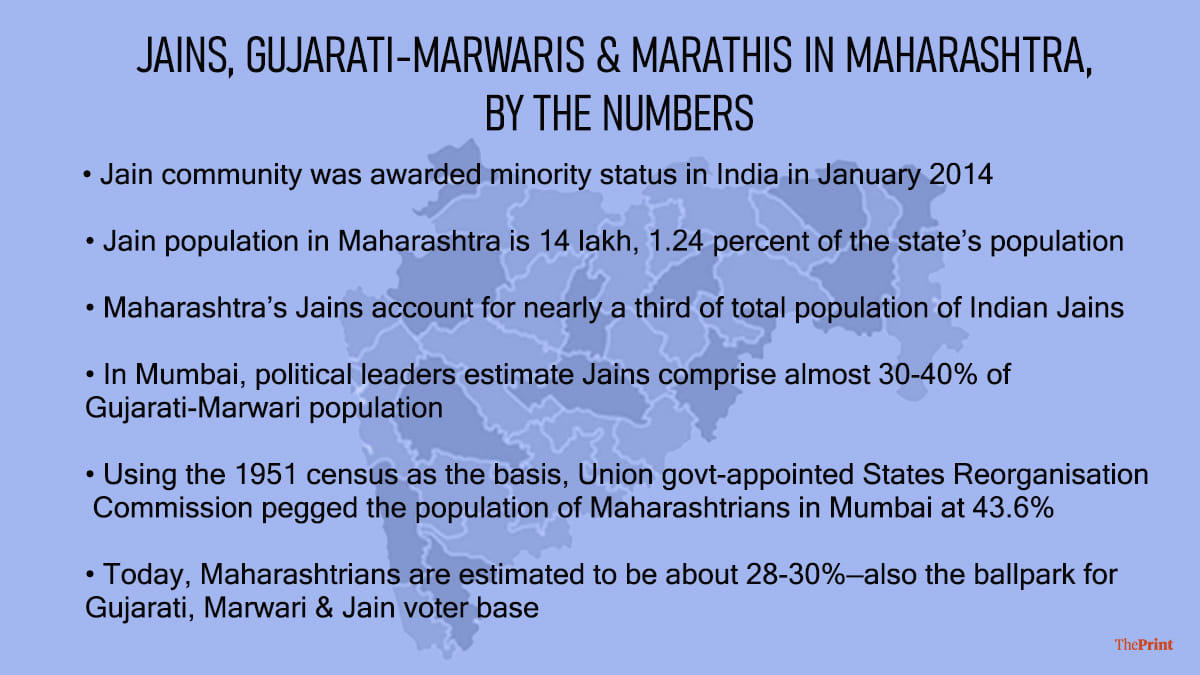
The Jain community was awarded minority status in India only in January 2014, and isn’t very numerically strong in the state. Their population in Maharashtra is only 14 lakh, 1.24 percent of the entire state’s population. Maharashtra’s Jains, however, account for nearly a third of the total population of Indian Jains.
In Mumbai, political leaders estimate that Jains comprise almost 30-40 percent of the Gujarati-Marwari population. The Jain community may not be very large in numbers, but is definitely affluent.
A couple of years ago, I wrote a long piece on the relations between Mumbai’s Marathi and Gujarati-speaking people, focusing on how they were perceived in the 1950s and 1960s. And the way they are perceived now by the youth, who have not lived through the battles and bloodshed of the Samyukta Maharashtra movement.
A Gujarati script writer in his late 30s told me that he feels more at home in Mumbai than Gujarat, and that the two cultures are very similar. He told me how he was disturbed to read that slogans, such as “Mumbai nahi konacha baapachi (Mumbai belongs to us, not to anyone’s father)” and “Mumbai tumchi, bhandi ghaasa amchi (Okay, Mumbai is yours, now come and wash our utensils)”, were commonly clouding the city’s social harmony once upon a time.
Similarly, a media professional in his mid-30s said he was shocked to read about a recent incident where a Marathi woman accused a Gujarati father and son of denying her office space because she was Marathi.
For this piece, I also spoke to a sociologist, who said the roots of the insecurities in the Marathi-Gujarati, especially the Marathi-Jain relationship, lie in the capital versus labour contradiction. Pre-Independence, she said, Mumbai’s capital was owned by different kinds of people—the Parsis, Jews, Anglo Indians, Marwari Jains, Gujarati Jains, Patahre Prabhus and the Sonars—but post Independence, the Gujarati and Marwari Jains, and Baniyas started dominating Mumbai’s powerful capitalist lobby. The labour, meanwhile, was predominantly from the Maharashtrian hinterland.
I don’t know what the social atmosphere was like during the years of the Samyukta Maharashtra movement, and post the creation of Maharashtra with Mumbai as its capital—the era of “Mumbai tumchi, bhandi ghasa amchi (Mumbai is yours, now come wash our utensils)”. I was born much later, but I have heard stories. And from everything I have heard, it seems like today’s discordant environment is quite reminiscent of that era, except that back then the ire of those fighting for Mumbai to be part of Maharashtra was against the government. Now, there is direct hostility between two communities.
This growing bitterness has been directly proportional to the BJP’s rise in Mumbai. Mumbai’s Jains have always supported the BJP, with votes as well as resources. And there’s at least a sizeable section of the city’s Marathi population—the section that voted for Uddhav Thackeray’s Shiv Sena to be the second-largest party in the Mumbai civic body—that fears the BJP’s rise will enable Gujarati Marwari and Jains to take dominate the city’s identity. Two incidents last year strengthened that notion.
In August last year, Jain community members staged vociferous protests against a decision of the BMC to shut down all kabutarkhanas (pigeon feeding spots) in the city, and penalise those feeding pigeons. The civic body’s decision was based on a Bombay High Court directive arising out of health concerns due to the uncontrolled feeding of pigeons in Mumbai. Members of the Jain community attempted to dismantle a blue tarpaulin cover put by the BMC over the Dadar kabutarkhana, causing massive chaos and throwing traffic out of gear. The protest was uncharacteristically aggressive for a community that believes in peace and non-violence. But, it was also something that the city had seen just a few months ago.
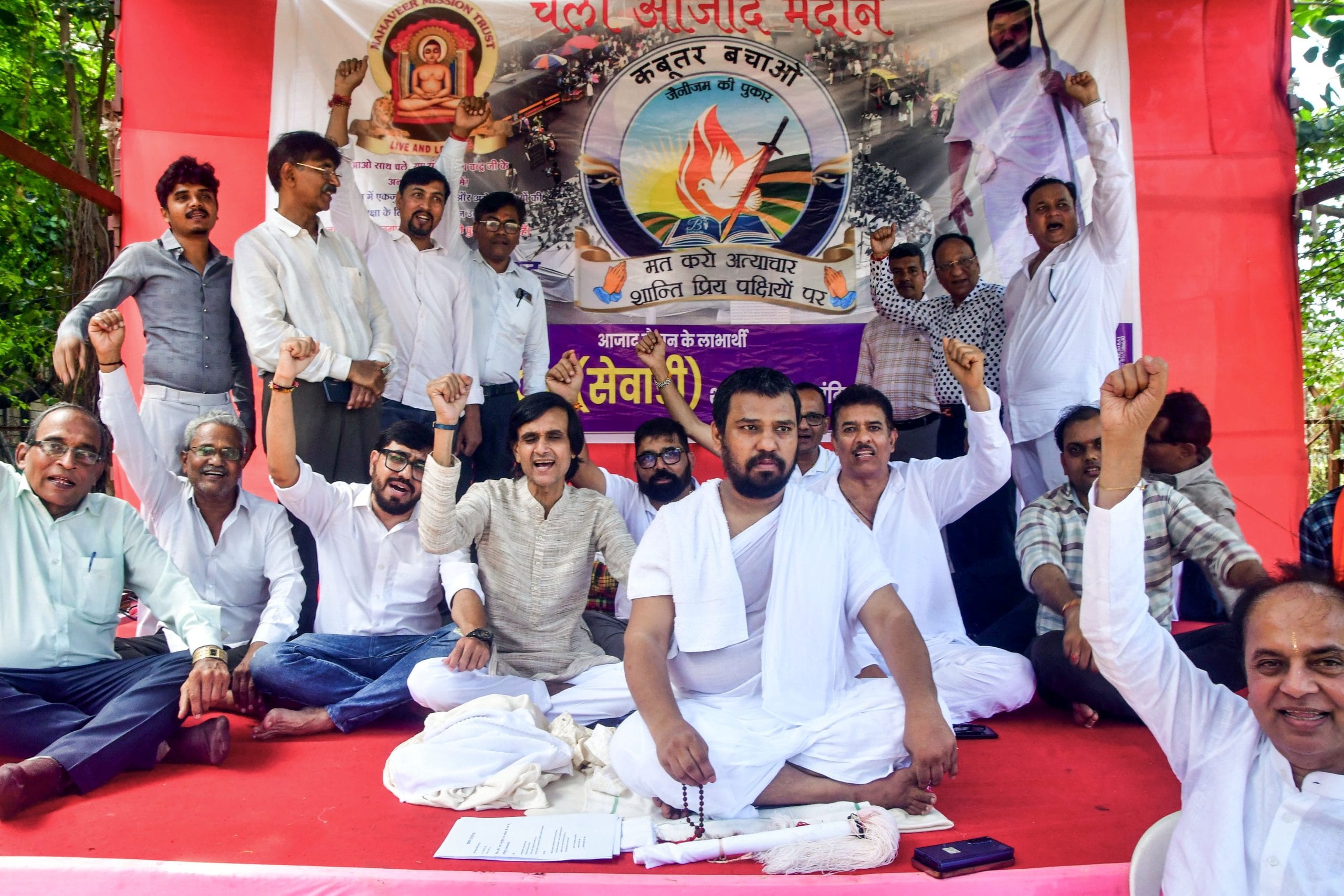
In April that year, Jain community members had similarly taken to the streets to protest against the BMC for demolishing a Jain temple in Vile Parle that was alleged to be illegally built inside a housing society. BJP leaders, such as Mangal Prabhat Lodha, MLA Parag Alavani and former corporator Moorji Patel, had attended the protests at the time. It was clear that the BJP was scrambling to assuage their biggest supporters. The BMC even shunted out the civic officer in charge of the demolition exercise.
When these incidents were taking place, even some BJP leaders admitted in confidence that the community is aware of its influence and power and that the BJP needs the community to be on its side. So, they aren’t afraid to strongly assert their position on issues.
The white stripe row that started in Ghatkopar—slowly spreading to areas such as Dadar, Girgaon and Lalbaug—continued to simmer, taking different forms. Earlier this week, there was a clash over someone placing a Jain community flag over the ‘jiretop’ (headgear) of a statue of Chhatrapati Shivaji Maharaj in Malad, sparking another controversy. The police reached the spot, and so did MNS workers, and ultimately the flag was removed with ample strongly-worded warnings about how Shivaji Maharaj was Maharashtra’s pride, its “aradhya daivat (worshipped deity)”, and no one should dare to disrespect this sentiment.
Did the MNS’ intervention escalate the white stripes row? I think it definitely did, with the party’s shrill involvement in the matter muffling some logical voices from both sides that were calling for a simple peaceful dialogue between the two communities to resolve such issues.
But, then, the party’s involvement was hardly surprising. It was doing what it does best. It has built its politics on standing up against any signs of supposed oppression of the ‘Marathi manus’ by non-Marathi “migrants”. Every time, there’s an allegation of a Marathi person being denied a house, discriminated against on the basis of food or anything else, there’s always an MNS leader in the scene. Not that it has paid off electorally in the last few years, but that’s the only space left for the party to really build on.
Between the white stripes and the jiretop controversy, MNS leader Yashwant Killedar in one of his interviews to a television channel had also squarely blamed the BJP, saying before the party grew stronger in Maharashtra, there was no social discord.
Using the 1951 census as the basis, the Union government-appointed States Reorganisation Commission pegged the population of Maharashtrians in Mumbai at 43.6 percent. Today, it is estimated to be about 28-30 percent, which is also the ballpark for the Gujarati, Marwari and Jain voter base. A Shiv Sena leader once told me in detail how more than half of Girgaon, traditionally known as a staunch Marathi neighbourhood, is now unrecognisable to him.
The Marathi people and the Gujaratis and Marwaris, including Jains, are almost equal in numbers. They occupy an equal space in the cityscape and culture. So, for the parties who represent them, it’s not just a numbers game anymore. It is about projecting the right kind of optics. It is about amplifying the voices of the people they aspire to represent and testing whose voice is heard the loudest.
In this battle, sometimes the stripes often appear gaudier than they actually are.
Also read: Mumbai: A Bandra demolition, and the city failing its poor