



Welcome to The First Metro. I am Manasi Phadke, a thoroughbred Mumbaikar, and once every fortnight, I try to bring you a glimpse of India through Mumbai-tinted glasses. Trust me, the hues seem different.
About 15 years ago, Bandra station figured prominently in my work day as I would head back to my office in Nariman Point after meeting officials at either MMRDA, MSRDC, MHADA or SRA. I used to cover infrastructure and housing as a daily beat. The tin roofs of the Garib Nagar slums were nearly at level with the foot over-bridge at Bandra station, and I used to drag my feet languidly through that stretch.
It used to be a sight that summarised Mumbai. At that time of the day, the sun would cast an orange halo over the thicket of Bandra’s buildings, and then the endless shanties of Garib Nagar. To my left, people rushed towards the platforms in a manic hurry and to my right, oblivious to it all, children played on Garib Nagar roofs that would seamlessly meet each other, almost creating a tin-floored playground.
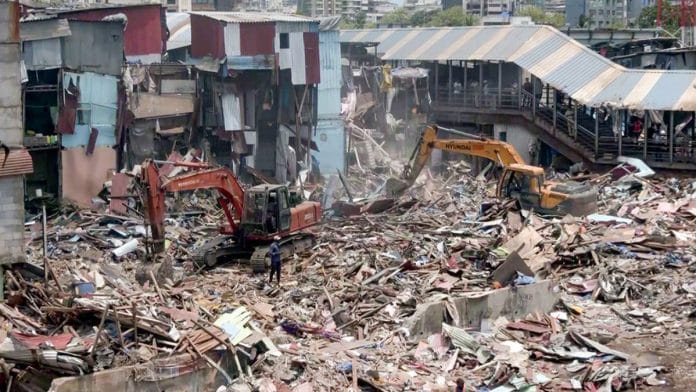
It was this image that my mind took me back to when I heard about the demolitions at Garib Nagar and the clashes that followed. The demolitions will make life a shade better (and rightly so) for the hard-working people whom I used to see to my left, rushing to board their trains as if their lives depended on it, as the Western Railway plans to use the land for additional railway infrastructure.
But the demolitions came at the cost of those I used to see on my right, trying to make the most of life in a city harsh on anyone without a decent amount of money. Agreed, the Western Railway, which had been trying to clear its land of encroachments for years, took action only after a decade-long court battle that identified all but 100 structures as illegal. But, the sight of children turned homeless overnight, families lugging household belongings like stoves and buckets out with nowhere to go and no alternative arrangements, was just sad.
About 50 percent of Mumbai’s population lives in slums, give and take a couple of percentage points here and there. A 2023 report by the state government’s Slum Rehabilitation Authority (SRA) said that of Mumbai’s total habitable area of 34,000 acres, a good 24 percent—8,333.53 acres—is covered by slums.
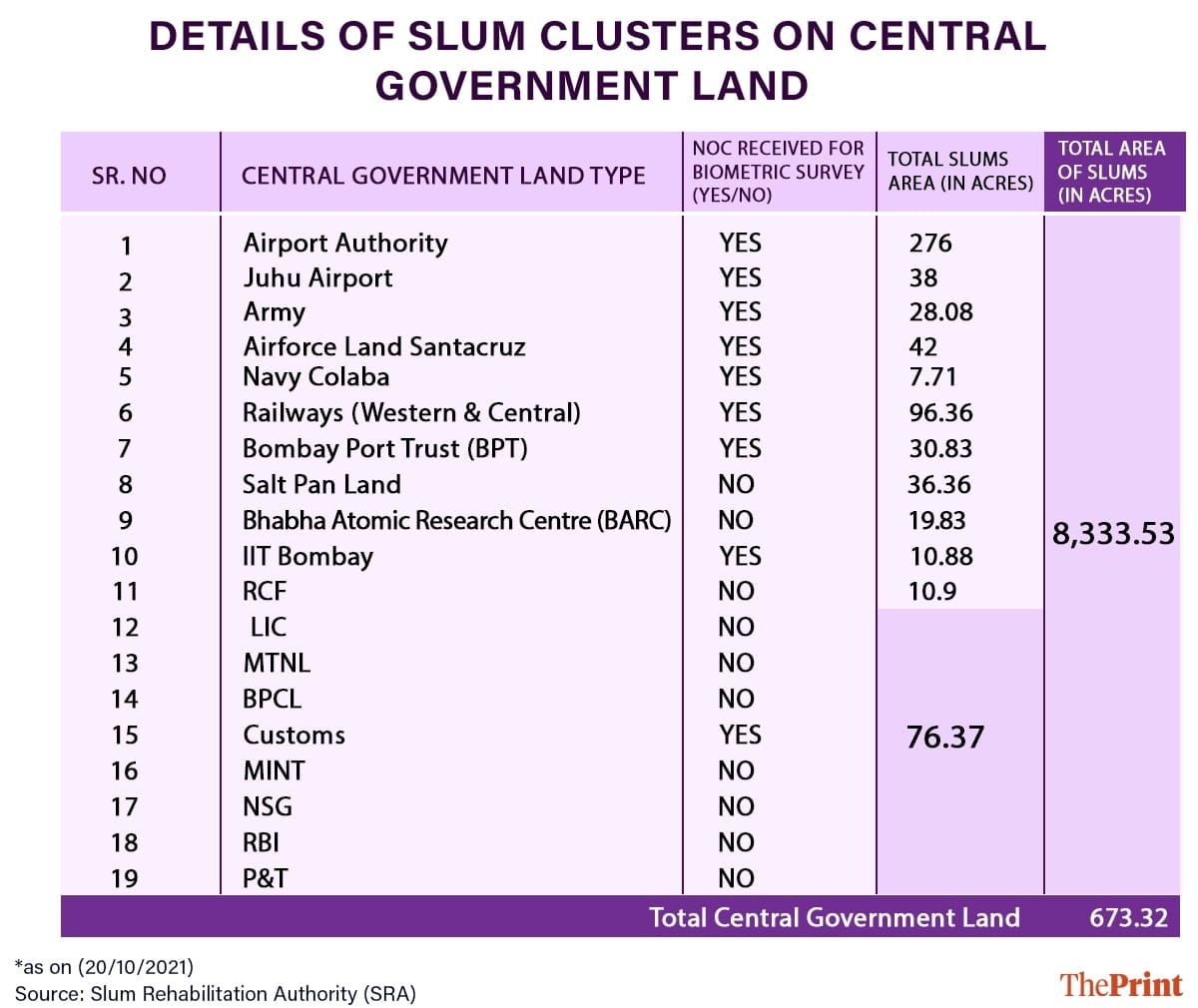
For as long as I have been writing on Mumbai (close to two decades), that figure has barely budged despite the state government’s policy of free in-situ rehabilitation for eligible slum dwellers through the SRA, and despite the eligibility criteria having had an elasticity linked to polls.
It was moved from 1 January 1995 to 1 January 2000, and later expanded to include the tenements built between 2000 and 2011, the occupants of which are considered eligible for rehabilitation at a fee of Rs 2.5 lakh per house.
SRA, perhaps, has been more instrumental in Mumbai’s vertical expansion than its slum eradication. Developers of all kinds lined up to get a pie of the construction incentives in return for slum development. More than a slum community-driven model, it became one driven by developers. Many projects languished as developers faced issues getting clearances, hit roadblocks in determining eligibility, got stuck in litigation and reeled under financial pressures.
Where projects were completed, the living conditions of the slum dwellers seemed no better, with prison-like buildings that had poor ventilation and lighting. And the entrance was most definitely separate from the buildings that formed part of the sale component. How would the builders otherwise be able to justify charging crores for flats with former slum dwellers as neighbours?
Just earlier this month, even the Bombay High Court remarked how Mumbai’s goal of slum extinction has largely remained a “dream on paper”, listing pretty much the same reasons, including the replacement of actual slums by vertical slums—poorly built houses.
The residents of towers that are products of slum rehabilitation projects usually look at this “vertical slum” next to their plush housing society and rationalise their crores with statements like, “We’ll at least have plenty of domestic help easily available.” This is also something that I have heard from people whose balcony views are marred by specks of slums.
The SRA has so far built over 2.79 lakh rehabilitation tenements that have received occupation certificates from the BMC and work on 3.36 lakh rehabilitation tenements is underway. If 50 percent of Mumbai’s population lives in slums, that amounts to at least 65 lakh going by the BMC’s population estimate for Mumbai as of 2023 (1.3 crore). You don’t even need to do the math for this one to know how inadequate and slow rehabilitation efforts have been.
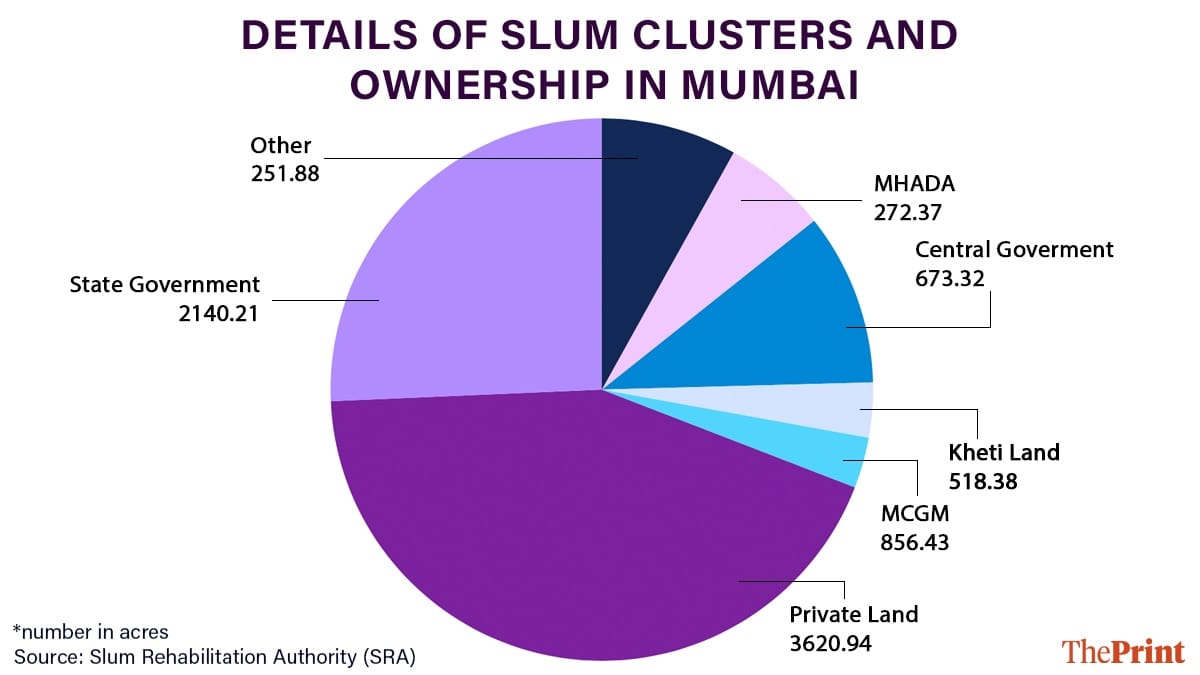
Fundamentally, why is slum extinction one of the city’s priorities? Yes, slums are blocking a very scarce public resource in the city–land, which is needed to build roads, railway lines, government buildings and legal affordable houses. Of the 8,333.53 acres of slum land in Mumbai, only 3,620.94 acres of it is privately owned. But there is one more reason that our slum rehabilitation approach has so far overlooked. Dignity of housing.
Is this any way to live? With houses made of tin roofs, industrial scrap, plastic and tarpaulin that are permanent fire hazards? Basic hygiene norms go for a toss due to proximity of the houses to each other, and the sheer density of the population with families of anywhere between five and ten members packed into a 100-200 square foot house.
These are the people who build Mumbai’s ivory towers, who clean the city’s drains, lay the water and gas pipelines, catch rats before the city wakes up, sell vada pav to hungry office-goers outside stations and bend over backwards as domestic help. And they did not choose to live like this. The city has, decade after decade, year after year, failed them by providing little choice in terms of affordable rental housing.
In 2017, my husband and I had saved enough for a down-payment on a house we liked and had a good cushion from our parents’ savings. I had always dreamed of a house where I could have a balcony and keep a hundred plants, and where the wind engulfed me in a cool embrace, taking with it all the weariness and anguish of the day. This house was exactly that.
We had a meeting scheduled with the developer one night, post work. I was standing on the main road in Parel trying to hail a cab when a homeless man lay on a plastic mat on the pavement to settle for the night. A Mumbai Police constable happened to walk past and told him in no uncertain terms that he could not sleep there. When the man paid no heed, the constable simply pulled out his water bottle and emptied it on the mat. There was no way he could sleep on it now.
I cried bitterly that night.
Here I was, praying that the deal for my dream house would go through without a glitch, weaving images in my head of how happy we could be there as a family, while a man was struggling to find a place to rest his head for just one night.
I live in that dream house now with my cognitive dissonance. But, even now, when I look back at that incident, I don’t judge the constable. He was only doing his duty, and I am sure he wasn’t returning to a particularly rosy housing situation either, given the dire straits our police housing conditions are in.
I judge our city and its inability to provide night shelters that the constable could have pointed that man towards. What is a long-term option for someone like him? Leaving the city or being a part of the informal slum economy.
On paper, our approach to dealing with slums has definitely evolved. Between the 1950s and 1970s, the idea was to simply clear slums and protect public land. In the next couple of decades, the state started taking a more humanitarian approach.
In 1971, the government got a regulation to deal with slums–the Maharashtra Slum Area (Improvement, Clearance & Redevelopment) Act. The government started issuing identity cards to slum dwellers and providing the living basics – water, drainage, toilets, street lights. Much of this happened through political will as leaders built their electoral fortunes on the patronage they got in return for pushing for these basic facilities. It is the same political will that is also held responsible for turning a blind eye as the slums mushroomed.
The 1985 case of journalist Olga Ellis and others versus the then Bombay Municipal Corporation was landmark in framing the approach towards encroachments. The Supreme Court for the first time recognised the ‘Right to Livelihood’ as part of the constitutional ‘Right to Life’. The court said that no person had the right to encroach on footpaths, pavements or any other place reserved for public purposes. But it called for rehabilitation of eligible slum dwellers and sufficient notice to be provided before eviction and demolition, and prohibited any action in that case until one month after the monsoon ended.
The SRA was set up in 1995 to speedily take up in-situ slum redevelopment projects. Over the last 5-6 years, the bureaucrats heading the authority have tried to make slum redevelopment easier and more efficient. For instance, it was decided that the eligibility survey, known technically as ‘Annexure 2’, should be done for slums pan-Mumbai in a mammoth exercise, once and for all, and be digitally recorded so that slum redevelopment projects can efficiently be taken up wherever the Annexure 2 is ready. Further, the SRA has been earmarking slum clusters and inviting bids from developers to take these up. These steps, however, are yet to show visible effects.
Back at Garib Nagar, it isn’t as much about the demolitions as it is about how they were carried out. Monsoon is just around the corner, so is the start of the school year. There are all these people who suddenly have no shelter. Like the man with the plastic mat I had seen in 2017.
Their options are, perhaps, not much different from his. Either leave the city or be a part of its informal slum economy, if not in Bandra’s Garib Nagar, then somewhere else.
Also Read: Hard to live, harder to relocate—Kanjurmarg residents’ fight to shut down Mumbai’s biggest landfill
Those living in slums who are stealing electricity and not paying lagitimate property tax unlike fools like us and our ancestors should not be given the poor category. We who are duly paying our taxes and are law abiding citizens are not getting enough compared to these poors. All the benefits from tax payers are going to them not to the legitimate tax payers. So if they are illigally occupying land which doesnt belong to them or they are not paying legitimate taxes then they should be send off where they came from. Enough of categorizing them as poor and giving them free benefits on the back of real poor middle class.
By far the most sensitive and poignant narration on the demolition I have read so far