







Welcome to The First Metro. I am Manasi Phadke, a thoroughbred Mumbaikar, and once every fortnight, I try to bring you a glimpse of India through Mumbai-tinted glasses. Trust me, the hues seem different.
Every few years, cities change in their look and feel, landmarks come down and are replaced by new ones. There’s always a silent but fast-paced urban renewal happening all around us.
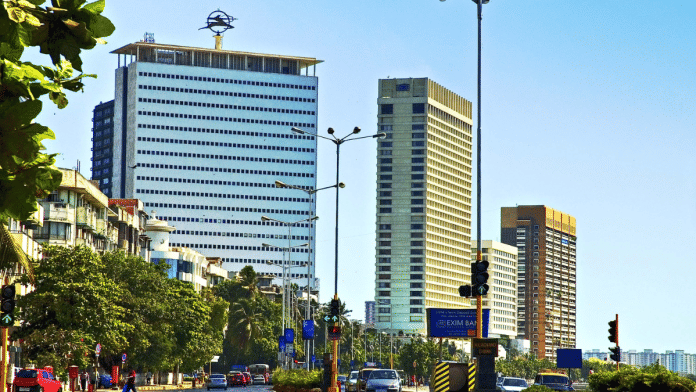
In the last two weeks, two more such landmarks in Mumbai ceased to exist—the Air India building at Nariman Point and the Air India colony at Kalina.
Both places had turned into ghosts of their former selves in the past few years, especially after Air India was privatised and its non-core assets were put under the Air India Assets Holding Limited for monetisation.
The Maharashtra government bought the iconic, sea-facing Air India building at Rs 1,601 crore for additional space to house its offices. The state secretariat, Mantralaya, its annex building, and the ‘New Administrative Building’ opposite Mantralaya are quite inadequate to house the expanse of the Maharashtra government’s activities.
The purchase was in the works since 2021, but the formal handover was completed only this week, and a day later, workers were seen removing the sign ‘Air India’ and the centaur logo from the building, marking the end of an era.
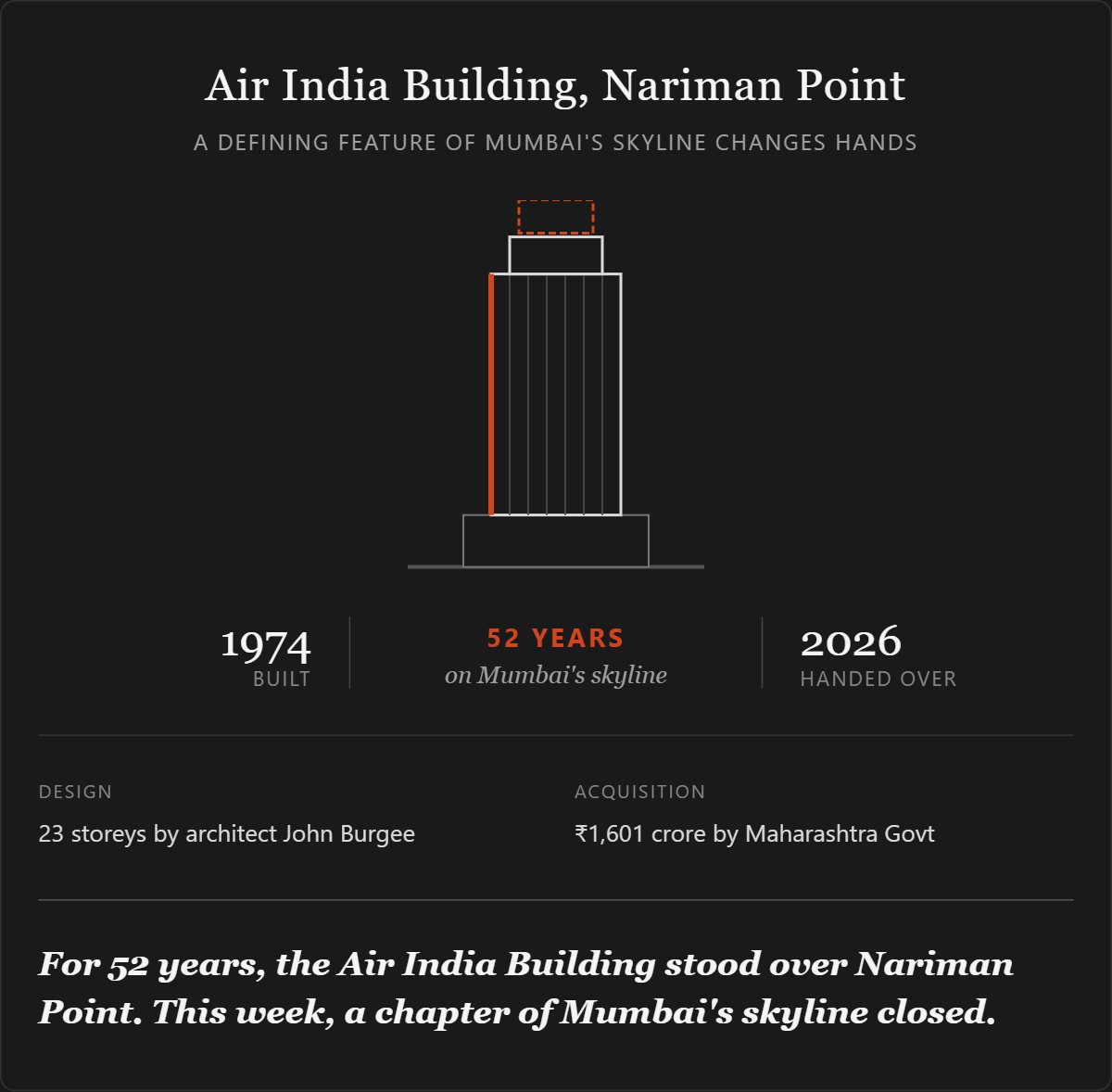
The building was built in 1974, designed by American architect John Burgee on reclaimed land that the Maharashtra government had leased to Air India. The 23-storey building had many modern architectural features for its time, like centralised air-conditioning, six high-speed elevators with piped music and two levels of basement parking when the concept was unheard of in India.
The building, built at an angle, however, badly obscured its neighbour’s sea view, and there’s an unconfirmed conspiracy theory behind it. Pure hearsay, which I’d rather not get into, but if you’ve been in Mumbai long enough, you’ve probably heard this story.
Express Towers, the Air India building’s neighbour and our office when I was at The Indian Express, was left only with a side view of the ocean. Very few desks offered a slice of the glorious Arabian Sea.
One of those rare partial sea view desks belonged to my friend, who was transferred to the Delhi office. The moment I heard about his move, I called dibs on the desk, and then spent the next few years looking into the horizon every time I had to pause to think while writing.
I used to be our newsroom’s Bhola from Lagaan, telling my colleagues it’s going to rain a good two minutes before it actually did. I could actually see misty rain clouds travel across the ocean and finally hit the land.
Now, some joint secretary of a government department might do the same for her colleagues.
And speaking of rain, no Mumbai monsoon would be complete without visuals of knee-deep water from the low-lying Air India colony in Kalina. During the 26/7 deluge, the colonies were so severely inundated that boats had to be sent to rescue residents.
Last week, the last few residents of the Air India Colony in Kalina, which had gone into disrepair over the last five years, vacated their houses after a protracted court battle.
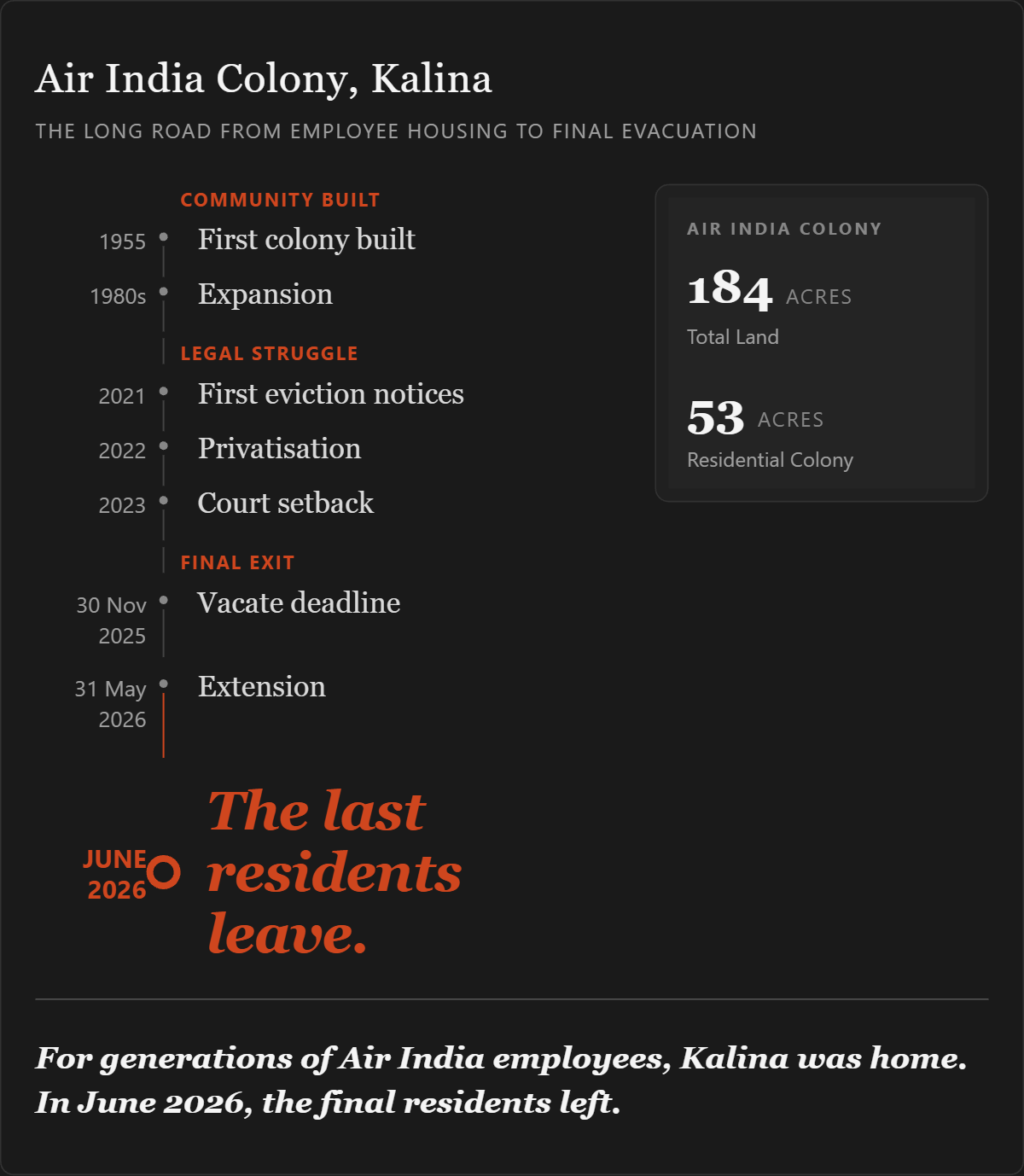
The residents of the colony received the first notices to vacate in 2021 when the national carrier was at the brink of privatisation. The Air India Specific Alternate Mechanism, formed by the Cabinet Committee on Economic Affairs, decided to allow employees to occupy their residential accommodation for at the most six months post disinvestment or until the property was monetised, whichever was earlier.
Some residents, who could figure out alternate accommodation within Mumbai, left then, but most others knocked on the doors of the labour court, then the Bombay High Court, and finally the Supreme Court, saying housing was a service condition and that the employees should be allowed to live on the premises till retirement.
Last year, the employees lost the case in the Supreme Court, which gave them time till 30 November, 2025, to vacate their houses. The Adani-led Mumbai International Airport Limited, which will be using the land for the airport’s expansion, informally moved the eviction date to 31 May on request of the residents.
And last week, the last of the families in the residential colonies, spread over 53 acres at a stone’s throw from the airport, moved out with their belongings. Overall, the land, including the grounds and surrounding schools, is about 184 acres. It belonged to the Maharashtra government, which handed it over to the Airport Authority of India years ago for airport development.
In 2024, there was a fracas between the MIAL and the residents when the former had brought in a bulldozer to demolish 20 vacant buildings in the colony, and the spooked residents had protested, saying the case was still sub-judice.
A spokesperson of the Mumbai airport had then told me that MIAL’s claim predates Air India’s privatisation. The entire airport land, including the area on which the housing colonies stand, was apparently transferred by the Airports Authority of India to MIAL through an ‘Operation, Management and Development Agreement’, and a lease deed in April 2006.
I had visited the colony in 2024 after the bulldozers moved out, and it was just a gloomy shadow of its earlier bustling self. The previous time I had visited the Air India colony was in 2006 when a college friend lived there. She had shown me around the beautiful tree-lined roads that made me forget we were in the thick of hot and sticky May. We bumped into some of her friends, and wasted time to the best possible extent on one of the many benches, chattering and watching life around us go by.
But, this time, I was greeted with eerily empty roads, unkempt trees whose fruits were squashed all over the streets, blackening buildings with tired windows, and the lowest density of population that you might ever find in Mumbai.
The handful of residents left behind told me that in 1999, there were about 2,300 families living there, which dwindled to 1,200 in 2021 and just about 350 over the 53 acres in 2024. There used to be a WhatsApp group of the youngsters in the colony called ‘Psycho Boys’, I was told, and they used to organise various events and festivals within the colony. Most of the ‘Psycho Boys’ had moved out but the bunch of residents left behind had tried to continue the tradition by celebrating Republic Day just a couple of weeks before the bulldozers arrived.
Air India Assets Holding Limited, which was responsible for the colony’s upkeep, had stopped spending on maintenance. It was just paying for the security of the land.
The Air India colony was in some ways iconic for the city. It had a large cricket ground where the MCA and BCCI would hold training camps and some practice sessions and, it is said that players like Ajinkya Rahane, Prithvi Shaw and Shivam Dube emerged from these. It also had a large football ground.
It’s a cliche, but change is really the only constant, and that’s what keeps cities thriving, I guess.
I think one of the tests of being a true Mumbaikar is to have been around long enough to see at least one such cycle of churn. It is to be able to identify at least some places by landmarks that used to once define those areas but now cease to exist.
Once when I was a child, my grandmother and I hopped into a kaali-peeli taxi with the intention of visiting my aunt in the Mahim area of Mumbai. She told the driver, “Badal Bijli jaana hain (we need to go to Badal Bijli).” He nodded and took off. I knew my aunt lived in Mahim, and throughout the journey kept wondering what the hell this Badal Bijli was. The taxi driver halted at an empty plot with signs of an old structure having been reduced to rubble. My aunt’s home was two buildings away.
Badal and Bijli were two famous single-screen theatres housed in the same building, which had stopped functioning, but were so famous in their heyday that the area was colloquially known as “Badal Bijli” even years after their demise. But, only those who had seen the theatres up and running ever got the reference.
Back then, my grandmother and the taxi driver qualified, but my single-digit years in the city where I have lived since my birth were not quite enough.
A few years later, there was a repeat of the Badal Bijli incident. But, this time, I passed my self-proclaimed test, and on the other hand, my husband, who moved to Mumbai from Pune in 2009, didn’t quite make the cut.
I texted my husband that he should pick me up from ‘Raja Rani Chowk’ near Shivaji Park. The next few minutes were very chaotic as he couldn’t figure out where exactly I wanted him to pick me up from. The only ‘Raja Rani Chowk’ that Google Maps was throwing up was in Nagpur. When he finally figured out where it was, he said, “Couldn’t you just say you were near Trofima?”
Trofima was a fairly new restaurant that had come up at the place that I, or anyone familiar with Dadar since the past few decades, have known as ‘Raja Rani Chowk’.
There used to be a hoarding with jumbo-sized playing cards with a king of hearts and a queen of hearts, and possibly one more suit, or maybe not. I can’t quite remember. It was the office of a tour operator—Raja Rani Travels—located at what was formally known as the ‘Raja Badhe Chowk’.
The large playing card hoardings were instrumental in that location being referred to as ‘Raja Rani Chowk’. The tour operator’s office is perhaps still there, but the playing cards have long gone, and the identity of that spot as ‘Raja Rani Chowk’ is fast fading.
Within a decade-and-a-half in Mumbai, my husband has also got the chance of being at the stronger end of my ‘true Mumbaikar’ test very often, as landmarks that he had grown to be familiar with have disappeared. The Worli sea-face promenade where we used to take our doggies for a walk every weekend? Gone. Chembur’s RK Studio? Gone. The US visa centre at Mahalaxmi with its serpentine lines outside in the sun? Gone. Elphinstone bridge, Air India colony, Air India building?
Gone, gone and gone.
Also Read: Mumbai: A Bandra demolition, and the city failing its poor