



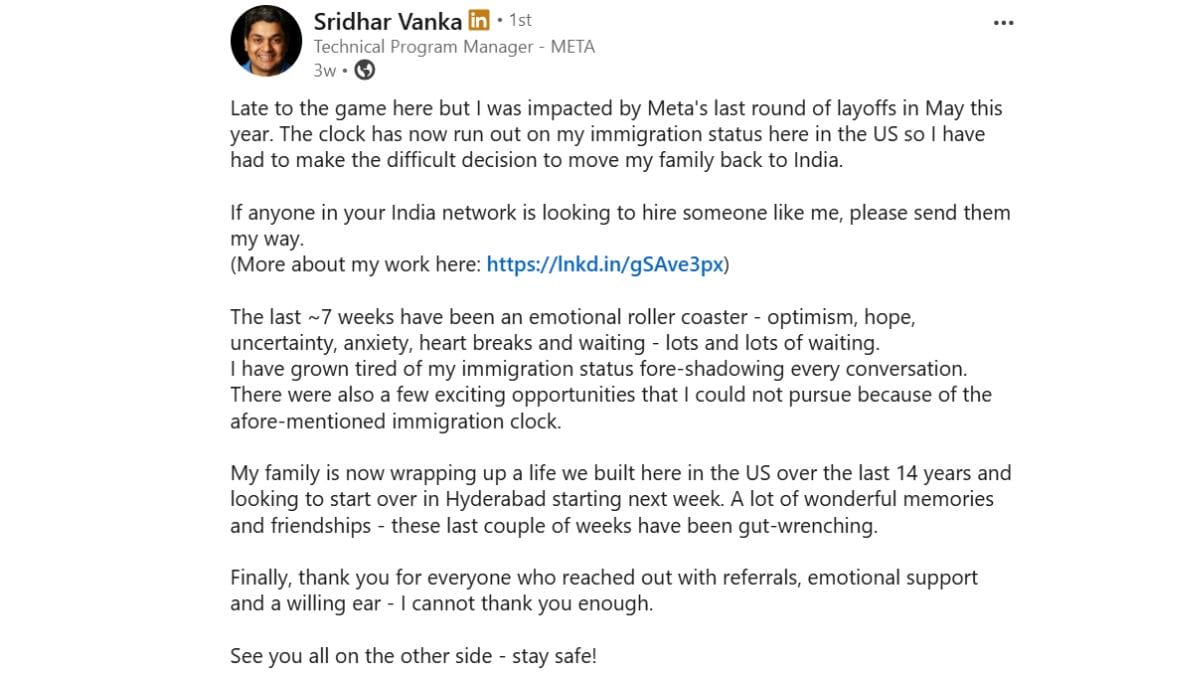
New Delhi: Sridhar Vanka had his eye peeled on the clock. A technical programme manager in the Greater Seattle Area, he was impacted by Meta’s last round of layoffs in May. Vanka had 60 days under the H1-B regime to find another job in the US. For the first 30 days, he tried to maintain calm. But the deadline ran out in no time. The only option available to his family of four was a one-way ticket to India. He’s now back in his hometown, Hyderabad.
“With the current administration, I think it was much more challenging because you have to be very cautious about not overstepping any bounds, even imaginary lines. After the first 30 days, we kind of resigned to the fact that we’ll have to move back and then we started planning for it,” said Vanka.
For hundreds of thousands of Indian IT professionals and their families in the US, immigration status now foreshadows every conversation. There’s a constant sense of uncertainty, exacerbated by harsher enforcement of the H1-B regime under Trump 2.0. The return ticket to India is no longer just a back-up plan. And guiding many of them through it is a small but growing tribe of transition consultants, an HR army that is helping them land on their feet with a job in the motherland.
According to Xpheno, a Bengaluru-headquartered tech talent solutions firm, more than 15,000 IT professionals returned to India from the US in 2025. The trend appears to be holding up this year too, with the number at 7,300 in June. Xpheno told NDTV that these numbers are expected to rise as more Indian techies are “stepping away from the American dream” – a benign euphemism for the stories of many who are being edged out of the American dream by Trump’s anti-immigration politics.
This reverse migration of Indian tech talent from the US was confirmed in July by a survey of 1,276 verified professionals in India conducted by Blind, an online forum. It found that 53 per cent of respondents witnessed people return from the US owing to visa-related uncertainty. Of these, 36 per cent said colleagues or candidates had already returned, and 17 per cent said someone they knew was planning to return.
“Tech jobs in the US have seen a degrowth because of AI and that is fuelling uncertainty. To add to that, tech companies here are now hiring more Americans who at one point weren’t that interested in tech jobs,” an Indian IT professional who has been in the US since 2010 told ThePrint on condition of anonymity.
Back in Hyderabad after more than 15 years in the US, his last job being Vice President of Infrastructure and Engineering at a ‘stealth mode startup’ in Denver, Snehal Kulkarni is still finding his rhythm. The day begins with a car ride to drop his six-year-old off to school, followed by back-to-back meetings with financial planners, potential employers and former colleagues. Kulkarni said there is “zero degradation” compared to his lifestyle in the US, with the exception of traffic.
According to him, many Indian techies in the US want to come back to India, but have very little understanding of how to enter the jobs market here.
“There is no book or anything for any returning NRI to follow. Everything is experience-based. In the past three years, I discovered a lot of gaps that need to be filled,” said Kulkarni, adding that even American visa officers he interacted with were not very happy with changes to the H1-B regime.
Sridhar Vanka, who returned to Hyderabad two weeks ago after more than 14 years in the US, said the uncertainty around H1-B had more to do with enforcement than the rules themselves.
“Even when I had a job, one of the things I always worried about was when I returned to the US after a vacation in India, I may be stopped at the port of entry. The enforcement was a little more uncertain this time, there was a higher threat,” he said.
He recalled how “super aggressive” enforcement of the H1-B regime dissuaded many Indians in the US from attending to family emergencies back home.
“I know of at least one person whose parent passed away. But they didn’t want to return to India, because they feared they might not be able to get back to their job, get back to their life.”
It was a perfect storm that had been building up over the past few years. Trumpian politics is just the latest push.
This shift coincides with a broader post-Covid trend of Indian IT giants reducing their dependence on H1-B visas, while ramping up offshoring execution from India, and American tech companies increasingly opting for nearshoring—hiring talent to work for US clients from Canada or Mexico.
For the nearshoring model, an unintended thrust came in the form of a Proclamation issued by US President Donald Trump in September 2025. It said that certain H-1B petitions filed thereafter “be accompanied by an additional $100,000 payment as a condition of eligibility”.
Job market in flux
Gone is the decade of the 2000s when the returning NRIs were a coveted tag among Indian headhunters chasing them with seductive salaries. Today, the job market in India itself has shrunk.
While seemingly at an advantage back in India owing to their “NRI leverage”, many of these IT professionals are landing in a jobs market that is in a state of flux.
“The job market is bad. I know someone who returned from the US, applied for at least 500 jobs and got only automated responses. Most people start going into a shell,” said Achyut Menon, a Hyderabad-based consultant who has been assisting NRIs manage the transition back to India for nearly 35 years.
Menon added that he handles about 10 such cases each week.
According to him, the Indian IT sector has “never seen more unemployment and underemployment in the last 10 years”.
This view is shared by Nupur Dave, a Bengaluru-based transition consultant and author who assists NRIs with planning their return to India.
“Most of these are mid-career professionals or like younger people whose first job was in the US and now they are planning to come back. It’s a mix but I would say more mid-career,” she told ThePrint.
Formerly with Google in the US, Dave has authored two books: ‘Back Home: An Emotional Guide for NRIs Who Are on the Fence about Moving to India’ and ‘The Unsettled NRI: The NRI’s guide to combating loneliness, pressure and worry’.
To her 1,06,000 followers on Instagram, mostly NRIs, Dave is their go-to person for advice on everything under the sun, from mutual fund investments to office feedback, the Indian taxation system, and the eternal dilemma of two identities.
Dave said she has seen an uptick in the queries she receives daily through her social media handles over the last two years.
“You could say about 30-40 (queries) a month…So, there is a correlation and position thing because my socials (reach) have also grown. More people know about me. But even if that were the same, I do see an uptick because of the AI-related layoffs,” she said.
She added that an NRI’s decision to return to India can be a culmination of various triggers.
“Sometimes it’s event-based; other times it’s a pressure cooker. One person said that I’ve given so much to the country (US) and they’re not giving me anything back for my loyalty. So, why should I be loyal,” she recalled.
According to Dave, most NRIs who reach out to her are worried about their finances, schools for their kids and landing a job upon their return to India.
Explaining the process, she said most NRIs reach out to her through her social media handles after watching her content. The next part of the process is an intro form, which allows her to understand their problem statement and narrow down their concerns. Then comes a 90-minute consultation, followed by a mitigation plan, which involves putting them in touch with the right partners.
“So, if I find that there’s a right person, I know somebody is hiring and I know this person is the right fit, I might just connect them. But I don’t do it actively because a lot of people come saying, please guarantee me a job and nobody can guarantee a job,” she said.
While Kulkarni said he hadn’t yet started his job hunt, Vanka got an early start. He admitted that he did not have a lot of leads until his post on LinkedIn about his final weeks in the US being an “emotional roller coaster” prompted an outpouring of responses.
“They were already reaching out to me while I was on the plane. By the time I landed, they started the interview. And the next day I got an offer,” he said.
Vanka also pointed out that, like in the US, the market in India too is “very obscure” when it comes to big tech firms like Google and Microsoft.
“It’s almost like a solid wall. You don’t know what’s happening behind the wall. You throw your resume in there and you never hear back. Sometimes you hear back if you’re lucky,” he said.
‘Talent comes second’
In the case of many such IT professionals whose life in the US hinges on a stamped piece of paper, the process can turn out to be a punishment.
One such account, shared on Reddit about a month ago, narrates the increasingly fragile nature of the American dream for H1-B holders.
Eleven years chasing the American Dream. He thought he did everything right. Degree, corporate job, buying a car. There was only one unresolved variable in the equation, the H-1B visa.
“You are always one layoff or one lottery rejection away from packing your bags. The background anxiety never actually goes away,” he wrote in a Reddit post on 11 July. Two months ago, he decided he was done waiting in line. He bought a “one-way ticket and moved back to India”. He concludes: “In America, your visa status always comes first, and your talent comes second. Here, I am just a person with skills, looking to add value.”
The rigmarole of securing a work visa in the US has, according to Menon, has become all the more complicated in the past decade as countries become “de-globalised”.
“They are all trying to protect their own nationalities and everybody, for various reasons, have either increased the work visa rates or made it more complicated,” he said.
However, this reverse migration has also led to a welcome change—not all Indian techies living the US are returning to take jobs here, some are coming back to create jobs and opportunities.
“More than 60 per cent of my audience wants to do a business of their own. So you see how curious and excited NRIs are and they don’t know where to start,” said Dave.
Creating opportunities
Nithin Hassan never planned to settle down in the US. The plan was to come back. Having returned to India in 2023 after more than 15 years in the US—including roles with Meta, Amazon and Microsoft—43-year-old Hassan founded Bengaluru-based Dolfyn Brands and B2I Elite Club. Dolfyn Brands offers AI-powered brand solutions, while B2I Elite Club is a community that assists returning NRIs with cultural and professional reintegration.
“Ninety-nine percent of the people who are coming back, they’re not coming back because they want to come back. It’s sort of their last resort. It’s when they’re out of options. When they come back, they’ll be getting one-tenth of the salary,” he said.
Hassan added that nobody is rolling out the red carpet for these NRIs, unless they can leverage their “NRI persona” or rope in investors.
He pointed out that for IT professionals returning to India, “the first priority is to search for other better countries, or even if they come back to India, it’s temporary. When things open up, they still want to go back”.
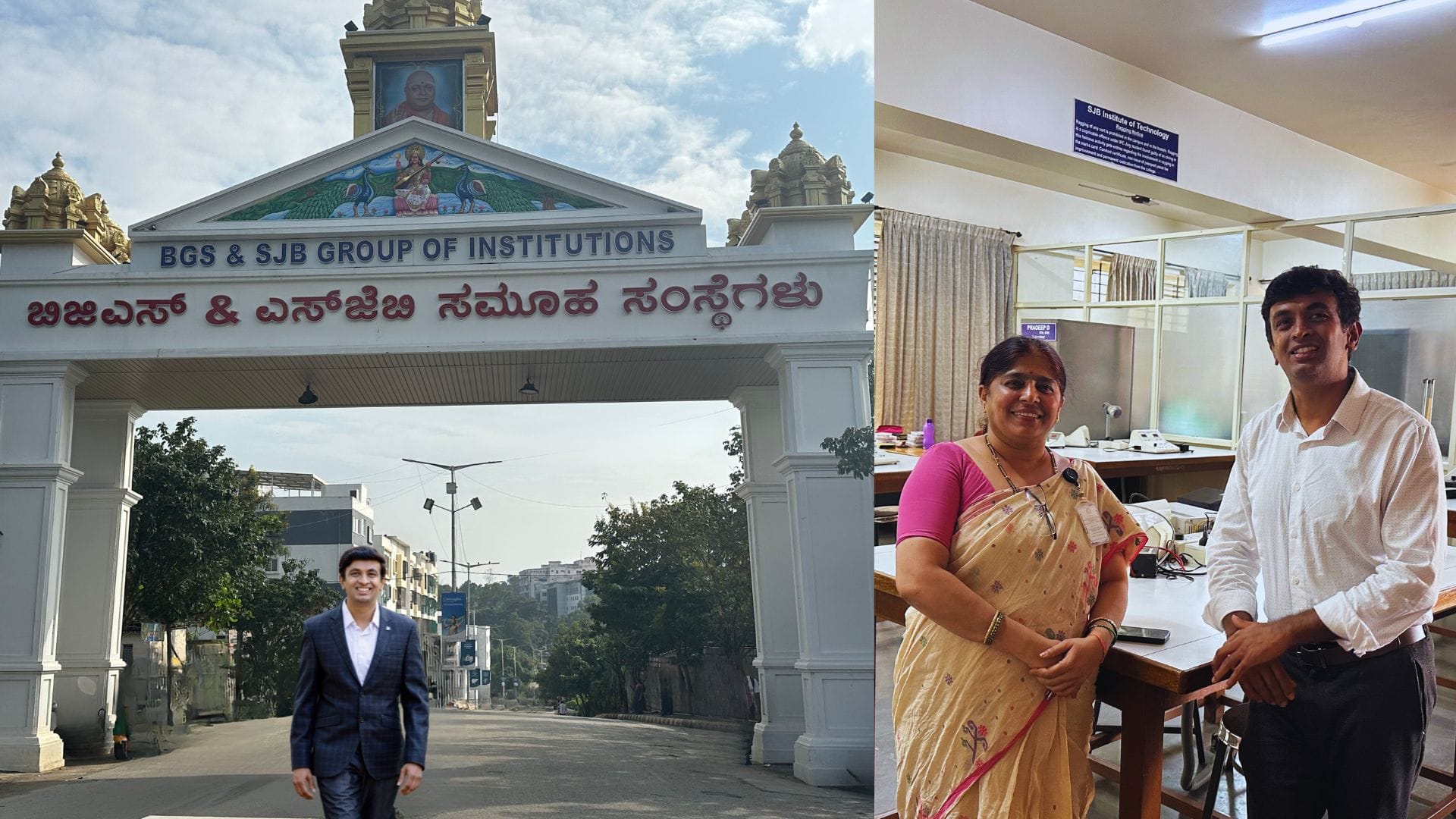
Like Hassan, Prajwal Rajendra Prasad, 35, and his wife Chandana, 33, too had made up their minds a long time ago. Their plan all along was to return to India and do something in the education sector.
“We were doing some sort of mentorship programmes. We were also passionate about education. So even when we came to India, we used to teach science and art to kids in my village,” said Prasad.
Prasad had moved to the US after graduation in 2014 and did his Master’s in computer science at Georgia Tech, Atlanta. His first job was tech lead at Oracle. He was still with Oracle when he moved back to India in November 2024, two months after his wife Chandana—who quit her job with Meta in the US. Prasad eventually quit his job in February 2025.
The move back to India, Prasad conceded, is not easy but “a lot of others are planning”.
“They’re planning out their investments, whether to sell or retain the home in the US, whether to make those kinds of investments here in India,” he said.
Upon his return, Prasad along with his wife launched Polygnan, a student-focused learning and community platform that helps engineering students in Karnataka grow through practical learning, entrepreneurship, AI upskilling, and industry exposure.
This drive to return to India and give back to the country is not the exception, but rather the norm, according to Nupur Dave. They want to be job-creators not return to the motherland as job-seekers.
But, setting up a business in India comes with its own set of challenges.
Also read: Delhi, Mumbai, Kolkata—women are facing ugly pushback after CJP protests
‘Trust deficit’
There are a lot of differences between the US and India when it comes to laying the groundwork for a startup, said Hassan, attributing it to “headwinds”.
“From the infrastructure perspective, government infrastructure, incentive perspective, the way things move in India, it’s very different compared to the US, because the policies are not designed in such a way,” he said.
“Take the example of company incorporation. It takes less than 24 hours for any company to be incorporated (in the US). My experience here has been different. It took almost like four to six months. That’s not the kind of expectation I had from the Indian startup system.”
Snehal Kulkarni shared Hassan’s opinion. Many returning IT professionals want to enter the Indian market but do not know how to, he said. He added that there is a “trust deficit” between employers and prospective hires and that the hiring in India still largely continues on a referral basis.
“They don’t have a system yet to evaluate the profile of returning leaders,” he said.
Kulkarni, however, is optimistic about the India story.
“India will be in a very better position in the next 10 to 15 years. And I would recommend anyone, any leader, if you want to move back to India, start planning, do it in the next three to four years. If you come after five or eight years, there is no use. You will miss the bus,” he said.
For Indian IT professionals returning home as part of this great reverse migration, the feeling is strange, yet oddly familiar.
As summed up in a Reddit post: “The reverse culture shock is definitely real. The traffic is insane, the humidity is hitting me hard and figuring out the right business problem to solve is going to take a lot of work. But hitting submit on an application without the ghost of immigration hanging over my head? I know I made the right choice. It is good to be home.”
(Edited by Ratan Priya)
American tech workers are exposing Indian H1 B visa fraud and body shops ; Tanul Thakur’s Wild Wild East exposed Indian fraud too. That is why they are returning