







Thiruvananthapuram: Jiliyya A.D. travels frequently between her native Elanad village in Thrissur and Ottapalam in Palakkad, where she lives with her husband. Technically, she would be a beneficiary of the free bus ride scheme for women announced by the newly elected Kerala government. But, she says, practically, the initiative would be of no help to her.
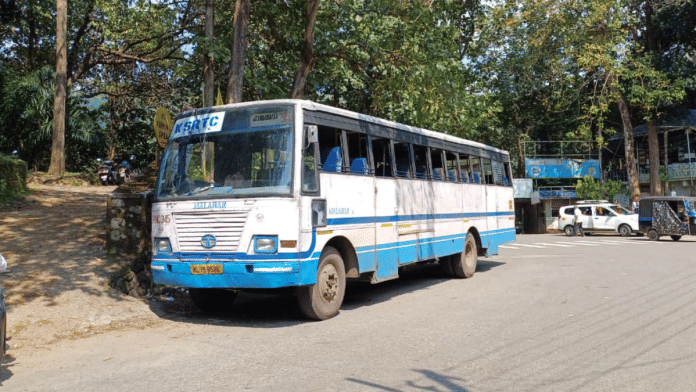
The initiative—approved by the Congress government in its first Cabinet meeting on 18 May—promises free travel in ‘ordinary’ state-run buses. Apart from ‘ordinary’ buses, the KSRTC also runs services such as fast passenger, super-fast, super deluxe, and inter-state.
“The only Kerala State Road Transport Corporation (KSRTC) bus running on our route is a superfast bus at 6.50 am, which goes to Kozhikode. So even leaving early to catch that bus will be of no use,” Jiliyya says.
Her experience highlights one of the key questions surrounding Kerala’s free bus ride scheme for women: whether the benefit will be equally accessible across the state.
While the initiative promises free travel in ordinary state-run buses, the availability of such services varies significantly by region, with many commuters continuing to rely on private buses due to limited KSRTC routes and frequency.
The scheme has also sparked debate over its financial sustainability, given the KSRTC’s mounting losses and dependence on government support. Questions remain over the state’s ability to simultaneously compensate the corporation for the lost revenue and invest in expanding services and improving infrastructure to make the scheme accessible to more women.
Providing free bus rides to women was one of the Congress’s five pre-poll Indira Guarantees. The scheme was first promised by Congress leader Rahul Gandhi at the concluding ceremony of V.D. Satheesan’s Puthuyuga Yatra on 7 March.
The Congress went on to win the polls, and Satheesan became the chief minister.
According to the Satheesan government, women of all ages and transgender persons would be allowed to travel free in all ordinary KSRTC buses from 15 June in the first phase of implementation.
The initiative, named Priyadarshini, is expected to cost an additional Rs 750-800 crore annually to the state government.
Free travel is socially beneficial, but economically it will pinch government and service provider: T. Elangovan, ex-member, Kerala Transport Fare Fixation Committee.
T. Elangovan, former director of the National Transportation Planning and Research Centre (NATPAC) and a former member of Kerala’s Transport Fare Fixation Committee, told ThePrint that while the scheme could deliver social benefits and increase public transport use, the government must decide who should receive it and how both KSRTC and private operators (who fear revenue loss from passengers shifting to state buses) will be compensated for the revenue loss.
“Free travel is socially beneficial, but economically it will pinch the government and the service provider,” Elangovan said.
ThePrint met G.P. Pradeep Kumar, Executive Director (Operations) & (Administration) of KSRTC. But, he refused to comment on the matter.
Also Read: Kerala had a cushion that was hiding its fiscal crisis. UDF’s white paper uncovers it
KSRTC financial stress
One of India’s oldest state-run transport corporations, the KSRTC traces its origins to the Travancore State Transport Department, established in 1937 and formally constituted in 1965. It currently operates around 4,500 buses, carrying nearly 25 lakh passengers daily through its various services.
Of the total buses, 3,125 are ordinary buses, according to official figures.
We will work towards increasing non-fare revenue. We have also received information that people are willing to donate buses to us: Transport Minister CP John.
The recent status report published by the newly elected government states that KSRTC incurred losses in every year under review, leading to a steady accumulation of losses over time. Its accumulated loss stood at Rs 20,961.36 crore for the financial year 2024-25, up from Rs 19,380.98 crore the previous year. In 2019-20, the loss stood at Rs 12,159.10 crore.
As per the state budget 2024-25, the then LDF government under Pinarayi Vijayan allocated Rs 5,002.13 crore during 2016-21, while Rs 4,917.92 crore was provided as assistance to the KSRTC during the first three years of the second Pinarayi government.
Soon after the Congress announced the proposal ahead of the polls, LDF Transport Minister KB Ganesh Kumar said such a move would lead to KSRTC’s permanent closure. ThePrint reached out to Kumar through calls and messages after the scheme was officially announced, but there was no response.
Beloved Rahul Gandhi ji has announced 5 historic guarantees for Kerala — a clear promise that a UDF government will stand with every Malayali.
• Free bus travel for women – empowering mobility, safety and economic independence.
• ₹1000/month for college-going girls –… pic.twitter.com/MWIsCJn0Ry
— Ramesh Chennithala (@chennithala) March 7, 2026
At a press conference on Friday, Transport Minister CP John said that while the initiative would entail a significant financial liability, the burden would not be imposed on the KSRTC as the Kerala government would provide the required amount as a grant to the corporation. He added that the scheme would instead help improve women’s economic participation.
“While deciding on the scheme, the Cabinet and the chief minister assured that there would be greater focus on the KSRTC. We will work towards increasing non-fare revenue. We have also received information that people are willing to donate buses to us. We welcome all such support. However, we have not discussed any modalities yet,” John said.
Defending the scheme, state minister P.C. Vishnunath said the government had announced it with a clear plan.
“The government is directly giving the money to the KSRTC. We knew how to do it before announcing it. There is no need to criticise it. Let poor women travel,” he said.
An official with the KSRTC Officers’ Association told ThePrint that employees of the corporation are largely welcoming the initiative, as the increase in passengers might help expand the KSRTC’s fleet and eventually benefit the corporation, with the government responsible for sustaining the scheme and strengthening the corporation.
“There used to be a saying that KSRTC is going to close forever. But now, that can’t happen. The government has to sustain it,” he said, requesting anonymity.
The officer said that, as per current data, over 75 percent of the total 25 lakh passengers in KSRTC buses are women, and the corporation expects this to increase.
“We thought all buses would be free. But we don’t know how many more (passengers) would come unless a route only has ordinary buses,” he said.
Economic impact, concerns of private operators
While Kerala’s scheme is a first for the state, similar initiatives have been tried elsewhere. Commerce in California became the first city to make bus travel free in 1962, while Luxembourg became the first country to make all public transport free nationwide in 2020.
In India, Delhi’s AAP government introduced free bus rides for women in all Delhi Transport Corporation (DTC) and cluster buses through the Pink Ticket Scheme in 2019. The scheme was later introduced by the Congress government in Punjab, Karnataka, Telangana and the DMK government in Tamil Nadu as part of the poll promises, similar to Kerala.
A 2026 study titled Ticket to Ride: Impact of Free Public Transport on Women’s Workforce Participation in India, by Udayan Rathore and Ashish Singh of the Shailesh J. Mehta School of Management (SJMSOM), IIT Bombay, found credible evidence that free bus schemes increased women’s workforce participation by about three percentage points compared with what would have occurred in the absence of the policy, while also increasing work-related travel.
Elangovan said the scheme might script a different story in Kerala, where female workforce participation remains low despite high literacy levels.
“Here, most women are educated in Kerala. They go out and earn money in Gulf countries or other places. They don’t contribute directly to the economy of the state, except through the remittances they send to their families for sustenance. So, this aspect has to be studied,” he said.
He added that a targeted scheme providing free travel for senior citizens, women from socially and economically deprived sections, and possibly students in government and aided schools would have been a better alternative.
The scheme has also raised opposition from the state’s private bus operators.
According to information acquired from KSRTC and the Private Bus Operators Federation, the number of running KSRTC buses stands at around 4,500, while private buses number around 8,000 at present, down from more than 34,000 in 2011. This is in contrast to neighbouring Tamil Nadu, where state-run buses account for nearly 80 percent of the total fleet.
In Kerala, KSRTC buses outnumber private buses in districts such as Thiruvananthapuram, Kollam, Alappuzha, Kottayam, Idukki, Pathanamthitta, and Wayanad, while private buses outnumber them in the remaining seven districts in central and northern Kerala.
Hamza Erikkunnu, state secretary of the Kerala State Private Bus Operators’ Federation, told ThePrint that private buses in southern districts and Wayanad will not be able to afford diesel from the very first day.
“Over half of the passengers in private buses are women. So if there is a chance to travel free in KSRTC, women passengers will naturally opt for that. That means we will lose over half our daily revenue,” he said.
He added that bus operators are already spending nearly 60 percent of their income on fuel and a large share on employee salaries.
According to the federation, private buses directly employ around 35,000 workers at present. The federation is holding a one-day meeting in Thrissur on June 16 to decide its future stand and present its proposals.
“The state government might give us some subsidy on taxes. But that will not be enough for us. So let them take over our buses,” he said.
(Edited by Ajeet Tiwari)
Also Read: 14 first-timers, 2 women, 2 SC members: A peek at Satheesan’s 20-minister cabinet in Kerala