





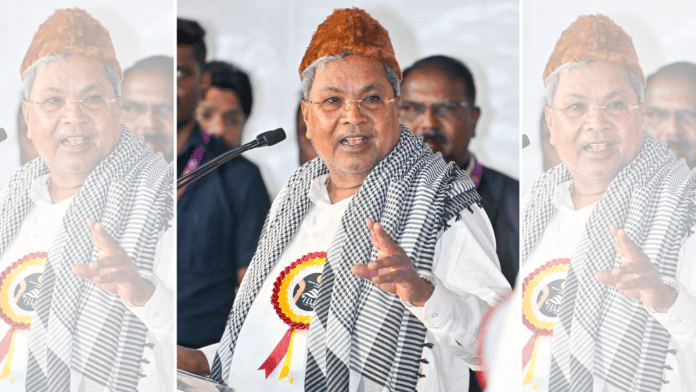


Bengaluru: The Karnataka government’s decision to withdraw a three-year-old order banning the Hijab is part of a strategic move by Chief Minister Siddaramaiah to overcome recent challenges involving his core-support base, according to Congress insiders and analysts.
Siddaramaiah is already facing discontent from a section of Scheduled Caste (SC) groups over the new internal reservation matrix and from Scheduled Tribes (ST) regarding corruption within state corporations. Both communities have also raised concerns over the diversion of welfare funds towards the Guarantees while protests are ongoing about the lack of recruitment into government jobs.
“Since he has an image of being the face of AHINDA in Karnataka, measures on the Hijab are likely to help unlike D.K. Shivakumar whose political platform is not based on these issues,” Phani Rajanna, an Udupi-based political analyst, told ThePrint.
Moves like rushing the decision on internal reservation, Hijab and caste census among others, help him reinforce his image as a leader of the backward and marginalised groups.
Though Siddaramaiah has had a relatively unchallenged stint since he took over as CM for a second time in May 2023, the 77-year-old has been making decisive moves at frequent intervals, forcing the Congress high command to rethink any possible decision of a leadership change in the state.
By linking recent instances of forceful removal of the ‘Janivaara’ (sacred Hindu thread worn by Brahmins) and other Hindu symbols at exam centres with the Hijab order, analysts say that Siddaramaiah has strategically insulated himself from backlash from the majority community and the principal opposition, the Bharatiya Janata Party (BJP).
‘Linking Hindu religious symbols to Hijab’
In its order Wednesday, the Siddaramaiah administration also withdrew the ban on several Hindu religious symbols.
“See, we have not just done this for people who wear the Hijab but also those who wear the Janivaara, Shivadhara, Rudraksh …all of them can wear it according to their respective faiths,” the CM said in Mysuru Thursday.
There have been at least two incidents where students appearing for the Common Entrance Test (CET) were forced to remove the Janivaara before entering the hall, creating a huge uproar by pro-Hindu groups as well as the opposition.
Health Minister Dinesh Gundu Rao, a prominent Brahmin community leader, is said to have raised strong objections to incidents where invigilators forced students to remove the Janivaara.
“In the past, when incidents occurred where students’ dignity was compromised by being asked to remove Hijabs, Janivaras, nose rings, earrings, or other religious symbols at examination centers, I personally expressed strong objection and raised my voice. Our aim was to ensure that students could pursue education without embarrassment or fear. Complementing that firm stance, the Education Department has today announced this important decision,” he posted Thursday.
ನಾಡಿನ ಜನರೇ,
ಕರ್ನಾಟಕದ ಶಾಲಾ-ಕಾಲೇಜುಗಳಲ್ಲಿ ವಿದ್ಯಾರ್ಥಿಗಳ ಭಾವನೆ ಹಾಗೂ ಧಾರ್ಮಿಕ ಸ್ವಾತಂತ್ರ್ಯವನ್ನು ಗೌರವಿಸುವ ನಿಟ್ಟಿನಲ್ಲಿ ನಮ್ಮ ಸರ್ಕಾರ ಇಂದು ಒಂದು ಅತ್ಯಂತ ಪ್ರಗತಿಪರವಾದ ತೀರ್ಮಾನವನ್ನು ಕೈಗೊಂಡಿದ್ದೇವೆ.
ಶಿಕ್ಷಣ ಸಂಸ್ಥೆಗಳು ಕೇವಲ ಪಾಠ ಕಲಿಯುವ ಕೇಂದ್ರಗಳಲ್ಲ, ಅವು ಸಮಾನತೆ ಮತ್ತು ಪರಸ್ಪರ ಗೌರವವನ್ನು ಕಲಿಸುವ ಸಂಸ್ಕಾರ… pic.twitter.com/LM3ykIefm6
— Dinesh Gundu Rao/ದಿನೇಶ್ ಗುಂಡೂರಾವ್ (@dineshgrao) May 14, 2026
Phani Rajanna said that there are no rules restricting clothing choices in exam halls and only electronic devices, phones, smart watches and other items that aid exam malpractice are disallowed.
Since the friction with the Muslim community following the choice of candidates in the Davangere South bypolls, Siddaramaiah and the Congress have carried out extensive outreach to Muslims–considered one of their strongest support groups.
Siddaramaiah has also approved Rs 600 crore for the construction of minority colonies.
Muslim religious leaders held protests after the Congress decided to expel Abdul Jabbar from the party and remove Naseer Ahmed as the political secretary to the CM over their alleged role in backing a rebel candidate against the party’s official choice.
On 16 May, Muslim leaders are scheduled to hold a convention to demand their dues from the Congress, including proportional representation in the Cabinet, government employment and reservation in education.
“Earlier, Muslims had a choice to vote for the Janata Dal (Secular) but since their alliance with the BJP, it is believed that minorities wholly back the Congress. Now, Muslims nurse a feeling that their vote is being taken for granted,” Rajanna said.
Also Read: Why local liquor manufacturers are upset with Karnataka govt’s new excise policy
‘Waited for SC to dispose off the case’
The Congress leaders dispute the claims, stating that withdrawing the Hijab ban was always on the cards.
“This issue has been raised many times but we (the government) were under the impression that it would be sub-judice. But on the advice of (senior Supreme Court advocate) Devdutt Kamat and our Advocate General, we were told that there will be no problem in withdrawing the (February 2022) order,” a Muslim Congress legislator said.
On the timing of the withdrawal, the leader said that the issue was also specified as one of the targets in the Congress’s 2023 election manifesto.
However, the manifesto mentions funds allocated for minorities under the heading, ‘Religious minorities’, a ban on organisations such as the Bajrang Dal and the Popular Front of India (PFI) which promote enmity or hatred, and undoing the ‘distortion’ of textbooks by the BJP. There is no specific reference to withdrawing the Hijab ban, which became a flashpoint in 2022.
Even at the time of the protests, the Congress maintained a stoic silence for at least two months before taking a relatively docile stand on the issue and keeping adequate distance from the campaign led by Campus Front of India, the student wing of the now banned PFI.
BJP firebrand leader C.T. Ravi Thursday said that Siddaramaiah’s order was nothing but a continuation of its ‘appeasement style of politics’ since the order itself mentions a few Hindu symbols but does not represent all religious beliefs that exist in India.
“You (government) have not said that you respect all religions. You have allowed Hijab but said no to saffron shawls. It appears that you are anti-saffron and acting like little Talibanis,” he said.
Ravi added that the order goes against the very decision to have uniforms and uniformity in educational institutions which was intended to maintain equality.
But Harish Ramaswamy, a Mysuru-based political analyst, said that Siddaramaiah has been reactionary with no long-term thinking of its impact.
“There are no long-term impacts of such decisions on the larger socio-economic aspects. The CM has been taking such decisions probably to please certain groups is not in the interest of the party nor the government,” he said.
But the analyst acknowledged that while decision-making is done at the central level, Siddaramaiah is making it harder for them to replace him.
(Edited by Tony Rai)
Also Read: Why Amit Shah’s visit to Karnataka shows just how much BJP needs Yediyurappa