




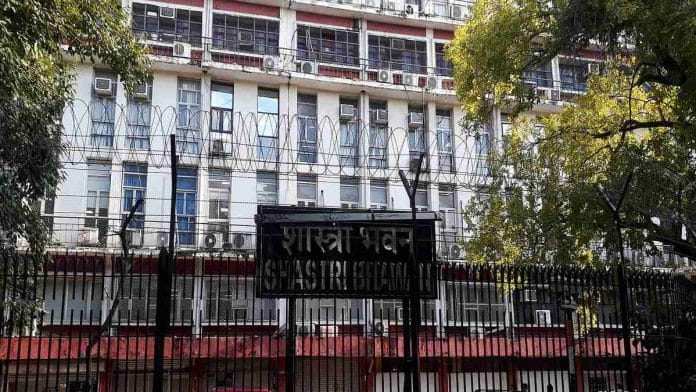

As Shastri Bhawan, a landmark location on Rajendra Prasad Road in New Delhi, gets closer to demolition, murals by Satish Gujral on the façade of the building, which have been there for 60 years, will be among those in search of a new address, as The Indian Express reported recently. While the headquarters of about a dozen government ministries and departments housed in Shastri Bhawan make their way to the swanky Central Vista offices, memories of the place would surely keep it alive for thousands of visitors and journalists, besides those for whom it was a workplace.
The seven-storeyed building, often described as a run-down office and not quite smelling like power corridors are expected to, was rather unique. Unlike other Bhawans, which have been mostly focused on related ministries in a particular building, Shastri Bhawan represented multiplicity like no other. Named after India’s second Prime Minister Lal Bahadur Shastri, this Bhawan served as the headquarters for ministries as diverse as information and broadcasting (I&B), petroleum and natural gas, corporate affairs, coal, education, law & justice, sports & youth affairs, tribal affairs and women & child development, among others.
The collection of so many ministries at one place gave Shastri Bhawan a democratic air and also made it a storied place. For journalists on multiple beats, it was a dream, as going from one floor to another and from one room to another was rather seamless till a few years ago. At the end of a good day, one could be richer by many stories.
It was important to know which lift a certain minister or a bureaucrat used to be able to get that single confirmation that could put a story on the frontpage. Tracking high-profile visitors at Shastri Bhawan (and there were many) was also a bit easier than in some other government buildings because of several pathways, nooks and corners that could be negotiated here without attracting suspicion from onlookers. One could pretend to be going to the coal ministry while actually proceeding to a room in the corporate affairs ministry, for instance.
Sometimes surprises could spring because of the failing infrastructure in the building. This was one. A business tycoon flew in on his private jet from Mumbai to meet a Cabinet minister, who wouldn’t meet industrialists at his residence. The industrialist, who was seeking to enter a new business, reached Shastri Bhawan along with his entourage to make a presentation to the minister. The designated lift for the high-profile visitor refused to work and he, along with his team, had to climb to the minister’s fifth-floor corner office via the stairs. On the way back, the lift functioned.
When media mogul Rupert Murdoch dropped in at Shastri Bhawan more than two decades ago to meet the I&B bureaucracy to discuss Star TV’s expansion plans, he was almost like a showstopper, being chased by Indian and foreign media. Mr Murdoch didn’t utter a word, while his security ensured maximum distance in the narrow corridors of the Bhawan.
While Bollywood stars, including the Khans, could be spotted at times for Censor Board approvals or new projects, some offbeat developments also made Shastri Bhawan what it was. For instance, when the film adaptation of Dan Brown’s The Da Vinci Code sparked protests in India, top Catholic priests of the country gathered at Shastri Bhawan to find a resolution. Also, when the conditional access system controversy was at its peak, prominent cable operators of the country made Shastri Bhawan their second home, even organising pizza parties at the sixth floor committee room, which was otherwise meant for meetings and conferences. No red flags were raised by the officials for the breach.
The binding force at Shastri Bhawan over the years has been the information officers (IOs) attached to the various ministries. Many of them have been household names because of the daily calls and the frequent visits to them — considered a must-do drill for the media. They were the first floor occupants of Shastri Bhawan for six decades, connecting the media to the larger world of policymakers in the upper floors of the same building and elsewhere. Of course, many of them have now shifted a few kilometres away to the National Media Centre on Raisina Road, while retaining their Shastri Bhawan connect.
Shastri Bhawan’s first floor conference room, best known for Cabinet briefings by ministers and the much-awaited snacks that followed, has been another piece to remember. Cabinet briefings too shifted to the National Media Centre some years ago.
Some other things stood out at this Bhawan. Like a few administrative offices managed by the ministry of external affairs for visas and such work — that part of the corridor had glossy walls and an air of discipline.
Remembering Shastri Bhawan — as the final shift to Kartavya Path is round the corner — would perhaps be incomplete without recalling that many Prime Ministers have held additional charge of portfolios whose offices were located here. Now, to the new address.
Nivedita Mookerji @nivmook is a consulting editor at Business Standard. Views are personal.