





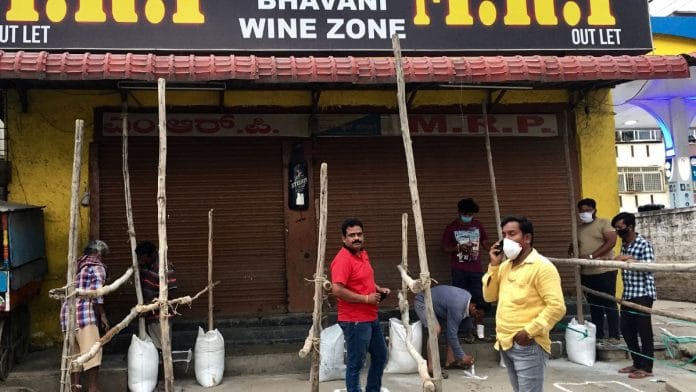


Bengaluru: Small and medium distilleries with operations in Karnataka Tuesday aired their concerns over the new excise laws to the Siddaramaiah-led government which they say leave them disadvantaged when compared to their larger counterparts.
Distillers met Excise Minister R.B. Timmapur and other senior officials in the Vidhana Soudha, a day after Karnataka Excise (Excise Duty and Charges) (2nd Amendment) Rules, 2026 were rolled out. The new rules came into effect after six decades of the earlier ones, which the government said were “outdated in today’s context”.
Under the earlier structure, excise was levied on bulk litres or total volume of liquid in a bottle. The new laws, rolled out Monday, tax the actual alcohol content in the bottle, making it the first such policy across India. The L-AIB (Litre of Alcohol in Beverage) system of reckoning under the new policy is estimated to increase costs for cheaper brands by 20-25 percent, while the prices of premium liquor are expected to come down 10-20 percent.
“The most affected by the new laws are local liquor makers who form the lower four or five slabs. Our prices are going up while [those of] products in the multinational-manufactured premium category are coming down. Local distillers are not getting any support from the government,” one Karnataka-based liquor maker said on condition of anonymity.
Karnataka, like several other states, heavily relies on income from excise in the Goods and Services Tax (GST) era, adding to the importance of the new law. Under the new laws, cheaper brands that fall in the ‘popular’ category with lower alcohol content (25-40 percent) will become more expensive. These brands benefited under the earlier structure since they were charged under a bulk-litre system of reckoning, taxing the entire bottle rather than the specific alcohol content.
Premium brands that have higher concentration of liquor earlier fell under the multi-slab Additional Excise Duty (AED), adding to end price. Popular brand makers rely on thin margins with high volumes, while the removal of slabs and alcohol content-driven taxing reduces prices of premium brands.
The government claims that the new policy will deregulate state-administered price fixation and that product placement within slabs will be left to producers based on market considerations. “For a long time there have been demands to allow producers to fix the quantity of alcohol and corresponding taxes on the same. The Resource Mobilisation Committee has also proposed the same mechanism,” an official said on condition of anonymity.
Income from liquor sales has been a steady source of income for Karnataka, and governments have often resorted to hiking taxes periodically to generate more revenue. Karnataka has set a target of Rs 45,000 crore from the excise department for this fiscal as against around Rs 40,056 crore last year.
Already under pressure due to supply constraints due to the ongoing conflict in West Asia, distillers now face the possibility of seeing their market shares decline as more people prefer to purchase discounted premium brands.
‘Govt addicted to alcohol taxes’
Led by former bureaucrat K.P. Krishnan, the Resource Mobilisation Committee (RMC) has recommended a new regulatory framework which, among other things, has strongly advised against prohibition, deregulation revenue-driven rate-setting or any measures that increase illicit trade risk without countermeasures.
These measures were expected to halve the number of slabs from 16 to eight, which the government claimed, simplifies the process. But distillers claim that the new laws are likely to have unintended consequences like increasing addiction, higher prices forcing people to turn to other intoxicants, and a potential collapse of smaller players.
Managing Director of Amrut Distilleries Rakshit N. Jagdale said that they are “extremely disappointed” with the new laws that put them at a considerable disadvantage.
The RMC has also brought in a social cost of 2 percent of the state’s gross domestic product, approximately Rs 51,000 crore annually. Aruna Urs, founder of Huli Spirits, said that the state government has imported the social cost study which was not even conducted in the state. He said that existing budgets for education or police were not even half of what is being proposed in the new excise laws.
“It looks like the government of Karnataka is more addicted to alcohol taxes than the people are addicted to alcohol itself. And the government sees very easy revenues from alcohol because they are unwilling to do policy reforms in other sectors of the economy to increase the tax base,” he said.
Jagdale said that the duties are far higher for smaller companies but significantly lower for Scotch-producing multinationals. “About 75 percent of the revenue comes from the first five slabs. And there the duty burden on the local distilleries has gone up significantly vis-a-vis, if you look at premium Scotch and luxury products… their duties have come down. That’s why the retail process are dropping,” Jagdale said.
Distillers add that in the past 12 years (since 2016), there have been two increases—Rs 35 and Rs 20—which adds to little since input costs in the same time have shot up to Rs 130-140. The government, however, said that the new laws are meant to strengthen transparency, modernise the excise-related regulatory framework and promote ease of doing business in the sector.
Several distillers have earlier raised complaints of corruption in the highly-regulated department with allegations even against the minister.
High taxes have also forced producers to look for more sustainable options.
“The new laws will not add to the burden of distillers. This is a first-of-its-kind experiment we have introduced where the distiller can choose the slab they want to come under,” Timmapur told ThePrint. He added that the RMC’s final report is awaited and distillers can expect some minor changes in the new policy.
Distillers say that the law has been notified and their only option is to get an audience with the chief minister and place their case before him. “Long-term it will be catastrophic for local distilleries. The government wants to do away with slabs, and want one single slab across the board which is unacceptable to the local industry. It only benefits multinationals,” Jagdale said.
(Edited by Nardeep Singh Dahiya)
Also Read: Why Amit Shah’s visit to Karnataka shows just how much BJP needs Yediyurappa