



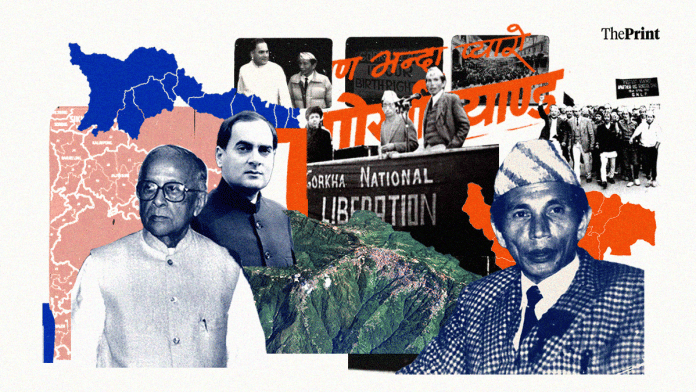
New Delhi: For more than a century, the hills of Darjeeling have been caught in the same political loop – protests, shutdowns, negotiations, a settlement, a brief peace and then – repeat.
Every settlement bought peace. Until it didn’t.
And now, there is a new face in an old story.
Pankaj Kumar Singh, former deputy national security advisor and New Delhi’s latest envoy, is in Darjeeling, meeting leaders and stakeholders, sounding out demands and searching for what the Centre calls a “permanent political solution” to the Gorkhaland question. A new round of talks was supposed to bring new hope. Except, just as Delhi opened fresh rounds of negotiations, the old demand was already back on the streets.
On 10 August, hundreds marched from near Darjeeling railway station carrying placards with just one message: Gorkhaland – and nothing else. The Centre, they said, has three months to act.
For Darjeeling, there is something almost déjà vu about it.
The last time the hills burned was in 2017. Bengal’s three-language formula, which made Bengali compulsory in schools across the state, triggered fresh protests in the hills.
Though Kolkata tried to douse the flames by exempting the hills, the damage was done by then. Police stations were torched. Bricks littered the roads. In Sonada, a late-night medicine run ended with the death of 29-year-old Tashi Bhutia, allegedly in retaliatory police firing. The next morning, the small hill town carried his body through the streets. And for the next 49 days, 108 candles burned silently in his home.
But this streak of violence in the serene hills of Darjeeling began roughly four decades back.
By the 1980s, the crisp air of Darjeeling no longer carried only the aroma of its GI-tagged tea, but of – smoke, tear gas and cries of Aazadi.
Before Gorkhaland
At a massive gathering in Kurseong on 2 June 1985, Subhash Ghising shouted into the microphone: “We Gorkhas in India have been orphaned”. He said that Gorkhas had become “slaves of Bengali in Bengal”. India, he said, had left the Gorkhas “crucified like Jesus Christ” and like him, “the Gorkhas also should be awakened.”
A year later came 27 July 1986 – one of the goriest chapters of the movement.
At the Kalimpong mela ground, CRPF jawans faced a large, angry crowd. Who threw the first stone? Depends on who you ask. What followed was absolute carnage – open firing, violence, and khukuris flashing in the mob.
There’s a history behind it all.
Long before “Gorkhaland” was plastered across Darjeeling’s walls and Ghising made his fiery speeches, these Himalayan hills had already lived through a history of changed hands, shifting borders and redrawn maps. With every change, one question kept returning. Whose hills are these? Could they ever become a state of their own?
The Himalayan chessboard
To ask who Darjeeling belongs to is to untangle a centuries-old knot of wars, treaties and imperial ambition.
Supporters of Gorkhaland would later argue, as Tanka B. Subba wrote in Ethnicity, State and Development, that Darjeeling was never historically part of Bengal. The West Bengal government claimed that the region was never part of Nepal either.
For centuries, much of the hills was the prized possession of the Kingdom of Sikkim. Then came Nepal’s Gorkha rulers, Bhutan’s hold over Kalimpong, and then back to the Chogyal of Sikkim. At last, the British arrived – and spotted something more valuable than just a health resort or a weekend getaway – tea.
In 1835, the East India Company secured the area as a “deed of gift” from the Sikkimese Rajah. Piece by piece, the hills were stitched together into undivided Bengal’s northern crown.
By the 1840s, pristine forests gave way to sprawling tea, coffee, and cinchona plantations. Plantations needed hands, so tribal labourers from Chota Nagpur and Santhal Pargana and Nepali migrants flocked to the hills, bringing their languages and customs. Nepali eventually became the hills’ lingua franca – helping forge a distinct Himalayan identity.
Yet the people who built these hills never quite felt they belonged. India got independence, but somehow that anxiety remained – as white sahibs were replaced by new babus from the plains.
Dawa Pakhrin, President, Central Committee, Gorkhaland Rajya Nirman Morcha Party, said it has always been about identity. “Wherever we travel within India, they will ask us, are you from Nepal? Are you from China? No, we are Indians,” he said.
And so began a century-long search for recognition, identity and autonomy – but never along a straight line.
Demands shifted. Boundaries shifted. Alliances shifted. At different moments, Gorkhas joined hands with Lepchas, Bhutias, and even Bengalis. They sought support from the Congress at one point and the Communist Party of India at another.
The demand also changed. Sometimes the people asked for autonomy. Sometimes a special arrangement. And, most forcefully, as a demand for statehood. There was even a brief call for an independent “Gorkhasthan”.And through every mutation, one desire remained constant: Gorkhas wanted to free from Bengal.
The Demand that refused to die
Long before the hills erupted in smoke and tear gas, Darjeeling’s battle was fought on paper – in ink, petitions, and many ignored memorandums.
As early as 1907, hill leaders representing Lepchas, Bhutias and Nepalis submitted the first formal petition for a separate administrative set-up, amid growing Bengali dominance in local governance and trade. But Darjeeling was too valuable a “gold mine” for the British Raj to loosen its grip.
A decade later, the demand found an organisation. In 1917, Bahadur Rai, Hari Prasad Pradhan, and S.W. Laden La formalised the Hillmen’s Association for a separate territory comprising Darjeeling and the Jalpaiguri Dooars.
From here on, every major turn in India’s political journey brought another petition, another attempt to redraw Darjeeling’s place.
By 1930, the Association yet again petitioned the Secretary of State, Sir Samuel Hoare, that Darjeeling, “where the Gurkha population predominate”, should be “excluded from Bengal” and made an independent administrative unit.
Then in 1943, the demand found a new home in the All India Gorkha League (AIGL), representing a rising class of shopkeepers, businessmen, teachers and intellectuals and a new prospect of Darjeeling joining Assam, wrote Bethany Lacina in Darjeeling Reconsidered. For a fleeting moment, the AIGL even entertained the idea of joining Nepal.
Just as the demands, the alliances too were fluid.
The undivided Communist Party of India (CPI) – whose successor CPI(M) would unleash lathis, tear gas and bullets – worked closely with the AIGL in the mid-1940s.
Realising that “Gorkhalism” carried far greater political weight than Marxism in the tea belts, CPI leaders, on 6 April 1947, submitted a startling memorandum to Jawaharlal Nehru and Liaquat Ali Khan: “Gorkhasthan” – an independent nation comprising Nepal, Darjeeling and Sikkim.
As the clock struck midnight on 15 August 1947, and the tricolour fluttered in the sky, Darjeeling became part of West Bengal.
But the old longing for autonomy did not leave with the colonial masters. During the great 1956 States Reorganisation drive, the AIGL’s pleas for statehood or centrally administered territory were buried – once more.
AIGL leader Deo Prakash Rai rallied the hills, winning six consecutive assembly elections. But, as electoral power grew, grassroots mobilisation for autonomy plateaued – a pattern the hills would see again. When Rai passed away in 1981, the AIGL fractured into internal chaos. In that political vacuum walked Subhas Ghising – ex-serviceman, author and founder of the Gorkha National Liberation Front (GNLF).
Identity, tea and exodus
Ghising did not really need to invent new grievances. He simply tapped into years of ignored petitions, identity crisis, and growing political disillusionment.
“I’m a Bengali, and I don’t mind saying that most Bengalis have seen Darjeeling as a place to holiday. You go for summer or Puja vacations, eat momos, and come back,” said Kanchan Gupta, Senior Advisor, Ministry of Information & Broadcasting. That conveys, as Gupta said, a certain degree of neglect and cynicism of the state.
The anxiety was no longer only about Kolkata.
Across Northeast India, a violent wave of xenophobia was forcing thousands of Nepali-speaking families out of their homes. Houses in ashes, lives stranded – refugees in their own homes.
By 17 September 1986, as reported by The Telegraph, more than 5,000 Nepali-speaking workers had been thrown out of jobs in Meghalaya for not possessing restricted-area entry passes that could only be obtained from Delhi.
The message was hard to ignore – If Meghalaya can do it, what stops West Bengal from doing it tomorrow?
Then there was the region’s economic lifeline – the tea industry – which was collapsing. Between 1935 and 1983, tea plantation land shrank from 25,503 hectares down to 19,739 hectares, wrote Prabhat Datta in The Gorkhaland Agitation in West Bengal. Falling productivity, labour unrest and financial troubles deepened the crisis.
“Darjeeling tea was globally considered the champagne of all teas,” said Gupta. Estate owners, he said, treated plantations as real estate, stripping assets and converting land into holiday resorts. “That created a labour crisis and economic angst.”
By the 1980s, this deepening alienation boiled over into the battle cry: Gorkhaland.
From Petitions to Khukuris
The walls of Darjeeling were screaming aazadi by the early 1980s: “We are stateless. We are constitutionally tortured all over India… It is better to die than live as a slave. All are, therefore, required to fight for Gorkhaland.”
Facing decades of official deafness, Ghising looked beyond India’s borders and on 23 December 1983, he sent a memorandum to Nepal’s King Birendra Bir Bikram Shah Dev. Copies travelled far beyond Kathmandu – to the UN Secretary-General and the governments of the US, UK, France, even Pakistan.
In that memorandum, Ghising claimed that six million Gorkhas were living in India as “degraded human beings”, stripped of their “national spirit, national identity, historical pride”, accusing India of “apartheid and genocide crimes” against Gorkhas.
Those precise words would return to haunt him. It was weaponised by Kolkata to brand the entire movement “anti-national.”
Two years later, however, at a massive gathering in Kurseong on 2 June 1985, Ghising cleared the doubts – he rechristened the struggle not as secession, but a fight for belonging.
“We don’t want to get separated from India; we want to remain within the Indian Union, being its loyal citizens. Simply, we have demanded a separate identity or separate State within the Indian Union.”
Then, he asked, “If the centre can give separate State Bengal for Bengalis, Rajasthan for Marwaris, Assam for Assamese, why we the Nepali, Gorkha can’t get separate State ‘Gorkhaland’ within Indian Union?” For Ghising, the Gorkhas had become “hired tenants” in the land of Gandhi, Nehru, Shastri and Morarji Desai.
The GNLF’s three demands were clear: abrogate the 1950 Treaty, put Nepali in the Eighth Schedule, and create Gorkhaland – stretching to Siliguri, India’s “chicken’s neck.”
The 1986-1988 bloodbath in the hills
The agitation became violent. On 13 March 1986, at a meeting in Ghoom, the GNLF launched its 11-point programme of action. April 13 was declared “Black Flag Day” to protest discrimination against Indian Nepalis, followed by a 72-hour bandh from 12 to 14 May.
Then came the public burning of Article 7, the “reciprocal” clause that made Indian Gorkhas indistinguishable from Nepali immigrants, of the 1950 Indo-Nepal Treaty. Invoking MK Gandhi’s historic “Do or Die” call, Ghising demanded a total boycott of all national holidays – until Gorkhaland was granted.
India Today, on 30 June 1986, quoted Ghising’s warning, “If justice is not given by the Central Government the political situation in Darjeeling will take a violent turn in the future.” And it did.
From May 1986, the serene hills began to shake with violence, arson, and killings. Sanjeev Chopra, former-IAS officer posted there, told ThePrint, “Things were pretty bad. You won’t believe that it was cheaper for the government to send us the helicopter rather than give us a full convoy, because every officer required a convoy of 8 to 10.”
The police were soon overwhelmed. “The West Bengal police had practically given up. Therefore, the CRPF and the DSF had been inducted.” Most GNLF members were ex-servicemen, Chopra said, familiar with ambushes, camouflage and sniper fire.
Yet, the deadliest clashes were between the GNLF and CPI(M) cadres in the tea belt. And soon, a relentless tit-for-tat campaign unfolded.
The Statesman reported on 1 September 1986 that a CPI(M) supporter was killed and others injured in a clash at Som Tea Estate. The next day, CPI(M) MP Ananda Pathak’s house at Sonada was gutted. In retaliation, 500 CPI(M) supporters torched 15 GNLF homes and destroyed 21 others.
House by house. Fire answered fire.
By December 1987, more than 500 houses had been burnt, wrote Subba. Thousands fled toward Siliguri, Sikkim or Nepal.
At the height of the violence, walls carried appeals to Gorkha soldiers: “Please quit the army at once, save our lives and fight CRPF.”
The hills were on fire – literally.
But it was the summer of 1986 that changed everything.
The hills on fire
On 25 May 1986, around 600 armed people gathered at Kurseong Motor Stand, demanding the release of arrested protesters. Their numbers soon swelled to 2,500. Who struck first remains contested. But when tear gas and lathi-charge failed, the SDO ordered firing – killing five.
Two months later came 27 July – Kalimpong.
At the Kalimpong Mela Ground, truth remains buried beneath two warring histories.
The West Bengal government’s Information Document on Gorkhaland Agitation narrates one version – a mob attacked the Kalimpong police station. Knifing one officer to death, striking another in the neck with a kukri, and repeatedly stabbing the DIG. With 25 officers bleeding, police opened fire, killing 13 and injuring 38 others.
Then there was another account.
Citing eyewitness Bikram Khaling’s Blood, Sweat & Gorkhaland (1986), Tanka Subba records a sharply different version. As the procession approached the police station, stones were thrown at the advancing demonstrators. “Thoroughly provoked…the angry mob started pelting the CRPF jawans with the same stones in retaliation.”
Khaling alleged that this was “the opening the trigger-happy CRP jawans were looking for” and that they “simply came out shooting”, leaving the junction “littered with bodies of the dead and wounded”. What followed was vengeance: young men with naked khukuris attacking the forces.
Guns and negotiations
While Darjeeling was burning, its leaders shuttled between Darjeeling, Kolkata and New Delhi – negotiating one day, blaming each other the next. Talks opened; talks collapsed. Bandhs returned. Followed by another round of talks.
As the confrontation deepened, the Gorkhaland question repeatedly came knocking on Parliament’s doors.
On 14 August 1986, Home Minister Buta Singh briefed the Rajya Sabha on the situation. But it was a 1983 memorandum by Subhas Ghisingh to Nepal’s King Birendra that set off an uproar across party lines.
M.S. Gurupadaswamy called it a “clear case of violation of all those things which we, as a nation, stand for”, branding it “an anti-national act.” Bengal MPs Dipen Ghosh and Chitta Basu questioned why the Centre had not condemned it earlier.
“It is not a political charter… we rejected it then and we reject it now,” P. Chidambaram retaliated.
Then Atal Bihari Vajpayee said that there was “a violent riot going on there, with bullets being fired, and people dying.” Why, he asked, had no preventive action been taken when such a dangerous memorandum reached the government? “Is politics stopping Centre from taking action?”
Buta Singh accused him of reducing a national issue to party politics. And then in his classic poetic style Vajpayee replied, “Ab aap samjh rahe hai ki dal mein kuch kala zaroor hai.”
Three months later, on 6 November 1986, the debate was back in Parliament.
CPI(M)’s Saifuddin Chowdhary painted the hills in one devastating line: “Darjeeling is in flames, people are being killed, our offices are being burnt and blood is flowing like anything.” He called the GNLF movement “anti-national”, “secessionist” and “divisive.”
“It is a political movement supported by the imperialist forces,” said Anil Basu of CIP(M), to destabilise India’s unity.
Yet New Delhi’s position was unequivocal.
On 19 September 1986, an Indian Express article made government’s stance clear. In a crowded press conference in Calcutta, Prime Minister Rajiv Gandhi said there was “no question of creating a separate Gorkhaland by dividing West Bengal” and that no constitutional amendment would be allowed to divide states.
By 7 December 1986, an Indian Express article described the ascent into Darjeeling – green GNLF flags lining the roads, overhead banners reading “Welcome to Gorkhaland,” and wall graffiti shouting “Bengal is not our master”.
After his Calcutta visit, Rajiv Gandhi finally arrived in the hills on 20 December — only to find GNLF supporters boycotting his visit and barely 100 people turning up to greet him.
A peace or a pause?
On 14 January 1987, the first serious attempt at conciliation began when West Bengal Chief Minister Jyoti Basu met Rajiv Gandhi and agreed to pursue a negotiated settlement.
Yet for eighteen long months, the hills suffered the same endless political choreography – talks, breakdowns, bandhs, violence and repeat.
The greatest irony was – CPI(M), which had once theoretically favoured a “Gorkhasthan” – now fiercely opposed even regional autonomy. Why? Politics.
“Whichever government is in power in West Bengal will naturally resist having its territory bifurcated. There will always be opposition from that side, always,” said Swaraj Thapa.
The end was finally in sight. On July 25, 1988, a tripartite meeting in New Delhi approved the Darjeeling Gorkha Hill Council (DGHC), officially signed on 22 August at Raj Bhavan, Calcutta. It granted administrative control over local development – backed by central funds, though sans legislative or police powers.
Upon signing, Ghising said, “I have done my duty to my people…Our identity is now established. My duty is over.” It was hardly over.
For the next two decades, Ghising reigned as the undisputed king of the hills, systematically crushing political competition. The very leaders who fought against state domination became the new establishment.
The old loop acquired a new ingredient: politics, power – and opportunism.
The settlement that changed nothing
To Darjeeling, statehood was never a misfit – the Northeast had established clear constitutional precedents.
“If you look at the Northeast, its states evolved through council setups or Union Territories. Meghalaya, under Article 244A, existed as a ‘state within a state’ inside Assam before attaining full statehood,” said Swaraj Thapa.
That was how many hill leaders viewed the DGHC – not as the destination, but as a stepping stone to statehood.
The DGHC’s promised autonomy proved bogus, while massive funds fuelled systemic corruption. What followed was – co-option, corruption and collaboration.
“It was a classic case of politicking, ensuring the issue didn’t snowball into a major crisis, while keeping the local political leadership appeased just enough to manage the situation,” said Swaraj Thapa.
When Kolkata postponed the 2004 DGHC elections, Ghising justified it as necessary for Sixth Schedule status. But the proposal itself alienated many in Darjeeling, who saw the “tribal” designation as demeaning.
That’s when, in October 2007, Bimal Gurung, once Ghising’s second-in-command, broke away and launched the Gorkha Janmukti Morcha (GJM) with a single promise: no Sixth Schedule – only Gorkhaland, instead.
Soon the familiar pattern – shutdowns, gheraos, tax boycotts, road blockades – returned. By March 2008, amid mounting protests, Ghising resigned and fled the hills.
When Mamata Banerjee’s TMC swept West Bengal in 2011, another deal was on the table: the Gorkhaland Territorial Administration (GTA). It came with a bigger brief than the DGHC – control over 59 departments. Gurung swept the elections. But beneath the new name, the old power equation remained.
“All the previous accords failed due to negligence of the state and central government. Because all the control remained with the district magistrate,” said Dawa Pakhrin. “So, what is the meaning of autonomy? Nothing.”
There was widespread disenchantment with how the council functioned, Thapa said. “Development wasn’t happening, the identity issue remained unresolved, and our core aspirations were left unfulfilled.”
Then, in 2017, language lit the fuse again. But the fault line ran deeper than language – or even statehood. “These are very complicated issues,” said Gupta, involving “society, politics, culture, economy.”
For decades, Gupta said, Delhi and Kolkata have handed real authority to transient “suitcase officers” who carry little commitment to local traditions, culture, or economy. And geography complicates everything further. The hills overlook the Siliguri Corridor, India’s strategic Chicken’s Neck.
Also read: Two aircraft, 349 dead at Charkhi Dadri. How liberalisation outran India’s air traffic control
The talks resume
After decades of fruitless settlements, the story has come full circle.
A central interlocutor is in place. Darjeeling is back at the negotiating table. In New Delhi sits a ruling party with a long record of backing the creation of smaller states.
The ball, this time, is squarely in the Centre’s court.
Since Pankaj Kumar Singh was appointed interlocutor in October 2025, several rounds of tripartite talks between the Centre, West Bengal government, and the hill leaders have followed. After the latest round on 22 August, Amit Shah announced a committee, led by Singh, to draft a roadmap for a “permanent political solution.”
“During the tripartite meeting on 22 August, we have given the ball to the central government,” said Dawa Pakhrin. “Now it is up to them to give us justice.”
The promise, however, came months earlier.
At an election rally in Kurseong in April, Shah accused Congress and TMC of “injustice” to the “patriotic Gorkha brothers”, promising that within six months of a BJP government in Bengal, “every Gorkha will have a smile on his face” and that the Gorkha issue would have “such a solution” that they could live in peace.
But what does an ideal solution actually look like?
For some, it is Sixth Schedule status. For others, a Union Territory. And for many, the demand remains the same one that has survived every settlement – Gorkhaland.
The Centre has enough constitutional room to choose from, said Swaraj Thapa. Article 3 gives Parliament the power to create or reorganise states. A Union Territory is another possibility. But whatever the solution, he said, it must be arrived at in consultation with the people.
“We are demanding more than Article 244A, so that after five years, it will be declared a state,” said Pakhrin. Rejecting the sixth schedule status, he said, “Our goal is statehood.”
(Edited by Ratan Priya)