





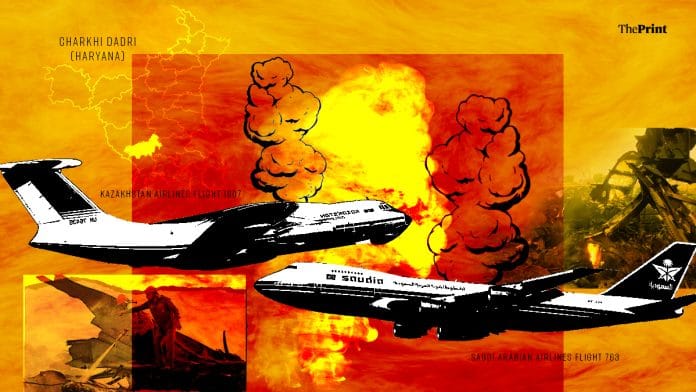

It was around 6:40 pm, and dusk had settled over Charkhi Dadri. In the Haryana countryside, barely 90 kilometres from Delhi, villagers, done with the day’s labour, went about their evening chores.
High above, a US Air Force C-141 transport plane was returning from Islamabad to Delhi via Hissar. That’s when the pilot saw an orange glow flash inside a cloud at his two o’clock. He radioed Delhi Approach.
“We saw something to our right… looks like a big explosion… two distinct fires on the ground.” In the Delhi control room, silence fell. They knew — and then the sky split open.
A deafening roar ripped through the evening – the scream of metal against metal. Windows rattled, the ground shook. Frightened families, believing it was an earthquake, poured out of their homes.
Instead, they looked up to see two fireballs, diverging in the sky, bright enough to turn night into day.
Then came a rain of burning fuel, twisted metal, fuselage — and death.
At the epicentre, terrified villagers found themselves amid shattered metal, the stench of charred flesh and hundreds of scattered bodies – some intact, many dismembered.
It was 12 November 1996. Saudi Arabian Airlines Flight 763 and Kazakhstan Airlines Flight 1907 had just collided in mid-air. Charkhi Dadri had witnessed one of the deadliest mid-air collisions in aviation history.
The tragedy resurfaced on the global stage when RSS Chief Mohan Bhagwat invoked it at Madison Square Garden in New York. On that November evening, 349 people died – every soul aboard both aircraft. And, as the blame game began, one question rose above the rest – how did two aircraft end up in the same piece of sky?
The Saudi 747 had taken off from Delhi at 6:33 pm. Coming from the opposite direction was a Kazakh Ilyushin Il-76, a Soviet-era relic, descending towards Delhi.
What transpired in those seven minutes that turned an ordinary evening into one of aviation’s darkest chapters? The answer, however, does not begin with those seven minutes or in the cockpit. It begins with a sky that was already changing.
The sky before the crash
With the arrival of the 1990s, India was changing. A new era of coalition politics had begun. The economy, meanwhile, was headed for a 180-degree overhaul.
In 1991, India found itself on the brink of an economic collapse. With barely a week’s foreign exchange reserves left, the IMF bailout followed, and with it, India bid farewell to the licence-quota raj.
The Indian economy opened up. So did its skies.
On 29 January 1994, President Shankar Dayal Sharma promulgated the Air Corporations (Transfer of Undertakings and Repeal) Ordinance.
With one stroke of the pen, the four-decade-long state monopoly over India’s skies was dismantled. The two erstwhile state corporations were transformed into new corporate entities – Indian Airlines Limited and Air India Limited.
Liberalisation brought a flood of private airlines – ModiLuft, Damania Airways, Air Sahara and East-West Airlines. Delhi, meanwhile, was fast becoming a busy international crossroads. By 1995, 42 airlines were operating services to, from and through India. But the system below was struggling to keep pace.
Retired pilot Shubhashish Majumdar told ThePrint that the repeal of the Air Corporations Act had pushed traffic sharply upward, even as ground infrastructure lagged behind.
“Delhi at the time had one common corridor for arrivals and departures, because the majority of the surrounding airspace was reserved for the Air Force,” Majumdar said.
And into this rapidly changing, increasingly crowded sky, the Charkhi Dadri incident unfolded.
The two flights
At New Delhi’s Indira Gandhi International Airport, the evening of 12 November 1996 began like any other. Aircraft arrived and departed, radios crackled, controllers watched their screens. But somewhere inside that familiarity, the fates of 349 people were about to converge.
At the centre of it all was VK Dutta, the approach controller and recently promoted senior aerodrome officer. And above Delhi ran Airway G452, a bidirectional highway in the sky, carrying aircraft outbound towards the Middle East and inbound from Central Asia.
On the apron stood Saudi Arabian Airlines Flight 763, its modern Boeing 747 prepared for departure to Dhahran. 312 people were aboard — 23 crew and 289 passengers, overwhelmingly Indian. As author Ray Monte wrote in Collision Point: The Night 349 People Vanished Over Charkhi Dadri, the cabin was a vibrant microcosm of the globalised world of the 1990s — Saudi pilots, Thai flight attendants, Indian ground staff and Filipino engineers. At the controls was Captain Al-Shubaily, with First Officer Nazir Khan and Flight Engineer Edrees.
Among the passengers were businessmen in tailored suits and migrant workers who had spent years building Saudi Arabia’s roads and skyscrapers. And then there were pilgrims – hundreds of them – bound for Mecca in white Ihram clothes and carrying prayer beads.
Cruising toward Delhi from the opposite direction was Kazakhstan Airlines Flight 1907. And the contrast could not have been starker. Flight 1907 was an Ilyushin Il-76, a rugged, Soviet-era relic built to haul cargo and equipment in the “most primitive airstrips from Siberia to the Sahara,” wrote Monte. It was not built for comfort – an austere cabin, temporary seats and engines that were notoriously loud. Kazakhstan Airlines, with its ageing fleet, questionable maintenance and underpaid crew, was teetering on the brink of bankruptcy.
Aboard were 37 people: 10 crew and 27 passengers, most of them Indian engineers returning home after work in Kazakhstan. In the cockpit sat veteran Soviet pilot Captain Alexander Cherepanov and First Officer Dzhangirov. Behind them was radio operator Repp — the sole link between the cockpit and the control room in Delhi. Repp was the only English speaker on the flight deck. Every instruction from Delhi had to pass through him – listen in English, translate into Russian, relay to the pilots, and repeat. All happening at about 1,000 miles per hour.
Everything depended on those words making it across. But what happens when, in a crowded sky, even one link in that chain goes wrong?
The final seven minutes
At 18:33, Saudi Arabian Airlines Flight 763 lifted off from Delhi, its engines roaring as the Boeing 747 climbed into the evening sky, bound for Dhahran. Coming the other way was Kazakhstan Airlines Flight 1907, inbound from Shymkent and descending on the reciprocal course.
In the control room, VK Dutta sat at a flickering green monitor. He was working with primary radar, a primitive system that projects distance and bearing, but remains completely silent on altitude. For Dutta, the only source of information was what the pilots told him.
The Kazakh crew made contact first.
18:34. Six minutes to impact.
“Good evening 1907. Passing through 230 for 180, 74 miles from DPN (Delhi),” they reported, according to the Lahoti Inquiry Commission (1997). Dutta acknowledged them and cleared the Il-76 to descend to 15,000 feet. The crew confirmed.
Then came the Saudi 747. “Approaching level 140. For higher, await.” Dutta cleared it to climb to 14,000.
“Maintain level 140. Stand-by for higher,” Dutta replied. That was the last transmission from the Saudi aircraft to ATC.
Now the two aircraft were on G452. Same airway – one climbing, the other descending – with 1,000 feet of air separating them. In theory, that separation was more than enough. But that separation would not hold.
Then came the first warning. “Identified traffic 12 o’clock, reciprocal Saudia Boeing 747, 14 mi-8 (14.8 miles). Report in sight.” A beat of hesitation. The Kazakh crew, struggling through translation, asked him to repeat.
“Fourteen miles now,” Dutta replied. In split seconds, a third warning followed. “Traffic is 13 mi level 140 (14,000 ft).” The Kazakh crew answered, “Now looking 1907.” Their last words to ATC.
Then – silence. It was 18:40.
On Dutta’s radar screen, the two green blips merged into a single point. They did not separate — and then they disappeared.
As the tail of the Kazakh Il-76 sliced through the wing of the Saudi 747, there was, Monte wrote, a strange calm in the Saudi cockpit — and a soft whisper of prayer: Istighfar and Shahada, offered in preparation to meet their Creator.
The morning after
The next morning, the reckoning began.
India woke to chaos, bewilderment and grief. The headlines blazed. Questions flew. Fingers were pointed. Was it the Kazakh crew? Their shaky English? Their use of metres and kilometres instead of feet and nautical miles? Or was something far closer to home to blame?
“349 die as planes collide mid-air near Delhi,” read a full-page article in The Indian Express.
Foreign media turned their gaze onto Delhi’s overwhelmed infrastructure. The Independent pointed towards a different culprit. With New Delhi’s air traffic having risen by 20 per cent, it reported, “the control tower is often left to juggle take-offs and landings with out-dated equipment,” lacking sophisticated systems capable of giving precise altitude information.
But the Indian authorities thought otherwise. On 14 November, The Indian Express reported, “Civil Aviation officials give clean chit to ATC.” The Washington Post, on 13 November, reported, “Officials rule out traffic control problems, but pose no theories.”
The scale was almost without precedent. United Press International recalled the Tenerife disaster of 1977, when 583 people died. But Charkhi Dadri was different. 349 people had been killed in the sky itself.
On the ground, a massive response was mobilised. Prime Minister HD Deve Gowda and Haryana Chief Minister Bansi Lal rushed to the scene alongside Army and Air Force units.
Standing near the wreckage, a visibly shaken Prime Minister Gowda said, “It is a national tragedy of immense proportions… We will spare no effort to uncover the truth behind this terrifying disaster.”
On 27 November, Civil Aviation Minister Chand Mahal Ibrahim, responding to George Fernandes in Parliament, laid out the geography of the catastrophe. There had been two separate impact sites. The main fuselage of the Saudi 747 had come down in the fields near Charkhi Dadri. The Kazakhstan flight crashed near Barohar village in Rohtak district.
The bodies became the next grim task. The Saudi remains were taken to Civil Hospital, Dadri. Of these, 69 were transported to different parts of India and Nepal by Indian Airlines. The 37 bodies recovered from the Kazakhstan flight were taken to Rohtak Medical College and flown to Shymkent by a special aircraft at 4 am on 17 November.
Almost ten days later, on 6 December, Rajya Sabha mirrored the mood of the country. The government stood in the crosshairs, accused of indifference, bureaucratic lethargy, and presiding over an outdated aviation infrastructure.
The questions came in a barrage. Were international safety standards being followed? Why were outdated systems still in use? And why, after a disaster of this magnitude, had the action been so slow?
K Narayanasamy went straight for the heart of the matter. “Whether it is a custom in the international airport of Delhi that when one flight is taking off, another flight is allowed to land within a short range?… you have only one runway.” This was followed by questions on why compensation had not yet been announced.
R Margabandu followed his lead. “In case of any mishap, State Governments announce compensation for victims immediately, but no compensation has been announced for these victims so far.”
But louder than the anger was the fear. Narayanasamy warned that the disaster had left Indians questioning whether their airports and aircraft could be trusted at all. “This message has gone to the people after this incident, horrifying incident,” he said.
Margabandu had seen that fear take root at home. On 15 November, watching television with his five-year-old grandson as the bodies were being recovered, he told the house that his grandson said to him, “Thatha, you don’t travel by air. From Madras to Delhi and back, you travel by train.”
Surinder Kumar Singla turned his fury directly on Ibrahim, questioning “whether the statement of the [Civil Aviation] Minister is really the statement of the Minister or whether it is a Public Relations Officer’s statement.”
Singla also questioned reports that a new safety system had been procured but remained uninstalled: “Is it true that the system which you had was not installed? Otherwise, this mishap could have been avoided.”
The numbers made the government’s inaction harder to ignore. Singla pointed to a 20 per cent rise in aircraft movements over five years, while questioning why nearly half the funds allocated for airport modernisation remained unspent.
Then the debate took its most sombre turn as Das Gupta turned from systems to people. Citing reports of delays and lethargy in the rescue operation, he argued that had help reached the site with greater urgency, “at least several people could have been saved.” And there was another complaint — one that went beyond radar and regulations. “The relations were not properly cared for, relations were not properly informed,” said Gupta.
While the government shuffled blame, a grieving nation watched in horror. The dead were gone, but for those left behind, the questions — and the grief — kept piling up.
Those who were left behind
Hours earlier, families had embraced their loved ones at the airport gate, unaware it was a final goodbye. Now they were travelling across India, desperately searching for them – or whatever remained.
The Independent, on 14 November 1996, captured the horror, reporting “aside from such things as a shoe or a wallet strewn in wreckage, there was nothing left to identify the bodies.”
Relatives embarked on agonising journeys to claim what remained. The New York Times, on 13 November, reported, “many of them in buses and cars, that took two days to reach.” Some travelled nearly 800 miles, only to find little official help reaching the remote crash site or hospitals where the bodies had been taken.
Left to wander aimlessly over bumpy rural roads, grief-stricken families hunted twisted metal for passports, jewellery, or familiar fabric.
For days, families waited for officials to complete the paperwork needed to release the remains, while also fighting off “coffin touts” offering black-market death certificates and embalming. At Charkhi Dadri hospital, the New York Times reported, bodies, badly mutilated or unrecognisable, were laid on blocks of ice in corridors, “causing rivulets of blood to run as the ice melted in the 80-degree heat of the Indian autumn.”
And amid it all were the villagers. Thousands gathered at the crash sites, bringing water, cooking meals over wood fires and passing around cups of tea to strangers whose lives had been shattered overnight.
The visuals were unimaginable. But perhaps the most haunting accounts came from those who walked into the wreckage and saw it first-hand.
Vishnu Som, then an NDTV reporter, was among the first journalists to reach the site. In a conversation with ThePrint, Som said that he and his camera person Tulsi drove there in a white Maruti Omni, navigating the suburbs of Haryana without mobile phones, maps or proper roads. The first sign that they were close was a distant, eerie fire burning in the fields.
They got out and walked towards it. In the fading light, Som could make out strange clumps scattered across the field. For a moment, he thought it was gobar (cow dung). Then they switched on the camera light.
“I suddenly stopped because I felt that, oh, God, what on earth is all of this?” They were human remains – burnt bodies, many incomplete, some hanging from trees.
Near the impact crater, Som watched two men lift a body, one by the legs, the other by the front. “And it sort of split in their hands. It was just bizarre, frightening and morbid.”
Then there was a harrowing photograph published in India Today, on 30 November 1996, that needed no caption: three passenger seats from the Saudi jet, joined together — and a lifeless passenger still in one of them.
For Natasha Badhwar, then an NDTV journalist, the horror stayed long after she left. In her book My Daughter’s Mum, she recalled stumbling upon the first dead body she had ever seen.
“The smell of burnt flesh would linger around me for days after I returned from Charkhi Dadri. I would bathe many times over and I would still be able to sense that acrid smell in the air.” She eventually threw away the shoes she had worn while walking over the dead.
As the smoke cleared over the scorched fields, the wreckage left behind a mounting trail of questions. Who turned the evening sky into a mass graveyard? Was it a controller’s mistake, a warning lost in translation or a system that had been stretched beyond its limits?
The answer would arrive nearly eight months later, when the Lahoti Inquiry Commission submitted its report on 15 July 1997.
The verdict
The Court of Inquiry, headed by Justice Ramesh Chandra Lahoti, reconstructed the final seconds and exposed a terrifying chain of failures.
The two aircraft were meant to pass with 1,000 feet of vertical separation, fully in line with ICAO standards. Saudi 747 did exactly what it had been told. The Kazak IL-76 did not. Its flight-data recorder showed the aircraft at about 16,439 feet, just 77 seconds before impact, even as its radio operator told Delhi ATC it had “reached one five zero.”
The Commission’s final verdict was uncompromising: “The root and approximate cause of the collision was the unauthorised descending by the Kazak aircraft to FL-140 and failure to maintain the assigned FL-150.”
“Direct pilot-controller communication was not established,” the report stated. Every exchange with Delhi ATC passed through the sole English-speaking radio operator. The pilots themselves had an “inadequate knowledge of English language… resulting in wrong interpretations of ATC instructions”.
Dutta was cleared of blame. His instructions were precise, his equipment functional. Yet, the blame couldn’t be pinned solely on the Kazakh crew. The tragedy was built on language gaps, a bankrupt airline, and missing safeguards – all of which came crashing down at 1,000 miles per hour.
But India’s own system hadn’t caught up.
“Aviation safety is an evolving process. Different incidents take place, and new systems come in place as a response to it,” says aviation journalist Ashwini Phadnis. Just as fortified cockpit doors followed 9/11 and psychological screening followed Germanwings, the Charkhi Dadri disaster forced a total overhaul of the skies.
“Incoming and outgoing routes were the same. After the accident, these two-way corridors were permanently split into separate routes,” says Shakti Lumba, a retired pilot. Then came TCAS, the airborne collision-avoidance system, which became mandatory. Radar systems were upgraded too, though the old sets could track aircraft only within roughly 50–60 miles but was blind to their altitude.
The Commission also pushed for institutional accountability — a senior ATC element within the DGCA, and a dedicated Member (ATC) on the Airports Authority of India’s board — along with strict enforcement of ICAO English-proficiency standards for pilots. S-mode transponders followed, allowing aircraft to exchange altitude and identification data.
They were 349 lost souls, silenced in an instant over the quiet fields of Haryana. But in their wake, the disaster permanently rewired the Indian skyways.
(Edited by Prashant Dixit)