







On returning to Delhi University, I found that something of the student movement from elsewhere had found its way to India but only in a small, marginal way. Less marginal was the development of some leftist movements in India—that of the Naxals or the CPI(ML) (Communist Party of India [Marxist–Leninist]). Naxalism was essentially a rural movement. There were students who wanted to go to the villages to work. Some among them insisted that they would go as cadres of the CPI(ML), or as Naxals, despite the fact that Naxals were now regarded as antisocial elements and terrorists and were being picked up by the police, or were meeting a worse fate in an ‘encounter’. Violent confrontations between those committed to revolution as a solution to current problems and the police or local authority became more frequent. References to Mao in their writing led to some being called Maoists, although there was much confusion in applying the label.
The Naxals were so named after the first big confrontation in Bengal in an area called Naxalbari. The self-contradictory and therefore meaningless term ‘Urban Naxal’ currently used to condemn independent intellectuals is wholly inappropriate. It is more a sign of the anti-intellectualism of those who use the term and who are generally unaware of its connotation. The confrontation has not stopped over the years and has instead become a kind of permanent civil war in one part of the subcontinent. It is also used to silence those thought to be troublesome by the authorities.
Many of us in the Delhi University faculty argued with students who were enthused by the Naxal movement. Their enthusiasm was impressive, but it was also upsetting as they could not see that if they did go to work in the villages, they would still have little or no integration with rural society. We could only try and dissuade them. Student protests at one level sharpen perceptions of the Indian university scene, filling in a grey area of contact with students and their problems. The visions that some students had—even if only a tiny percentage—did question some of the complacency of others. They planned their lives around comfortable city jobs and their perks, which I didn’t mind, but we still had to recognize that society works better when its forms are debated. Those of us who are mentors to students have to be particularly sensitive to these debates.
Occasionally a desperate parent would come to see us, wanting us as teachers to disabuse their children of Naxalism. There were some hilarious conversations, and some full of desperation, clearing the mist on each side! My view was that we should discuss their intention seriously in our efforts to dissuade them.
Also read: Andhra women were ready to abandon their husbands for the swadeshi movement
I personally learnt much from conversations with those whom we were teaching, as, for instance, their opinion about the subjects we taught them. Did this equip them for a future in existing society? This gave me a glimpse of how the young saw the world around them, so essential to the context of education. The projection of my own once youthful thoughts onto the next generation and the dynamics of nationalism in which we forged our thinking had already been superseded in these young minds. Nationalism was no longer concerned with expelling the alien, but rather that the alien having been expelled, how do we battle the inequities in our own society? This was the logical next step. What was debatable was the method to be used.
As we grow old, we still insist, perhaps even more so, on projecting our early experience and commitments onto the young—sometimes even without a full understanding of the situation. Naxalism seems to be a case in point. Those in authority have always treated it entirely as a law-and-order problem, where all Naxals are to be punished for their beliefs and their actions in opposing the state. Hence the police accused and still accuse those who have Leftist literature in their homes of being Naxals and therefore anti-national. They have a large number of people to pick from since there are those who still read on the subject merely out of intellectual curiosity.
There were others, such as some of us, who recognized that the stir arose from not just a law-and-order problem; it was a crisis of many dimensions. Young people were wanting more from their education than just a degree. It also reflected a concern for the dangers that Indian society might face, and how were they to avoid these? The violent solution they propagated was certainly not desirable, but that there was a problem was undeniable. Historically, Indian society continues to be at a point of enormous change—a fact that cannot be set aside. The problem lies in the lived experience of those sections of society that are facing socio-economic problems. These are not adequately addressed by those governing. Naxalism at one level draws attention to these problems, but does not have the solutions.
Much of this made me think of the historical dimension to this, which has been expressed in many societies in various ways. India was not unique in this. Why were so many people committed to opposing the state? What had it done to them, or not done for them? Even those who are squelched have a voice and every right to scream. The scream may take many forms: in India, there was no invitation to students to man the barricades as in Paris, or to examine the files in the administrative offices as in Oxford. The concerns were about moving towards a society that was meaningful to daily living and one that gave them access to knowledge systems.
Predictably, many of those students who wanted to become Naxals and with whom we came into conflict finally landed middle-class jobs, the flavour of their radical past being a passing romance, if that. Were these Naxals? The question remains open and pertinent even to present times. The actual Naxal movement refers to other kinds of people with different commitments both to themselves and their society. There have of course been divisions in political movements and in political parties in the past, as there are today. For some it was the minutiae of ideological theory and for others it was the result of manning institutions, from trade unions to barricades, and for yet others it concerned lives that needed to be, and still need to be, bettered. Governments fail to recognize the difference when they arrest persons indiscriminately and accuse them all of indulging in terrorism.

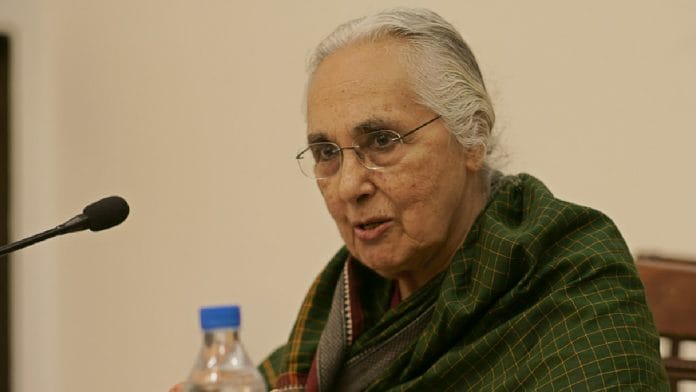
This excerpt from ‘Just Being’ by Romila Thapar has been published with permission from Seagull Books.