





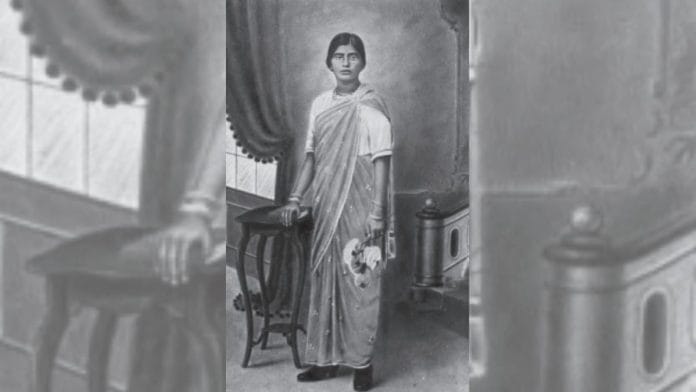


I am really vexed living in Chataparru and wasting my life. I feel that I will be spoiling my life, if I live at home [for long]. I am seriously thinking of joining Gandhi’s ashram…. Once I decide, I pray to my parents to leave me to dedicate myself to the motherland. My love! You please help me in this. I just do not want my life to be wasted; yes, I will not allow it to happen. Please help me…. Please do not reveal my plans of joining the ashram to anybody. I am very much worried about it. May God bless me! My beloved! Help me; help me, please—Annapoorna Devi’s letter to her husband, dated 16 November 1919.
The letters of Maganti Annapoorna Devi, a prominent nationalist and feminist intellectual activist, amply demonstrate the strong appeal of the Indian national movement for women in the Andhra region, how deeply it influenced them and the ways in which they engaged with it.
Annapoorna Devi (1900–1927) was the only child of Kalagara Ramaswamy and Pichchamma and was born in Chataparru. Unlike many others, her reform-minded parents decided to educate her. She received her elementary education in Eluru and later joined a Mission School in Guntur. Although her parents were not wealthy, they sent her to Calcutta, where she studied in a Brahmo Girls’ School and lived in the home of the famous Brahmo leader Hemachandra Sarkar. She passed the matriculation examination in Madras, appearing as a private candidate. In 1920, at the age of twenty, she married Maganti Bapineedu. The letters excerpted here are all addressed to her husband, Bapineedu. In one of them, she states:
I feel sorry for not being able to write to you for two to three weeks. I could not write for one week because I had been to Bezawada [Vijayawada]. Two lakh people came to see Mahatmaji [Gandhi]. I had the fortune of seeing Sarala Debi. In Bezawada and Eluru, I welcomed the Mahatma on behalf of women. Initially, I was scared to approach the Mahatma. Because the responsibility of inviting fell on me, I discharged the duty…. In Bezawada, when Mahatma Gandhi asked me as to what I would offer to the nation, I had offered two pairs of [gold] bangles. When he came to Eluru, I offered all my remaining [gold] ornaments to the nation.
Now, I have no ornaments except a bangle each in the hands and the ornament you tied in my neck as a mark of our marriage. You will be surprised to see the clothes I am wearing. I will use only the handwoven cotton cloth until the achievement of Swarajyam…. Both of us will have to boycott the foreign cloth till our death…. Wherever you see, you will find the charkhas. The charkha is not an ordinary thing. That is the wheel of Vishnu. The sound it generates is nothing but the majestic sound of the Vedas.… If we conduct according to the Mahatama, we can achieve Swarajyam in just six days…. Ours is a non-violent sacred movement…. Is the Mahatma an ordinary mortal? No. He is not. There seems to be some magical power in him.… I am ready to sacrifice even my life and follow his orders–Annapoorna Devi’s letter to her husband, dated 12 April 1921.
Annapoorna Devi and Maganti Bapineedu’s match may be termed a ‘reform marriage’ on several counts. The marriage chants were recited in Telugu, rather than the usual Sanskrit and the priest was a non-Brahmin. In 1920, the year of their marriage, Bapineedu left for the USA to pursue higher education in agriculture. Annapoorna, too, had planned to study in the US, but the call of nationalism stopped her; when confronted with these contrary pulls, she embraced nationalism happily.
Annapoorna Devi always wore khaddar clothes and moved from village to village selling swadeshi clothes and propagating nationalist ideology, incurring the displeasure of her in-laws. Women of that era remembered her fiery speeches. She disliked foreign clothes to the extent that she burnt all her wedding sarees, each worth Rs. 500, a large sum at the time. In Vijayawada, when Gandhi asked women to make donations for the national movement, she immediately donated her gold bangles.
When a surprised Gandhi asked ‘if she had the permission of her parents’, she promptly replied that ‘they would not object [to] her decision’. A staunch follower of the swadeshi movement, when her husband returned to India, she went to see him at the port itself, flung his foreign clothes into the ocean, and gave him khaddar clothes. She established the ‘Sri Mohanadasu Khaddaru Parishramalayamu’ at Eluru to popularise Khaddar and attended the Ahmedabad session of the INC in 1921.
I heard that Gandhiji showed them to many in Bombay… Since 1 August, there is not even a single foreign cloth in our home. My heart’s suffering is beyond description when I see foreign made clothes… Sixty crore rupees are drained from this country. Because of this, six crore Indians are suffering from abject hunger. Use of Swadeshi clothes gives life to many [of our Indians]. Is it strange to burn such clothes? How does it matter, even if it is a wedding saree? That, too, is equal to poison. Out of ignorance, we had committed a number of sins. Do we need to continue with them still?
Without asking you, I offered your wrist watch and [gold] ring to Tilak Swaraj Fund. I did that assuming that you would agree to that. Do those, who are ready to offer their life to the nation, care for wedding clothes and ornaments? I am not doing all these things for earning people’s appreciation. Though I am doing it secretly, information is leaking out. I am very much embarrassed. I am worried that I am unable to serve the nation more and more. I think how much more I would have offered to the nation, had I been a millionaire and feel sorry for not being that–Annapoorna Devi’s letter to her husband, dated 23 November 1921.
Given the strong nationalist feelings they possessed, it is no wonder that women like Annapoorna Devi were prepared to sacrifice everything, including their lives, for the sake of the nation, questioned husbands and were even prepared to ‘abandon’ them (even if rhetorically) to enable service to the ‘motherland’:
You have escaped immediately after marriage. I do not know how much more time I will have to await you? You do not love me. Maybe you got a number of educated and beautiful women there! Am I of any more use to you? Perhaps you treat me like a cheap animal after your arrival here! The attitude of the foreign returned people is like this. My sadness is equal to my happiness with regard to your arrival. Happiness is natural. But why am I sad? It is because I am afraid that you may enter government service.
I am scared that you may not put on the Swadeshi clothes and burn the foreign clothes and that you may not take part in the Non-Cooperation Movement and thereby earn me accusations. When I am suggesting other women to serve the nation even by abandoning their husbands and if you conduct against my wishes, I may have to commit suicide. For that I am preparing myself right from now. … You use the foreign clothes you have with you there. Take a photograph on nationalist lines by putting on the wedding clothes, i.e., panche, chokkayi and kandua. … Do not get new pants stitched. You do not need them here in India. We should burn all your foreign clothes the moment you deboard the steamer–Annapoorna Devi’s letter to her husband, dated 22 February 1922.
When women, who do not know what politics is, are going to jail how can you step back? Is your life more precious than the lives of women? Are you weaker than women? Are you ignorant? If new people do not join the movement to sustain it, how can Swaraj be achieved? … I believe that, if at all you have any love for your wife, you come to India soon after the examinations. Will you not come to serve India even when you hear that I am jailed? You are not so stone-hearted. I am thrice certain. You will certainly come. If you treat that your wife’s life is your own life, come immediately after the exams. If you do not come, you will reap its fruit. Do as you like. But you will suffer all your life. Coercing somebody into serving the nation is of no use at all. Is not your heart melting even after learning that the Mahatma is jailed? For whose sake Swaraj is? Is not it for the sake of Indians? Are you not an Indian? How long will you forget your mother land and be there in a foreign country? –Annapoorna Devi’s letter to her husband, dated 6 March 1922.
Apart from her activism as a nationalist, she was a scholar, polyglot and translator with exceptional oratory skills. A girls’ nationalist school named Annapoorna Devi Jaatiya Paathashala was established in Eluru to keep her memory alive after her death.
Women from the Andhra region played a significant role in India’s freedom movement. While identifying a precise starting point is difficult, we have already noted that women from the region were politically active and participating in the public sphere through women’s organisations and by running women’s journals, well before M. K. Gandhi entered the stage of Indian national movement. The Gandhian movement further expanded their arena of activity, diversifying and intensifying them. Many women from Andhra attended the Calcutta Session of the INC in 1917. When Annie Besant, an important Home Rule leader, was arrested in 1917 in Ootacamund, a large number of women participated in protest meetings organised in places such as Guntur, Vijayawada, Kakinada, Machilipatnam, Madanapalli, Bellary, Cuddappah, Chandragiri, Eluru and Tenali.
Large-scale participation of women from colonial Andhra can be seen from the launch of the Non-Cooperation Movement in 1920. The Chirala Perala Movement and the Pullari Satyagraha in Palnadu in 1921 provided a fillip to women’s direct resistance to colonial dominance. The people of Chirala and Perala protested against municipal authorities in 1919 for a tenfold increase in taxation, from Rs. 4,000 to Rs. 40,000. This resulted in massive protests, memoranda submitted to the government and a no-tax campaign by the people. The colonial government arrested 12 protesters for refusing to pay the tax. One of them was an elderly woman named Ravuri Alivelu Mangatayaramma, perhaps one of the first women to be put behind the bars for a political offence. The magistrate’s court in Bapatla awarded her a seven-day jail sentence.
Gandhi advised a mass exodus to nullify the imposed municipality. At midnight, 25 April 1921, under the leadership of Duggirala Gopalakrishnaiah, 13,573 villagers (out of a total population of 15,326) evacuated Chirala Perala and moved to makeshift set of improvised shelter named Ramnagar. D. S. R. Rao, a correspondent of The Hindu who visited the place, remarked that ‘it was a sight to watch them and their furniture move from their old homes to their new parnasalas’. They experimented with the idea of a parallel government, establishing panchayat representatives of all communities, passing necessary legislative enactments, and issuing administrative orders. They spent 11 months in this manner, until Gandhi called off the Non-Cooperation Movement following the violent Chauri Chaura incident in 1922. As of now, no historical records are available to assess the impact of the event on the lives of women involved in the movement.
Defiance of colonial forest laws was a significant aspect of the Non-Cooperation Movement in Andhra and depended on women’s active involvement. The people of Palanadu had to pay an exorbitantly high tax called ‘Pullari’ for letting their cattle grazing on forest land. They suffered constant persecution at the hands of the subordinate staff of the forest administration. As the colonial administration paid no heed to their demands, the people organised a social boycott of forest and revenue departments.
Amid drumrolls they announced that no washerwoman or barber would serve the officials and the boycott grew to a complete suspension of essential services to all government officials. Unnava Lakshminarayana and Madabhushi Vedantam Narasimhachari, who were deputed by the Andhra Pradesh Congress Committee (APCC) to lead a peaceful protest in Palnadu, were arrested in Macherla. Protesting the arrest, the former’s wife, Unnava Lakshmibayamma led a massive protest in Guntur and a no-tax campaign in Palnadu. The Andhra Patrika issue of 17 August 1921 reported that ‘when Unnava’s wife hailed her husband on his arrest in Guntur, hundreds of women steered the chariot of Swaraj with their gentle hands…. In this, you can see the outpouring of people’s power.’
The situation escalated in February 1922, when Swaraj was proclaimed in several villages. On 26 February, on the outskirts of Minchalapadu, when the police seized 50 goats and 120 buffaloes that had been sent to graze in defiance of forest rules, the posse was attacked by a crowd of 200–300 men and women. In the firing that followed, Kanneganti Hanumantu, one of the leaders of the Palnadu struggle, was among the people killed. In the aftermath, 9 women and 28 men were arrested.
Also read: Nehru’s enthusiasm, Jinnah’s silence, and Gandhi’s baffling indifference to Mohenjo-daro
The AICC session held in Kakinada in 1923 acquired greater significance due to these events. A number of women came forward to render their services as office-bearers and volunteers. Duvvuri Subbamma was one of the chairpersons of the Reception Committee. A 15-year-old Durgabai (later known as Durgabai Deshmukh) recruited many women as volunteers but could not work herself because she was too young. For women, the experience of leaving their homes, their villages and their families was enormously liberating. This was a period when Duvvuri Subbamma, Ponaka Kanakamma and Unnava Lakshmibayamma ‘exceeded the men propagandists in their ability to sway large masses of people’.
The Salt Satyagraha Movement further intensified women’s nationalist activism. In March 1930, the APCC decided to launch the Salt Satyagraha simultaneously at several places. The centres were: Mypadu (Nellore District), Machilipatnam (Krishna District), the beach opposite the town Hall in Visakhapatnam, Mettapalem and Chollangi villages in Kakinada (East Godavari District), residence of Konda Venkatappayya in Guntur and Berhampore and Naupada in Srikakulam District. The movement was inaugurated on 6 April 1930 in the East Godavari District where a large mass of people broke the Salt Law at Chollangi.
Women in Andhra began to make salt in Guntur near the home of Konda Parvatamma, wife of Konda Venkatappayya, inviting lathicharge and arrest in Mypadu of Nellore District, near Chinnapuram in Bandar, near Vadarevu in Chirala, etc. In Guntur, as the girls of Sharada Niketanam, a nationalist girls’ school established by Unnava Lakshmibayamma, applied vermilion marks to the foreheads of the satyagrahis, singing nationalist songs, the satyagrahis broke the Salt Law and courted arrest. A total of 200 people, women and men, walked five miles to the camp at Vadarevu, made salt and returned home.
The Satyagraha camps in Devarampadu, Nellore, Komaravolu ashram and Angaluru ashram worked tirelessly during the Salt Satyagraha. Women assumed leadership everywhere. Unnava Lakshmibayamma went to the Devarampadu camp. The batches of Satyagrahis, who came to the camp, would halt at every village they passed through holding meetings.
 This excerpt from Shaik Mahaboob Basha’s ‘Scripting a New Gender Politic’ has been published with the publisher Orient BlackSwan’s permission.