



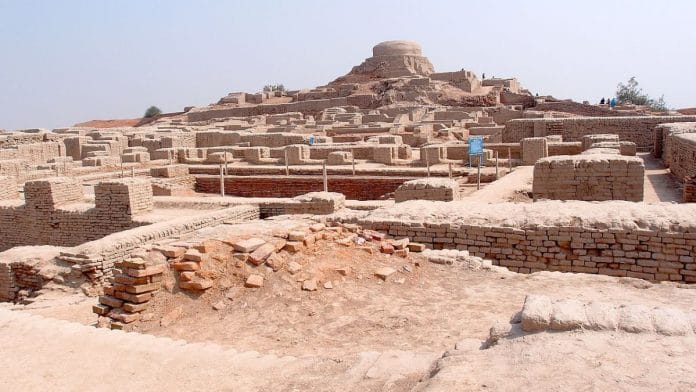

In the Discovery of India, published the year before he became India’s prime minister in 1947, Jawaharlal Nehru wrote memorably of his personal encounters with the Indus civilization in 1931 and 1936, as follows:
I stood on a mound of Mohenjo-daro in the Indus valley in the northwest of India, and all around me lay the houses and streets of this ancient city that is said to have existed over five thousand years ago . . . Astonishing thought: that any culture or civilisation should have this continuity for five or six thousand years or more; and not in a static, unchanging sense, for India was changing and progressing all the time. She was coming into inti mate contact with the Persians, the Egyptians, the Greeks, the Chinese, the Arabs, the Central Asians, and the peoples of the Mediterranean. But though she influenced them and was influenced by them, her cultural basis was strong enough to endure. What was the secret of this strength? Where did it come from? . . . It was, surprisingly enough, a predominantly secular civilisation, and the religious element, though present, did not dominate the scene . . . [At] this dawn of India’s story, she does not appear as a puling infant, but already grown up in many ways. She is not oblivious of life’s ways, lost in dreams of a vague and unrealisable supernatural world, but has made considerable technical progress in the arts and amenities of life, creating not only things of beauty, but also the utilitarian and more typical emblems of modern civilisation – good baths and drainage systems.
Evidently Nehru, though a nationalist at the political level, was intellectually and emotionally drawn to the Indus civilization by his regard for internationalism, secularism, art, technology and modernity.
By contrast, Nehru’s political rival, Muhammad Ali Jinnah, the founder of Pakistan, neither visited Mohenjo-daro nor commented on the significance of the Indus civilization. Nor did Nehru’s mentor, Mohandas Karamchand Gandhi, India’s greatest nationalist leader. In Jinnah’s case, this silence is puzzling, given that the Indus valley lies in Pakistan and, moreover, Jinnah him- self was born in Karachi, in the province of Sindh, not so far from Mohenjo-daro. In Gandhi’s case, the silence is even more puzzling. Not only was Gandhi, too, an Indus dweller, so to speak, having been born in Gujarat, in Saurashtra, but he must surely also have become aware in the 1930s of the Indus civilization as the potential origin of Hinduism, plus the astonishing revelation that it apparently functioned without resort to military violence. Yet, there is not a single comment on the Indus civilization in the one hundred large volumes of the Collected Works of Mahatma Gandhi. The nearest he comes to commenting is a touching remark recorded by the Mahatma’s secretary when the two of them visited the site of Marshall’s famous excavations at Taxila, in northern Punjab, in 1938. On being shown a pair of heavy silver ancient anklets by the curator of the Taxila archaeological museum, ‘Gandhiji with a deep sigh remarked: “Just like what my mother used to wear.”’
It would not be much of an exaggeration to say that the enthusiasm of Nehru and the indifference of Jinnah and Gandhi established a pattern for the response to the Indus civilization in the decades following the political independence of the subcontinent. Since its Indo-British discovery in the 1920s, it has stirred the keenest interest internationally, rather than nationally, that is, among European, American and Japanese archaeologists and linguists, who have taken the lead in excavating and interpreting the civilization. In many cases, they have collaborated fruitfully with archaeologists from Pakistan and from India – but with a few distinguished exceptions from both countries, such as Rafique Mughal and Iravatham Mahadevan, the impetus towards greater understanding has come from abroad, not from Pakistan and India.
Certainly part of the problem is that the international border, with its history of political tension, has divided the field of study since 1947, physically and academically. However, in addition there has been a psychological difficulty on both sides. The majority of Pakistanis have not, it seems, come to regard the Indus civilization as a key part of their heritage (though Mohenjo-daro is shown on one of the Pakistani currency notes) – perhaps in somewhat the same way that present-day Egyptians do not really relate to the civilization of the ancient Egyptians. On the other side, the majority of Indians prefer, like Gandhi, to devote their attention to the Vedic culture, the Indo-Aryans and the subsequent epics of Hindu civilization. Hence this lament by the archaeologist Chakrabarti at the start of his academic collection, Indus Civilization Sites in India: New Discoveries, published in 2004:
If Indian school and university history textbooks are anything to go by, the Indus civilisation hardly plays a role in the historical consciousness of the nation. An insignificant position in the curriculum and hopelessly disjointed writings are characteristic of the Indian academic approach to this civilisation. And yet, there ought to be a far more focused interest in this largest of Bronze Age civilisations of the third millennium bc, which is firmly rooted in the Indian subcontinent and has contributed fundamentally to the formation of India as we know it today. The still undeciphered Indus script denies us ready access to contemporary ideas and discourses, but the excavated remains go a long way to show how this civilisation rose, flourished and declined to eventually become a part of the cultural flow of the subcontinent as a whole.
One hopes that in the decades to come, this plea will not fall on deaf ears in India. Along with Nehru, Indians can legitimately take pride in the fact that the Indus civilization was essentially indigenous, like the civilizations of the ancient Sumerians and Egyptians.
Nonetheless, the Indus civilization is far from being lost. Though located in Pakistan and India, it belongs to the world, as John Marshall announced in the Illustrated London News in 1924, and as Kenneth Clark reminded the world in his Civilisation in 1969. In 1980 Mohenjo-daro was inscribed in the list of World Heritage Sites by UNESCO. The Indus civilization’s half-understood mysteries continue to fascinate anyone interested in the origins of civilization. Personally, I am drawn to what appears to be its success in combining artistic excellence, technological sophistication and economic vigour with social egalitarianism, political freedom and religious moderation over more than half a millennium. If further investigation were to show this attractive picture to be accurate, the Indus civilization would also be a hopeful sign for the future of humankind.
 This excerpt from ‘The Indus’ by Andrew Robinson has been published with permission from Reaktion Books.