



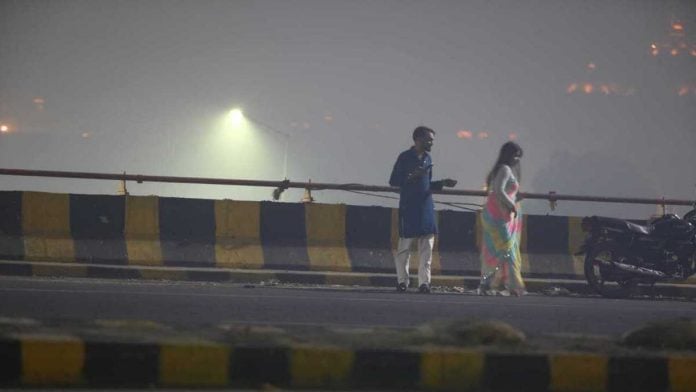
Another Deepawali, another spell of agony for Delhiites and another round of whataboutery by our politicians. On Monday, the Aam Aadmi Party was accusing the Bharatiya Janata Party government of shutting down Air Quality Index (AQI) monitoring stations to underreport the data. In turn, the BJP was accusing the AAP government in Punjab of conspiring to increase pollution in the national capital by deliberately allowing stubble burning on Deepawali. It’s a familiar story. Last year, the controversy was over the BJP government in Delhi allegedly deploying sprinklers at AQI monitoring stations to manipulate the data.
Amid the war of words on Monday morning, India Today TV was showing a glaring discrepancy between the AQI reading on the digital pollution screen outside the meteorological department headquarters at Lodhi Road and the Central Pollution Control Board’s data for the same location—143 and 342 respectively. The shocking gap of 199 between the AQI readings released by two government bodies only added to growing scepticism about the official pollution data.
In a video clip on Sunday, Sonia Gandhi and Priyanka Gandhi were reminiscing about the blue sky over Delhi during Deepawali. That must have been eons ago. For the common resident of Delhi, the choice between their lungs and jobs isn’t an easy one. Most have to stay put in the national capital and keep breathing poison for weeks. And even if one thought of driving out of the gas chamber for a few days, one must possess a car that meets the prescribed emission standards because of the Graded Response Action Plan (GRAP) being in place.
This emergency plan to tackle worsening pollution in Delhi-NCR seems to be a non-plan, in fact, going by an analysis of AQI data over four winters by Manoj Kumar of the Centre for Research on Energy and Clean Air (CREA). The revised GRAP came into effect in 2022.
“Delhi’s winter AQI has fluctuated over the past four years, with no consistent improvement. The mean AQI rose from 280 in winter 2022-23 to 304 in 2023-24, fell to 285 in 2024-25 and increased again to 295 in 2025-26. The median AQI followed a similar pattern, rising from 294 to 324, falling to 289 and then increasing to 305…. In short, Delhi’s winter air quality has not followed a consistent downward trend since the 2022 GRAP revision,” said the analysis.
But who cares about what the long-term data reveal when governance is all about managing optics?
Also Read: Modi is overreacting to INDIA’s ‘vote chori’ campaign. He needn’t think like Indira Gandhi
Different crises, same old drill
Yet another building collapsed in the national capital last Thursday, killing seven people. Chief Minister Rekha Gupta visited the spot and ordered the suspension of two officials and action against the contractor—all in front of TV cameras. Then she left.
She must be quite used to the drill by now. It’s the latest of several building collapses in Delhi this year. Death toll—36. It’s the third such incident since September, when a five-storey building in Satya Niketan crumbled, killing seven people, including five Delhi University students aged between 17 and 20. Every time a building collapses, the CM expresses her outrage in front of cameras. Some officials are suspended. The government moves on—only to repeat the drill when another building collapses.
In July 2024, three young IAS aspirants drowned after rainwater flooded the illegal basement library of Rau’s IAS Study Circle in Old Rajendra Nagar. The AAP was in power. Then BJP spokesperson Shehzad Poonawalla called it “a murder committed by AAP”. Other BJP leaders also fumed. Only the government has changed since then. Seventeen people died in a Karol Bagh hotel fire in 2019 when the AAP was in power; 21 people died in a Malviya Nagar hotel fire in June 2026 when the BJP was in power.
Not that you are any safer staying outdoors in the capital city. A 17-year-old girl was allegedly gang-raped in a park in an area where hundreds of female students stay in paying guest accommodations. A few weeks before that, a 16-year-old girl had allegedly been gang-raped in a moving bus in what came as a reminder of the 2012 Delhi gang-rape case. There were 1,901 rape cases in Delhi in 2025—that is, five cases every day on average.
The best thing about Delhiites, those in power may think, is that they’ve learnt to move on quickly. Their entire attention is on air pollution today. They have forgotten about the water crisis in several areas in May-June. Residents of upscale Gulmohar Park, for instance, complained of foul-smelling contaminated water, which seemed to be mixed with sewage, in May. Many people fell sick for days.
Many other areas reported water shortages. But they moved on. Then came the monsoon. Video clips of waterlogging inside the newly constructed Parliament premises gave a glimpse of what might be happening elsewhere in the national capital.
On an August evening, I happened to drive from ITO to Paschim Vihar, a distance of around 17 km. It took me two hours. I was stuck on New Rohtak Road for an hour because everybody was trying to keep their vehicle on whatever sliver of the road was visible. Water-filled ditches made the rest of what was supposed to be the road look dangerous.
I can go on about the state of civic infrastructure beyond Lutyens’ Delhi in the national capital, but it would get boring reading the same stories in every other locality every summer, monsoon and winter. So, I’ll end it with just one more instance. The Barapullah Phase-3 corridor was inaugurated with much fanfare by Union Minister Amit Shah a few weeks back. It was supposed to cut travel time from Mayur Vihar to South Delhi from 45 to 15 minutes. Instead, the very next day, a 3.5 km jam on the stretch left thousands of commuters fuming. Authorities have since been working on the faulty designs and making U-turns.
Also Read: Viksit Bharat 2047 is a self-defeating slogan. PM Modi needs a new one
Triple-engine breakdown
The question is how Delhi, the seat of the government of India, could become one of the worst examples of urban governance. What about the triple-engine government? You can’t blame Mayor Pravesh Wahi because his claim to fame is his ideological moorings in the Vishwa Hindu Parishad, not governance. You can’t blame CM Rekha Gupta because she has managed the optics well — from selling artificial rain through cloud seeding as a solution to air pollution to throwing an open challenge to Rahul Gandhi for a debate in Parliament to making preparations for Chhath Puja. You can’t blame Lieutenant Governor Taranjit Singh Sandhu because the L-G’s office isn’t expected to be proactive when an elected BJP government is in place. You can’t blame Union Home Minister Amit Shah because he has to virtually run the entire BJP and the government at the Centre—and also keep Gen Z protesters away from the national capital. And you can’t blame Prime Minister Narendra Modi, for sure. Because you can’t.
To answer the question, because everyone is responsible for Delhi—the Mayor, the CM, the L-G and the HM—nobody is actually accountable. And because citizens here are so used to patiently waiting on roads to let the VIP cavalcades pass, they can’t think of asking questions to those VIPs.
So, Bangaloreans and Hyderabadis, take a deep breath. You can because you aren’t in Delhi. No point crying about traffic mess, drinking water shortages or myriad civic infrastructure problems. Learn to live with it from Delhiites.
DK Singh is Political Editor at ThePrint. He tweets @dksingh73. Views are personal.
(Edited by Asavari Singh)