




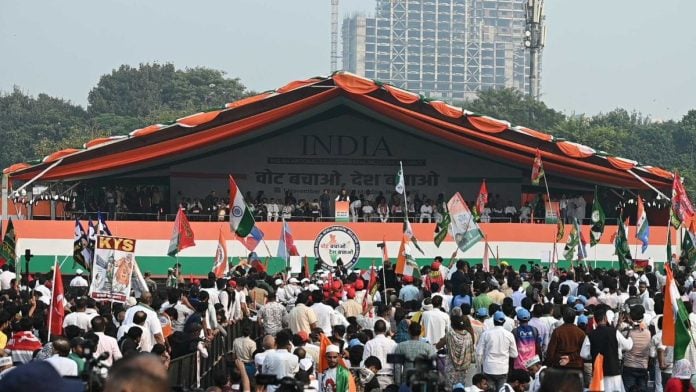

The Opposition’s rally in the national capital on Sunday was massive. The atmosphere was electric and the speeches thunderous. Union Home Minister Amit Shah wouldn’t have been impressed, for sure.
Days before this rally, Shah dismissed the Opposition’s stir against the Special Intensive Revision (SIR) in an interaction with a select group of reporters at the BJP headquarters. The home minister was of the view that a few years down the line, Chief Election Commissioner (CEC) Gyanesh Kumar would be seen as a better reformer than TN Seshan, who served as the 10th CEC from 1990 to 1996, for ‘purging’ the electoral rolls.
A master political strategist that Shah is, he would know that political parties—that, too, the combined opposition—bringing a few lakh karyakartas to New Delhi might be good optics in terms of a show of strength, but it’s not necessarily a measure of their electoral might. To cite just one example, a year before the West Bengal Assembly elections, Left-affiliated organisations had organised a rally at Kolkata’s Brigade Parade Ground in April 2025. Hundreds of thousands participated in it. The Left ended up with one seat in the 294-member Assembly.
There is also no evidence yet of the alleged ‘vote theft’ influencing people’s voting behaviour. Rahul Gandhi’s ‘vote chori’ campaign in Bihar flopped in the Assembly election. He hit the Delhi streets on this issue, but it paid little dividend for the Congress’ students’ wing, the NSUI, in the students’ union elections in Delhi and Panjab Universities.
Also, Karnataka was the state from where Rahul Gandhi produced evidence of the alleged ‘vote chori’—from Bengaluru’s Mahadevapura and Kalaburgi’s Aland Assembly constituencies. Yet, the Congress drew a blank in the Legislative Council elections for four seats in the state, including the Bengaluru Teachers’ constituency that it had won last time.
From mockery to ‘araajakta’
So, it’s not about the size of the gathering at the Ramlila Maidan or the resonance of the anti-SIR campaign. The INDIA bloc rally serves to unite the opposition, energise their cadres and keep dominating the political discourse in which the BJP has been lagging for some time. These are good takeaways for the Opposition, but are they significant enough to worry Prime Minister Narendra Modi?
On the face of it, no, as I explained earlier. Why would PM Modi then talk, like Indira Gandhi, about foreign hands attempting to create ‘araajakta’ (anarchy) in the country? Because such talks betray insecurities. Without naming Rahul, the PM said on Saturday, “Who is secretly meeting whom abroad? Who are anti-India forces supporting?”
The BJP, which used to call the opposition leader ‘Pappu’, is suddenly finding him capable of creating ‘araajakta’ in India, something Indira Gandhi thought Jayaprakash Narayan was capable of. Modi used to mock Rahul earlier. He sounds angry with the Opposition leader now.
I would like to think it’s Gen Z and Alpha, not Rahul, who have rattled the ruling BJP. It has seen post-millennials ousting governments in the neighbourhood—Sri Lanka, Bangladesh and Nepal—and a wave of protests in Germany, Belgium, France, Italy, Albania and Serbia.
There are many similarities between Indian Gen Z and Alpha and their counterparts in these countries. For instance, they echo similar grievances—poor education system, lack of economic opportunities, systemic corruption, cost of living, weakening institutions and, more importantly, not being heard in what they see as a sign of democratic backsliding. They vent it out not just on Instagram and other social media platforms but also on the streets.
They are mostly leaderless. In Serbia, protests started on university campuses two years ago and became a national movement to end Aleksandar Vucic’s roughly 14-year-long authoritarian rule. Not a single student contested the election. Of 250 parliamentary candidates from their party, the ‘Student List’, 160 have a doctorate. Serbia has elected “the world’s brainiest Parliament”, read the headline in Science journal.
The new parliamentarians include an astrophysicist who studied galaxy evolution, an electrical engineer who helped design robots, an organic chemist who worked on Covid-19 drugs, an education researcher, a sociologist, several political scientists, economists, physicians, and medical researchers, according to the journal. Then there is an ex-basketball star, an opera singer and the former National Bank of Serbia governor.
Yet, a week after winning the election, the Student List hasn’t been able to declare its Prime Ministerial candidate. That’s because there was no obvious leader of the students’ movement that went on for two years. Incidentally, Vucic also saw foreign hands behind his defeat. He blamed “different European countries and the American deep state” for it.
Indian Gen Z and Alpha are also leaderless. The Cockroach Janata Party (CJP) might have created the circumstances and allowed them to vent out their frustration but there is no obvious leader. While CJP leaders sat on dharna in the national capital, demanding education minister Dharmendra Pradhan’s resignation, students and youth spontaneously gathered in Mumbai, Patna and many other places across the country to press for the same demand. Even when the CJP wasn’t participating in the INDIA bloc’s rally in the national capital on Sunday, many students and youth attended it.
And this is what may be worrying Modi-Shah—mainstream parties tapping into Gen Z-Alpha’s disillusionment. In Nepal, Gen Z protests were targeted at all old parties. In Serbia, students kept away from other Opposition parties. In Belgium, Germany, Italy and Albania, too, political parties have largely stayed away, with a few in the opposition voicing support for the students’ cause.
Also read: The Opposition’s ‘vote chori’ campaign has a language problem
Politicisation of Gen Z protests
What’s happening in India is a bit like what happened in Bangladesh and what’s happening in France now. In Bangladesh, while the protests were led by the youth, the Bangladesh Nationalist Party, the Bangladesh Jamaat-e-Islami and their students’ wings provided organisational support and also joined the protests. In France, far-left France Unbowed is being accused of fomenting violence. Its leader Jean-Luc Mélenchon joined the protests last month.
Similarly, in India, the CJP might be instrumental in bringing the students out on the streets, but political parties have sought to co-opt them from the very beginning. While Left-affiliated students’ organisations were part of the CJP’s protests over the NEET paper leak, the Congress and its youth and students’ wings organised parallel protests.
Pictures of AISA’s Neha Bora with Rahul and Priyanka Gandhi and of CJP leaders with Opposition leaders at a Diwali party underlined this convergence of interests. In Mumbai, it was the Thackeray brothers who became the face of the Gen Z protests. The prospects of the Opposition bloc co-opting the CJP and emerging as the guide and messenger of the disgruntled Gen Z and Alpha is what must worry PM Modi.
The Opposition’s anti-SIR campaign is not producing electoral dividends for them as yet. It does, however, feed into the larger grievances of the students and youth, some of whom reached Delhi’s Ramlila Maidan on Sunday.
PM Modi and other BJP leaders are, however, going over the top with their angry reactions and conspiracy theories. It’s premature. The Opposition coming to the forefront of the Indian Gen Z movement, unlike in most other countries where students led from the front, has its flip side, too.
It politicises the Gen Z protests, which would divest it of the romanticism attached to the idea of resetting the social and political order. It runs the risk of killing the movement at its nascent stage. Also, one still doesn’t know the extent of the Gen Z-Alpha’s disgruntlement, if any, beyond cities, even though the BJP’s defeat in Graduates’ and Teachers’ constituencies in the MLC polls on BJP stalwarts’ turfs such as Varanasi, Lucknow, Nagpur and Patna seemed to suggest disillusionment among the educated youth.
The next parliamentary elections are two-and-a-half years away. Consistency and perseverance aren’t the Opposition’s forte. See how quickly they have forgotten about education reforms and moved back to ‘vote chori’. There would be something else next. Gen Z would struggle to keep pace with the shifting priorities of the Opposition.
DK Singh is Political Editor at ThePrint. He tweets @dksingh73. Views are personal.
(Edited by Saptak Datta)