





India is witnessing student protests that have expanded from the issue of NEET paper leaks and education to the integrity of the electoral process. After successfully securing the resignation of the education minister, the protesters have now turned to demanding the resignation of Chief Election Commissioner Gyanesh Kumar. Many activists and political analysts argue this could be the final nail in the coffin of the Modi government.
While the protests have undoubtedly dented the infallible, larger-than-life image of Narendra Modi, do they really hold the potential to bring down the current government? Not only does that seem unlikely, but the idea also comes across as a consciously concocted booby trap that has engulfed Opposition parties into a movement that may not have a deeper reach and is largely confined to urban pockets, educated youth and activists. Why is it so?
Firstly, the Opposition parties’ “save the Constitution” and “save democracy” narrative may seem too abstract to the common person on the street. These ideas are not as self-evident as their proponents project them to be.
Historically, the language of constitutional morality and constitutional principles has rarely resonated directly with popular politics and mass mobilisation. The demand to uphold constitutional propriety, however important it may be to protecting the democratic structure, is severely constrained by the technicalities and legal provisions involved. This is not the language people speak or through which they understand or navigate their everyday lives. They approach everyday life through cultural ethics and ethos.
Even as these protests remain important to safeguarding the fairness of the electoral process, the challenge is to translate their demands into the experiential realities of people in mofussil towns and rural India. The last person to successfully translate the modern ideals of democracy and equality into everyday cultural symbolism was MK Gandhi. Consider how he framed the question of sovereignty in terms of the right to produce and consume salt. Salt became a cultural symbol of reclaiming sovereignty, dignity and swaraj. The commonplace act of consuming salt cut across caste, class, rural-urban and other social divisions.
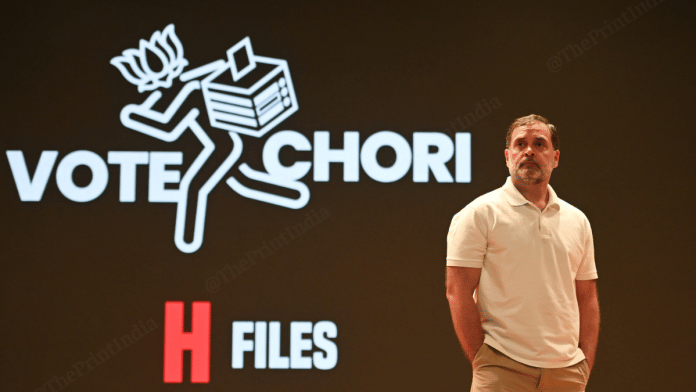
For the “vote chori” campaign to resonate with people living on the margins of society and the economy, the language of the “right to vote” will have to be connected to their growing anxieties about quality of life, including access to education, healthcare and employment, among other basic needs. Opposition parties and social activists have yet to invent a political discourse that connects the “right to vote” with welfare.
Part of the problem is that the BJP is already delivering the kind of transactional welfare that the Opposition is also promising, including free rations, free bus passes for women and other such schemes. The BJP has combined transactional welfare with what has been described as the “new welfarism”, which involves building infrastructure such as roads and highways. It may also be acknowledged that the BJP performs marginally better in service delivery because of its hold over the bureaucracy and its organisational heft.
For ordinary people to take notice, Opposition parties will have to move towards what I call structural welfarism. This could involve large-scale social transformation through greater budgetary allocations for education, healthcare and other social sectors. Are Opposition parties willing to move beyond neoliberal, transactional welfare? As of now, that is certainly not the case. They have the same libertarian economic imagination as the BJP, which is why “vote chori” has become a stand-alone demand.
The fact that this may not succeed electorally was evident in Bihar, despite mass demonstrations and large crowds at the campaign led by Rahul Gandhi and Tejaswi Yadav. In fact, the Opposition may have let the ruling dispensation off the hook in Bihar by not capitalising on growing anti-incumbency fuelled by poor healthcare and educational facilities, as well as youth unrest over widespread underemployment and unemployment. One may recall how Tejaswi Yadav’s promise of 10 lakh jobs in the previous Assembly election cycle yielded better electoral dividends.
The Opposition’s counterargument is that even if it makes greater promises, how can it ever win if the electoral process itself is compromised? This is the classic chicken-and-egg quandary into which the Opposition has been pushed.
Also read: India’s Gen Z is fighting, not praying. Why its protests are bigger than politics
SIR campaign goes beyond voter deletions
Second, the BJP has floated the entire bogey of Special Intensive Revision (SIR) not just to win elections through malpractice and manipulation of electoral rolls. There is a larger and deeper strategy of social polarisation through the SIR campaign. The recent data has clearly reflected that deletions from voter lists are not random but targeted. An overwhelming majority of those removed are Muslims and Dalits.
This is the reason why Opposition parties, despite campaigning relentlessly against “vote chori”, have been unable or unwilling to mobilise those whose names have been deleted. Such mobilisation would involve bringing large numbers of Muslims onto the streets, which will feed into the BJP’s dominant narrative of Hindu-Muslim polarisation and its rhetoric of ‘appeasement’.
The BJP, it seems, is eyeing to consolidate its support among upper castes and OBCs while excluding Muslims and Dalits from the electoral processes. The Opposition is therefore on the back foot, condemned to rely on its own party cadres and, now, Gen Z to sustain the protests. It has no clear strategy to overcome this impasse. As a result, Opposition parties are talking about voter deletions without mentioning the social composition of those deleted.
By default, the protests have become a movement of the privileged. The narrative of a democratic crisis remains trapped at Jantar Mantar. This scale of crisis may not be enough to get the BJP worried.
Ajay Gudavarthy is an Associate Professor of Political Science at the Centre for Political Studies, Jawaharlal Nehru University (JNU). Views are personal.
(Edited by Prashant Dixit)