



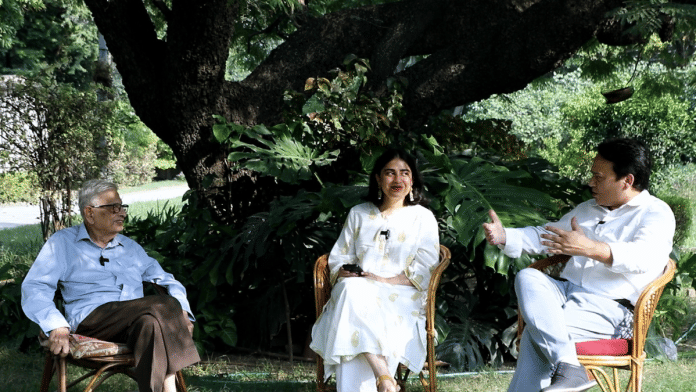
New Delhi: The Supreme Court’s Ram Janmabhoomi-Babri Masjid judgment of November 2019 was “totally illegitimate” from a historian’s point of view, renowned historian Irfan Habib told ThePrint in an interview.
“It is illegitimate because there is no proof that there was a temple there. They assumed, but archaeologically, there was no proof… The evidence for Babri Masjid being a temple is very slight,” he said.
Habib made the remarks in an interview to ThePrint in Aligarh. The 95-year-old has written several books, and is currently a Professor Emeritus at Aligarh Muslim University.
“You first destroy a mosque, and then you start digging. So when a brick comes out of Muslim construction, you throw it away. But when a stone comes out, you say it is a part of an idol. The evidence that has been presented of the Babri Masjid being a temple earlier will hardly be sustained. No archeologist of any repute has supported it,” Habib added.
He said that when mosques were built, sometimes stones which had been used in a temple were used. “So when you find a stone here, it doesn’t mean that the stone has come after the destruction of a temple here. It may have been brought from anywhere else.”
According to him, the message from Rashtriya Swayamsevak Sangh (RSS) chief Mohan Bhagwat to not look for a ‘shivling’ in every mosque came because “they overdid it”.
On Bhagwat’s conciliatory tone, Habib said that while he does not know whether there is a sincere effort, “clearly some kind of conciliation is necessary from RSS’ side after their militant statements”.
“At least Mohan Bhagwat has stopped that,” he remarked.
On Prime Minister Narendra Modi often cirticising the first PM Jawaharlal Nehru, Habib said that he does not often read statements of Prime Minister Narendra Modi. But he asked, “Nehru is one of the most important minds and what people like the present Prime Minister say about him is useless. It’s hardly worth any attention. What has he done in history?”
Habib also criticised the attempts to rewrite history through the changes being made to social science textbooks and school curriculum.
“Unfortunately, that is present in India. Earlier, Pakistan gloried in it. But now we are practically outpacing Pakistan by falsification… In the syllabus, the caste system is placed under medieval India and not ancient India, as if the Manusmriti was written in the Sultunate period,” he said.
“The syllabus drawn up in the name of the government of India and the Ministry of Education is atrocious. As if somebody who has drawn it has no idea of Indian history, no idea of the origins of the caste system,” Habib added. Citing an example, he said that while Ashoka is someone India can be proud of, he is being driven out of the textbooks.
“He is not being given the importance that used to be given to him when I did my high school because now, for some reason, Manusmriti is glorified. I don’t know what the reason is,” Habib said.
The historian, who was once denied a passport to study abroad on a government scholarship because of his affiliation with the Communist Party of India, says, “There is this word—’ultimate’—which may mean nothing, so one feels that ultimately capitalism has to go. It is so illegitimate a system, very much like feudalism.”
With both CPI and the RSS having completed 100 years, Habib viewed both their trajectories through the years.
“In Pakistan you can say, look at the Muslim League. RSS and Muslim League are of the same type, they appeal to the same kind of sentiment. They appeal to religion and to an extent, casteism also… Nothing has gone wrong with the communists and the working class, but we haven’t worked enough, that is all.”
Also Read: Maulana Azad cautioned against ‘nationalism’ in 1947. CAA shows we didn’t learn a thing
‘1,200 years of slavery’
Habib also responded to Prime Minister Narendra Modi’s oft-quoted “1,200 years of slavery” phrase. The PM uses the phrase to include British rule as well as the period under which the major rulers of the country were Muslims.
“That kind of slavery, that is to say undemocratic polity, had a much longer history. The Mauryan empire did not have a Parliament, and Ashoka, for all his inscriptions, never invited his subjects to participate in the government. So clearly, that kind of thing that wherever the rulers were Muslim was a slavery, is of course wrong,” he asserted.
Talking about the revival of temple-mosque disputes in the last few years, Habib asserted that the Archeological Survey of India has not been providing adequate protection to monuments.
“Under the present government, particularly, Muslim monuments are very badly protected…I’m not disputing (that temples were demolished). I’m just saying that when there is a mosque there, are you justified in putting an idol there? It’s just what the Muslims did in turning temples into mosques,” he said.
“If Muslims had destroyed temples, there would not have been so many temples… Aurangzeb did (destroy temples), Akbar and Jehangir didn’t. And Aurangzeb also (destroyed) a limited,” he said.
Habib’s father, who was also an eminent historian of the time, was a Congressman. He recalled that his father always wore Khadi.
“He (Habib’s father) was also a supporter of Communist party, but opposed to its pro-Pakistan policy at that time,” he said.
“We (Communist Party) made great mistakes at that time. We equated Congress with Muslim League which was the basic error. So the Communist Party lost many of its Muslim members because they were sent into Muslim League and there they signed various documents which the Communist Party denounced. So they practically left the party,” Habib explained, while clarifying that he was talking about the pre-independence era, much before he joined the CPI.
A ‘scolding’ from Nehru
During the conversation, Habib fondly remembered a “scolding” he got from Nehru.
He recalled that he had received a government scholarship for studying in Britain, but he could not get a passport because an objection had come from the Uttar Pradesh Chief Minister citing that he was a member of the Communist Party of India. He then wrote a letter to Nehru, with a quip that the government should have mentioned in the scholarship advertisement that ‘Communists need not apply’.
“I think something tickled him,” he says. PM Nehru then asked to meet Habib. “He scolded me for about 10 minutes, saying that communists are all right in China and Russia but they are all wrong in India… He said, you go to China and you see what communism really is. They worked so hard… The border quarrel had not broken by then, so he spoke less of Russia and more of China,” Habib recalled.
In a letter to the Vice Chancellor of AMU, Zakir Hussain, Nehru wrote the same day on 12 August 1955 that he met Habib and mentioned his conversation with the historian.
“Personally, I have had no animosity against the communists at all but I have come to feel increasingly how out of date communist parties in noncommunist countries are,” Nehru’s letter said.
Nehru wrote that he was advising the Education Ministry to give Habib the scholarship as an exception, saying, “Anyhow, in the balance, I feel that we should decide in favour of Irfan Habib as a special case. My main reason for so thinking is that he is a young man of intelligence and, I believe, integrity, and both these qualities will no doubt influence his future growth… Naturally, his future behaviour will be a consideration to be kept in mind.”
(Edited by Viny Mishra)
Also read: Colonial narratives still fuel hate speech in India, says historian Irfan S Habib