




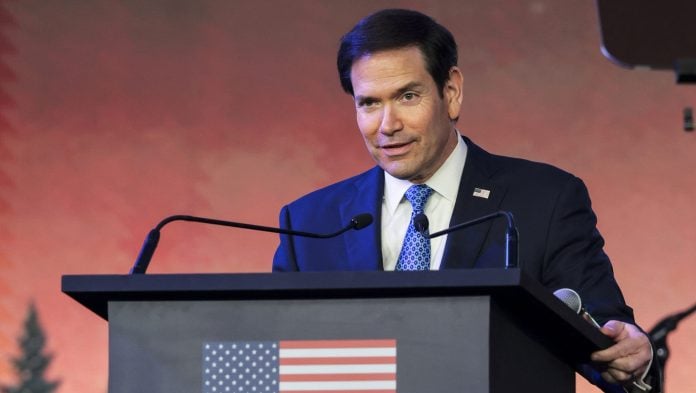

In a striking departure from traditional diplomatic protocol, US Secretary of State Marco Rubio bypassed India’s political capital, New Delhi, during his official visit in October, heading straight to the financial hub of Mumbai and then to Reliance Industries Limited’s massive private oil refining complex in Jamnagar, Gujarat, making it the centrepiece of his visit.
The unconventional itinerary signals a major pivot in Washington’s approach to India in particular and South Asia in general, reflecting a new US priority: raw economic pragmatism and energy security over standard political optics and diplomacy. This comes at a time when US-India relations face persistent friction over trade tariffs and visa restrictions. Unlike during his visit in May, when Rubio formally conveyed US President Donald Trump’s invitation to Prime Minister Narendra Modi to visit the White House, this time there was neither a meeting with the PM nor a letter from Trump to hand over.
One cannot overlook the fact that Rubio’s October visit highlighted deep, systemic frictions in India-US bilateral ties, even if officials on both sides could dismiss these as the compulsions of a business trip. While public statements framed the diplomatic engagement as productive, the underlying circumstances and the visit’s transactional nature suggest that current US policies are straining ties and could hurt Indian economic, strategic and diaspora interests.
The Trump administration introduced plans to severely restrict certain H-1B visas and freeze permanent residency pathways. When asked how these policies disproportionately affect Indian tech talent and professionals, Rubio defensively brushed off the concerns, stating that the measures “were not targeted at India”, but quickly added that the US would always prioritise American workers.
Besides putting its energy agenda on the table, Rubio’s visit also made sufficient noise about efforts to clear regulatory roadblocks that were stalling broader bilateral trade. Following meetings with top Indian conglomerates, including the Tata and Adani groups, and External Affairs Minister S Jaishankar, Rubio announced that a long-awaited US-India Bilateral Trade Agreement (BTA) was “very close” to finalisation, asserting that roughly 99 per cent of the groundwork was complete.
It is difficult to believe that the US is seriously interested in concluding the BTA any time soon. Washington’s sudden urgency and unsubstantiated assertions that the agreement would be signed soon appear to be a knee-jerk reaction to New Delhi successfully securing free trade agreements (FTAs) with the European Union and other global partners while the US dithered.
Rubio’s visit to RIL’s petrochemical facility in Jamnagar suggests a clear U-turn by the Trump administration and decisively underscores its desperation to address the energy crisis facing the US, a tragedy brought upon the country by its own policies. Although Trump has reached out to Russia for energy supplies and is keen on weaning India away from Russian oil, the inherent weaknesses in America’s economic and diplomatic strategies are too glaring to ignore.
While the US announced a temporary waiver of sanctions for countries importing Russian energy, Rubio explicitly noted that the waiver was temporary and would expire in 60 days. This forces a ticking clock on India’s strategic autonomy and energy security, particularly its ability to procure cheaper crude.
Also read: Marco Rubio’s visit shows US needs India—the ‘refining superpower’
India’s energy security and economic priorities
For New Delhi, volatile policy changes and a fluctuating relationship with Washington present a complex geopolitical balancing act. India currently relies on imports for nearly 90 per cent of its energy needs, requiring roughly 5.6 million barrels per day to fuel its expanding economy. While the ‘tariff-free’ US consumer market offers lucrative opportunities, economic prudence demands that India approach Washington’s overtures with cautious optimism.
Rubio’s agenda reportedly includes pressing India to increase its investments in the United States—a proposal that conflicts with New Delhi’s domestic goals of promoting Make in India, advancing Atmanirbhar Bharat and stimulating the manufacturing sector.
India is pushing to scale up its manufacturing output from $501 billion to $7.5 trillion by 2047, a cornerstone of its long-term strategy to build a $30 trillion economy. Achieving this requires retaining domestic capital and aggressively easing restrictions on inward foreign direct investment, rather than exporting capital to the West.
Rubio’s visit has clearly demonstrated that Washington is ready to set aside geopolitical fallout to transact on purely commercial terms with any country, more so with India. Amid talk of a G2 or G3, the US, China and Russia are strategising to navigate their competing national interests. With the outcome of the Israeli election and the US midterm elections uncertain, the political fortunes of the countries’ top leadership could change. This would also have far-reaching consequences for the ongoing Russia-Ukraine and West Asia conflicts, as well as the broader global geopolitical trajectory.
India cannot be content with serving global interests as the “refinery of the world” without securing economic, strategic and security benefits in return. As an emerging economy, India is well-positioned to reciprocate and engage with the world not out of obligation, but from a position of absolute economic equality and strength.
Seshadri Chari is the former editor of ‘Organiser’. He tweets @seshadrichari. Views are personal.
(Edited by Prashant Dixit)