



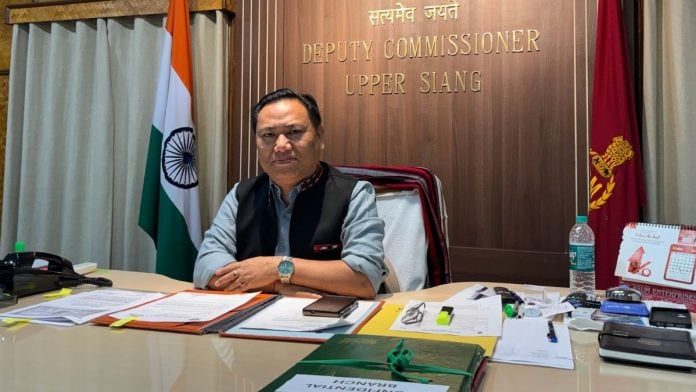
Yingkiong: The Arunachal Pradesh government has not disbursed any money under its livelihood scheme for families affected by the proposed Siang Upper Multipurpose Project, even as protests against the dam and a planned pre-feasibility report (PFR) continue to complicate efforts to engage with villagers, Upper Siang Deputy Commissioner Ashok Tajo told ThePrint.
Tajo said the Rs 350-crore Special Development and Livelihood programme, announced by the Centre and the state government last June, was intended for all eligible project-affected families and was not restricted to those who had signed consent documents.
“Regarding your livelihood activities, it is not going to be limited to people who have signed the application. This scheme is for all project-affected (families),” Tajo said in an interview on Thursday.
However, the absence of disbursal has contributed to mistrust among villagers who signed up for the programme, with some now saying they were misled by the administration, the Deputy Commissioner acknowledged.
“We did not get a single rupee till now. They have sent a scheme,” he said, adding that the administration was trying to communicate the programme’s terms and address concerns over its implementation.
The protests have intensified amid allegations from villagers that they were misled into signing documents related to the proposed dam and its PFR study under the guise of enrolling for the livelihood scheme. Residents have also questioned the transparency of the process and the circumstances under which memorandums of understanding (MoUs) were signed. However, the MoU says that the implementation of the special development package “shall not, by itself be considered, as an agreement by the likely Project Affected Families for construction of the SUMP.”
Tajo said the administration’s approach to communicating the scheme and explaining the documents had contributed to the present situation.
“If the approach was right, then this situation would not have come,” he said.
Confusion and suspicions
The Rs 350-crore package is intended to cover project-affected villages in Siang and Upper Siang districts. Under the programme, eligible families are to receive financial assistance of Rs 2.5 lakh each, alongside training in livelihood activities such as horticulture, animal husbandry, handicrafts, bamboo crafting, and beekeeping. Some families are also expected to receive assistance to convert their homes into homestays.
The scheme is meant to support communities that could be partially or fully affected by the proposed project. According to the state government’s announcement, the assistance can be used by eligible families according to their individual needs and priorities.
Tajo said the livelihood initiative was also intended to prepare residents for possible displacement and changes to their existing livelihoods if the dam were built in the future. He said the training was meant to help people identify alternative sources of income, including in areas where rising water levels could affect existing agricultural land.
But, he added, the programme had not been adequately explained to residents, leading to suspicions that the administration was using financial assistance to secure consent for the dam.
“The narrative is that we are giving (the scheme) selectively. It was open to all. Now again I am saying that it is open to everybody,” he said.
The PFR study, meanwhile, is intended to assess the feasibility of the proposed project. Tajo stressed that conducting the study would not, by itself, mean that the dam would be built.
“Nothing has happened here (on the PFR). But we are prepared,” he said, adding that the administration needed to explain the study’s purpose to villagers and facilitate direct discussions between them and the chief minister.
The proposed Siang Upper Multipurpose Project has faced sustained opposition from sections of the local population concerned about its potential impact on their land, livelihoods and settlements.
Tajo also attributed part of the current impasse to political interference and disagreements over the process of securing consent for the PFR.
He said the issue had become politically contentious, with local leaders taking different positions on the dam and the administration’s efforts to engage with residents.
According to Tajo, villagers became particularly suspicious when documents related to the PFR were circulated alongside the livelihood programme. He said residents questioned why the MoUs had been signed without adequate clarity about their contents.
The formation of village development committees (VDCs) to implement the schemes has also created concerns, he said, because elected panchayats already exist in the villages.
“We have an elected panchayat. Here, they started forming village development committees. Through this, they wanted to implement these (schemes),” Tajo said, warning that parallel structures could create competing centres of authority within villages.
The protests have also created an atmosphere of fear among those who had signed the MoUs, he said. Tajo alleged that 31 houses in Geku had been damaged and that gardens, horticulture farms and produce had been destroyed as part of attempts to intimidate supporters of the scheme.
He said this had made it harder for residents to express their views openly and for the administration to bring opposing groups to the negotiating table.
Also read: Arunachal farmers’ body calls CM Khandu ‘two-faced’, says won’t meet until detainees released
Rebuilding trust
The administration is now attempting to facilitate talks between the government and local groups opposed to the project. Tajo said attempts for these talks had been underway since 13 October. And then again on 23 October, talks could not take place after the chief minister was unable to meet the protesters.
The administration is waiting for the Chief Minister’s Office to decide on a fresh date, he said.
Tajo said the administration was also engaging with different organisations and groups, whose demands include the release of detainees, withdrawal of Central Armed Police Forces (CAPF) personnel, and the withdrawal of police cases.
He said the release of detainees was an issue the administration could take up, while decisions on police cases and the deployment of central forces lay with the police and the Union Home Ministry, respectively.
The security presence in Upper Siang has increased since the unrest, Tajo said. Seven companies had initially been deployed in the district, with the number rising to eight following the incident in Pasighat, he added, referring to the deployment of the Rapid Action Force.
Tajo said the deployment was intended to maintain order and ensure that government officials could continue their work, but acknowledged that the presence of security personnel had added to the challenges of restoring normalcy.
“Now it is up to me. I have to bring them on the platform for peace talks. That’s the biggest task in front of me right now,” he said.
He added that the administration wanted to ensure that villagers could participate in discussions without fear or pressure.
The detention of four people from the region under the Arunachal Pradesh Unlawful Activities (Prevention) Act (APUAPA) is also part of the ongoing tensions. Tajo said the government had approved the detention orders and that the cases would be reviewed by an advisory board headed by a retired judge on Friday.
He maintained that the detentions had helped prevent further incidents, but said the administration was continuing to work toward peaceful talks.
For now, the challenge remains to rebuild trust among villagers who fear that the livelihood programme is linked to securing consent for the dam, while ensuring that those who enrolled in the scheme are not left waiting indefinitely for the promised assistance.
(Edited by Aamaan Alam Khan)