







According to a recent study by the United Nations University Institute for Water, Environment and Health, the world has officially entered an era of ‘Global Water Bankruptcy’. The emerging trend in global water dynamics is marked by the state of ‘near permanent erosion’ of the natural resilience and recovery capacity of water ecosystems due to extraction beyond renewal limits. The report warns that humans are consuming water faster than nature can replenish it, transforming a renewable resource into a rapidly diminishing ecological reserve.
This global crisis will have grave implications for India, the world’s most populous country and one of the largest consumers of groundwater. It already extracts approximately 247.22 billion cubic metres annually—around 60 per cent of the national extractable threshold. India has an estimated annual recharge potential of 448.52 bcm, yet is at the centre of the water bankruptcy.
With the highest rates of groundwater withdrawal in the world, over-dependency and over-extraction, without serious effort for groundwater recharge, is steadily pushing states like Punjab, Haryana and Rajasthan toward irreversible groundwater stress.
According to NITI Aayog’s Composite Water Management Index of 2018, major cities such as Delhi, Chennai, Bengaluru and Hyderabad are impacted by overextraction of groundwater, finding a place in the world’s 20 most water-stressed cities list.
It is evident that India needs to invest in natural water systems. Experts are of the opinion that India must leverage community-led groundwater management efforts to address the fast-depleting aquifers in the cities.
Long before sustainability became a global slogan, ancient and medieval societies developed sophisticated systems of rainwater harvesting and groundwater recharge suited to local landscape and climatic conditions. From reservoirs of Dholavira to the baolis, stepwells and interconnected tank systems spread across the country, archaeology preserves the memory of ecological traditions. It excavates the forgotten ways to survive in fragile environments.
At a time when modern solutions are increasingly inadequate, the future of India’s water crisis may lie in learning how earlier societies understood water, the landscape and survival.
Also read: Jaipur’s havelis, bazaars are disappearing. Even UNESCO tag can’t protect heritage in India
Archaeology as ecological knowledge
Archaeology is not simply about reconstructing the past through physical and material remains, it is also the study of how societies adapted to droughts, shifting rivers, changing monsoons, and ecological stress.
A recent editorial in the journal Antiquity by Robin Skeates calls for Green Archaeology, an approach that views archaeology as a discipline deeply connected to environmental ethics, sustainability and climate resilience. At a time when climate change threatens not only our futures but the remnants of the past, archaeology offers something increasingly rare. It provides a long-term perspective on how human societies learned to live with their environment and what happens when that balance breaks down.
Archaeology understands learned behaviour in the form of archaeological cultures, which is the cumulative result of adaptive strategies developed by prehistoric and ancient societies in response to environmental pressure and climatic challenges. In India, this ecological adaptation is visible in every archaeological site. The UNESCO World Heritage Site of Dholavira stands as one of the prime examples.
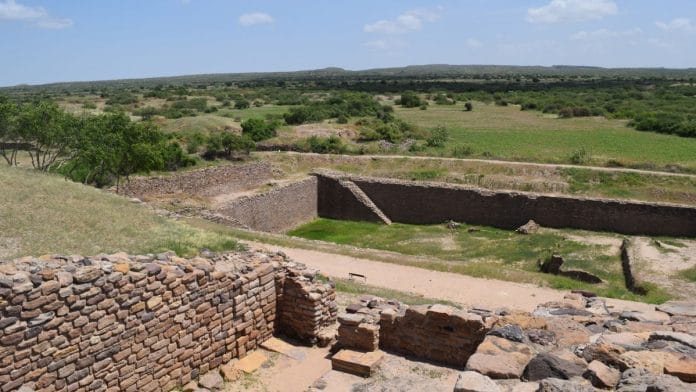
Dholavira, located in the arid island of Khadir, in Kutch, Gujarat, is one of the finest excavated and preserved examples of ancient water conservation. The Harappan city, dated between c.3000-1500 BCE, was among the five largest settlements of the civilisation. It was divided into a citadel, bailey, middle town, lower town and cemetery. Its greatest achievement was its sophisticated water management system, which enabled the settlement to survive and thrive in harsh climatic conditions.
This region of Kutch receives 260mm rainfall annually, and the communities had to depend on monsoonal cycles for subsistence. Similar conditions prevailed over 5,000 years ago. The people of Dholavira came up with a solution. Situated between seasonal streams —Mansar and Manhar—the inhabitants engineered an advanced hydraulic network of check dams interconnected with reservoirs, tanks and wells to capture and store monsoon runoff. By diverting seasonal water into sixteen reservoirs surrounding the city, they ensured a stable supply throughout the year.
Excavations at the site have revealed a series of stepped rock-cut reservoirs, interconnected with tanks and wells which helped recharge the groundwater. Masonry drains and covered channels directed rainwater from streams, fortified walls and elevated parts of the city into storage tanks within the settlements. This technological advancement helped Dholavira to thrive into one of the largest port-cities of the Harappan realm.
The principles underlying Dholavira’s hydraulic system continue to offer important lessons for sustainable water management in India’s increasingly water-stressed regions.
Also read: Mohenjo-daro city is not older than Egyptian cities. Here’s what the recent dig really shows
Water harvesting
Beyond Dholavira, several ancient societies across the subcontinent developed similar traditions of water conservation and ecological adaptation. Sudarshana Lake in Gujarat, originally constructed under Chandragupta Maurya and later repaired by Western Kshatrapas and the Guptas, suggested that reservoirs not only supported irrigation and agriculture, but also demonstrated how states invested in long-term water management and hydraulic infrastructure.
The tradition of water conservation became even more sophisticated during the early medieval and medieval periods, particularly through the construction of baolis—large stepwell tanks— across the subcontinent. In Gujarat and Rajasthan, stepwells emerged not merely as a source of water, but as architectural responses to climatic stress. Gujarat alone has over five hundred baolis, including the UNESCO World Heritage Site Rani ki Vav. Rajasthan has over a thousand baolis, excluding hundreds of stepwells which are not recorded or are in dilapidated conditions. These structures were carefully engineered to access groundwater and store rainwater, thus maintaining a balance between extraction and recharge.
The subcontinent also has numerous ancient water-harvesting systems which have stood the test of time. Many in India are still functional. Jhalaras, Talab, Bawari, Tanka, Ahar-pynes, Johads, Kund, Zing, Kuhl, Zabo, etc are just a few water harvesting systems adopted across the country.
Southern India also had a remarkable distinct hydraulic tradition. Under the Chola, Pandya, Kakatiya and Vijaynagara rulers, extensive networks of artificial tanks, canals and reservoirs transformed the landscape. In Telangana, the Kakatiya rulers developed an intricate and unique chain-tank system, where surcharge from one reservoir would feed into another.
Artificial lakes, such as Lake Pichola and Fateh Sagar Lake in Udaipur, are used to store rainwater. They have helped regulate local hydrology in drought prone regions. Similarly, the Pakhal Lake created by the Kakatiyas in the 13th century helped irrigation as well as hydrology of the region. Such lakes and other structures are part of an ecological landscape designed to harvest rainwater and recharge groundwater. It’s part of the ingenuity of our ancestors.
Also read: Fatehpur Sikri was extraordinarily well-provided with water. Lessons for modern India
Need for revival
One of the solutions proposed by experts to this crisis was the revival of community-led water-harvesting systems. In doing so, it is equally important to revive the baolis, tanks, reservoirs, lakes, which have either become garbage dumps or are neglected to the point of ruin.
Some efforts have been made in this direction by organisations such as Aga Khan Trust and INTACH. Recently, Hyderabad’s Bansilalpet stepwell was restored after clearing 40 years of garbage. This was done through a collaboration between many organisations collectively known as the Stepwell Atlas.
The Rainwater Project in Telangana, done in collaboration with the state government, has revived about 25 stepwells.
The Environmentalist Foundation of India (EFI) has restored over 600 natural and artificial water structures in western India. Similarly, in Chennai, the ‘City of 1000 tanks’ initiative focuses on restoring historic tanks and reservoirs to capture rainwater.
These structures and hydraulic systems were abandoned as a result of colonisation and post-Independent policies, which relied on westernisation rather than focusing on indigenous ecological intelligence. But India must come full circle. Archaeology does not merely teach us how ancient societies survived under adverse climatic conditions, it reminds us that the future of sustainability may depend on our willingness to revive what we chose to neglect.
Disha Ahluwalia is an archaeologist and junior research fellow at the Indian Council Of Historical Research. She tweets @ahluwaliadisha. Views are personal.
(Edited by Theres Sudeep)