



It is often said that Indian politics is bereft of ideology; that politicians believe in nothing other than their own advancement; and that major parties act only on the basis of pragmatism and greed, not any larger ideological framework.
It is not an unfair characterisation, especially at a time when people from nearly every party have rushed to join the BJP. If they believed in ideology, people ask, with some justification, how could they join the very party they had spent years opposing?
And yet, despite the political opportunists, it is wrong to think that the people at the core and those at the very top of the BJP believe in nothing. Yes, they can be pragmatists: Narendra Modi’s government has adopted many of the welfare measures and the idea of direct transfers to the poor introduced by the Manmohan Singh government (some of which they opposed while in opposition), to the extent that welfare has become central to Modi’s own popularity.
But the idea of governance-by-welfare does not alter the BJP’s essential ideology. Modi, Amit Shah and most of the party’s top leaders are still committed to an idea of India as a fundamentally Hindu nation, both in ethos and governance. They reject the idea of a pluralistic India and are hostile to the Congress for promoting secularism.
In all democratic countries, political parties oppose each other, but it is rare to find a party that wants its political rivals to disappear entirely. And yet, the BJP slogan of ‘Congress-mukt Bharat’ enshrines this idea, and the party continues to despise those who helped create a pluralistic India.
More than six decades after his death, the BJP is still obsessed with its hatred for Jawaharlal Nehru. And though its top leaders are circumspect in their speeches, it is clear that some (many, even) party functionaries admire Nathuram Godse and loathe Mahatma Gandhi.
The ideological divide in Sonia Gandhi’s memoir
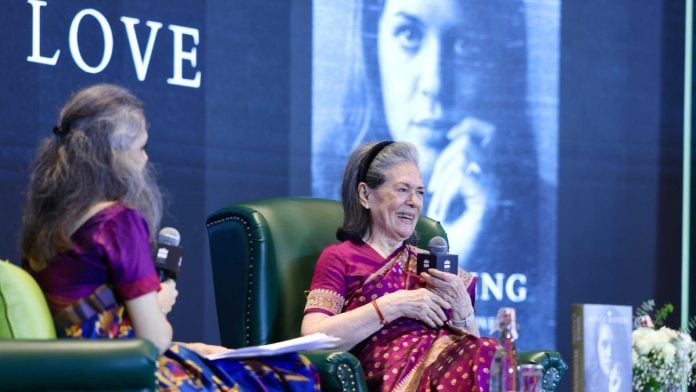
In the thousands of articles written about Belonging, Sonia Gandhi’s memoir, most writers have focused on the political bits but overlooked the ideological strand that runs through the book.
If they had, they would have noticed that Sonia’s politics are centred around her deep opposition to the RSS and its vision of an India where Hindutva rules. I counted 29 different pages, starting at page 81 and going on to page 495, towards the end of the book, that attack the RSS and its role in the freedom struggle and later, in independent India.
Judging by what Sonia writes, Indira and Rajiv Gandhi felt the same way. And we know how opposed Rahul is to the RSS because he says so repeatedly in his speeches.
Belonging demonstrates how much the Gandhis see their mission as one of protecting India’s pluralism. They see the RSS as their primary opponent. The BJP, Narendra Modi and the rest are just manifestations of what they see as an ideology of hatred.
In the memoir, nearly every major development in Indian politics is seen through the prism of RSS involvement. Writing about the Nav Nirman agitation in the 1970s, Sonia says it was “spurred on by the RSS” through the ABVP. Jai Prakash Narain, she says, was used by the RSS to garner wider support.
Indira Gandhi, she writes, had always worried about the RSS. It was one reason she was upset with the Congress Syndicate bosses, who sought support from the Jan Sangh to try and get Sanjeeva Reddy, one of their own, elected as President of India although he lost.
A young Indira had written to her father after witnessing an RSS rally:
“The organisation is so amazingly like the Brown Shirts in Germany that if we are not quick on our toes it will grow…”
In Mrs Gandhi’s mind, fighting the RSS was like fighting the Nazis. Sonia writes: “Their chief ideologues, in their writings and speeches, had expressed their admiration for Hitler and his policies concerning minorities.”
Sonia draws a link between her sister-in-law Maneka’s exit from Indira Gandhi’s house and the RSS. Not only was Maneka spending time with the family of Rajmata Scindia, a senior Sangh Parivar leader, but when Maneka sold Surya, the magazine she had founded, the buyers were two RSS stalwarts.
Also read: There are 3 different books in Sonia Gandhi’s memoir
A memoir’s unrelenting attack on the RSS
The attacks on the RSS are relentless and unceasing.
“The RSS dreamed of a Hindu India with second-class citizenship for Muslim,” she writes, adding: “Their supremacist beliefs became the political ideology of the BJP.”
She blames the RSS for the scurrilous rumours about her and, when she talks about the last general election, in which the BJP failed to win a majority, she mentions “the tricks and stratagems of the RSS and the BJP”.
Some of her criticisms of the RSS are neither new nor unusual. She writes about the India Against Corruption movement, which, according to some of its participants, was “covertly organised and supported by the BJP and RSS”.
She adds: “Behind the scenes the BJP was laying the groundwork for the advent of a new Prime Ministerial candidate Narendra Modi …, who had been part of the RSS system since boyhood.”
You don’t have to agree with everything Sonia Gandhi says to recognise that Belonging offers a deep insight into what she (and the rest of her family, probably) regards as her motivation and the uncompromising nature of her worldview.
People who know her say she is most hurt by the defections of Congress leaders she liked, because she cannot comprehend how people who seemed to accept the Gandhi-Nehru view of the country can suddenly abandon the original idea of India in pursuit of power alone.
She sees the move to the BJP as a betrayal not just of the Congress, but of the values on which India was founded. She is happier dealing with people who have always opposed the Congress because at least they have stayed true to what they believed in.
Two parties, two competing ideas of India
In the hurly-burly of day-to-day politics, we often miss the fact that the two major parties are divided by an ideological gulf that can never be bridged. If you listen to Modi or Amit Shah, it becomes clear that the ‘Congress-mukt Bharat’ slogan goes beyond the Congress itself.
The idea is to destroy the India created by the leaders of the freedom movement and replace it with a proudly Hindu, more muscular India.
Sonia Gandhi’s aim, she suggests in Belonging, is to protect and cherish that India and nurture its pluralistic spirit.
Vir Sanghvi is a print and television journalist and talk show host. He tweets @virsanghvi. Views are personal.
(Edited by Maryam Hassan)