



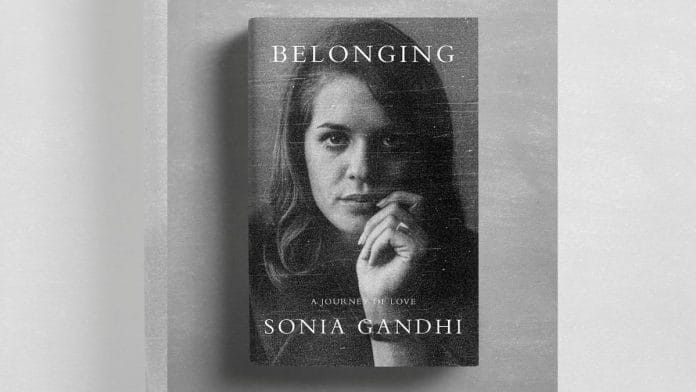
If you have been following the attempts to manipulate a social media uproar over Sonia Gandhi’s memoir, you may have been misled into believing that Belonging is a political book.
It is not. The bit where the Congress wins the 2004 elections and comes to power only begins around page 420 of a book of 544 pages. Most of the first hundred pages are devoted to events in Italy and Cambridge and Sonia Maino’s life before she married Rajiv Gandhi.
Belonging is basically a love story. It’s the story of how Sonia met Rajiv and how she was struck by “a bolt of lightning” or, as she also describes it in Italian, “un colpo di fulmine“. That stroke of lightning changed her life in ways she had never imagined were possible.
There is a second love story running through the book too: the story of how she fell in love with India. But it’s not — at least till the very end — a book about politics. There is some criticism of Narendra Modi and the way he has transformed India in the penultimate chapters, but it’s not very different from the sort of thing opinion columnists write on social media every day and is much more restrained than the attacks that Rahul Gandhi and other opposition leaders regularly launch on the Prime Minister.
So, it’s hard to see why the BJP is so eager to demolish the book. It could possibly be because nobody of consequence in the party has had the time or patience to read Belonging’s over 500 pages and the social media strategy was planned as a pre-emptive strike before the book became available. It is as hard to see why Penguin, once a publisher of courage whose editors risked their lives publishing The Satanic Verses, should have been too terrified to handle Belonging.
Yes, there are a few revelations if you are looking for gossip fodder. Bill Clinton sized up women (surreptitiously) at a banquet. Prince Edward had already begun showing signs of the dismissive arrogance required of all Dukes of Edinburgh over a decade ago, even before he got his father’s title. Princess Margaret was a lush. Nicolas Sarkozy spoke patronisingly to Manmohan Singh. And so on.
Not a tell-all
The biggest domestic revelation is the suggestion that Pranab Mukherjee tried to oust Manmohan Singh in 2010 when things were going wrong for the UPA. Sonia is still angry about people who tried to drive a wedge between Manmohan Singh and her and singles out (but does not name) Sanjaya Baru whose The Accidental Prime Minister she rubbishes for its “malicious and totally false allegations”, also quoting Manmohan Singh’s daughter who called it “a stab in the back.”
Beyond that there is nothing sensational in the book that has not already appeared in previous reports. I guess that is only to be expected because this is not meant to be a gossipy book or a tell-all.
In fact, there are three different books in Belonging. One is the love story of Rajiv and Sonia. The other is probably the best portrait of Indira Gandhi that I have ever read. And a third, at the very end, is about the Congress and the RSS. (In Sonia’s mind, the RSS and its divisive vision of India is the real problem; Modi and the BJP itself are just manifestations of the RSS’s ideology.) That, I imagine, is the book that BJP supporters were concerned about.
The love story of Sonia and Rajiv is beautifully told from the time she sees him at a restaurant in Cambridge and goes back in the hope of bumping into him. Rajiv comes off rather as we expect him too: a simple, decent man who tries to hide from his ancestry. He does not want to be known as the grandson of Jawaharlal Nehru or later, as the son of the Prime Minister. Even after he joins Indian Airlines he asks that the crew only refer to him as Captain Rajiv, never letting them use his surname in passenger announcements.
Contrary to what Indians may expect, it is Sonia’s father who objects to the match, does not attend their wedding and then, after they are married, writes her a letter, which she finds “brief and cold”, saying that the door of his house will always be open to her. “That hurt me and I shed a few tears,” she writes. “Did he think I wouldn’t adjust to India?” (He came around eventually.)
The most moving bit in the love story is, of course, Rajiv’s tragic death. But there are others. I did not know, for instance, that in 1969, before Rahul was born, Sonia and Rajiv had another son, born prematurely, who did not survive. Sonia writes: “Both of us were shocked and heartbroken. We held each other tight. I cried my heart out. Rajiv, in spite of his stiff upper lip, wept copiously.”
It is no secret because she has talked about it before that after Rajiv’s assassination, Sonia went through a bad patch, partly because she felt, with some justification, that Rajiv could have been saved had proper security been provided. But even then, in the midst of her depression, leaving India was not an option because she had fallen in love with the country and its people, slowly abandoning most of her Italian ways.
For an Italian for whom food was so important (the early part of the book is full of stories about how vile British food was and how she longed for cheese and pasta in the India of the 1960s), one significant shift was that she began to find European food too bland and longed for spices, chilli and the arhar dal that is still made in her house every day.
Even the most vicious attacks on her over the years did not cause her to think badly about Indians; not even when a paper wrote falsely and cruelly about the death of her first child that “Indira Gandhi failed in her attempt to become the grandmother of a bastard child.” (Rajiv and Sonia were married so the accusation of illegitimacy was just abuse.)
Also read: The 3 big interviews Sonia Gandhi gave to Shekhar Gupta, Vir Sanghvi, Arnab Goswami
Sonia on Indira Gandhi
Sonia’s portrait of Indira Gandhi is loving but candid. She writes about her mother-in-law’s moods. In fact, the staff and even Mrs Gandhi’s doctor would ask, before going in to see her, “mood theek hai?”
They were right to do so. Sonia writes that when Indira had faced a particularly unpleasant exchange in parliament, she came home for lunch, sat down and then “in a fit of temper she pushed her thali away with such force that it landed on the other side of the long dining table.”
For all that, Indira was capable of great love and consideration. When Sonia met her in London in one of their early encounters, Sonia was nervous and conscious of her fractured English. But Mrs Gandhi was welcoming and when Rajiv pointed out that the hem of Sonia’s dress had unraveled, Indira got out a needle and thread and fixed it on the spot.
They were a close knit family and Mrs Gandhi doted on the children. She also had a wicked streak. When the young Rahul became a little chubby with a round face, Mrs Gandhi took to comparing him to Kamalapathi Tripathi, the veteran Congress leader. (Sonia was not amused.)
If there is a complicated relationship in the book, it’s the one between Rajiv and Sanjay. They start out being very close and drift apart after Sanjay marries Maneka (who is clearly not Sonia’s favourite person). The open disagreements emerge when Rajiv asks his mother to resign after the Allahabad judgment. Sanjay insists that she continue in office and urges her to impose the Emergency. When it all goes wrong and she is driven from office by a landslide after the 1977 election, Indira finally sees the light.
“I cannot forgive you Sanjay,” Rajiv says. “You have brought Ma to this pass.” Indira adds, “What Rajiv said is true Sanjay. How many times you gave orders without my knowledge!”
It’s an unusual degree of candour for Sonia Gandhi who is regarded as being famously unknowable. She even writes honestly about her health scares during UPA 2. The first time, she had tumours in her breast removed in Milan in 2010. And in 2011, she went to Rotterdam, the Netherlands, for an operation on her pancreas. (She did not go to New York as the press had reported.)
The operations went well. The pancreas tumour was not malignant and chemotherapy was not required. But Sonia was concerned enough to leave “a note for Rahul and Priyanka with instructions on what to do if things went wrong.” In 2016, she faced another health episode when she collapsed during campaigning in Varanasi and had to be flown to Delhi. (It got worse when the men carrying her stretcher dropped her, breaking her shoulder.)
But how she coped with these emergencies is pure Sonia. “Floating in and out of consciousness I glimpsed the anxious faces of my colleagues. Then I saw him again – Rajiv reaching out to me, smiling at me reassuringly as if to say, everything will be fine.”
And it was. She got back on her feet after an operation and resumed her normal life. Sometimes love can conquer everything.
Vir Sanghvi is a print and television journalist and talk show host. He tweets @virsanghvi. Views are personal.
(Edited by Aamaan Alam Khan)