


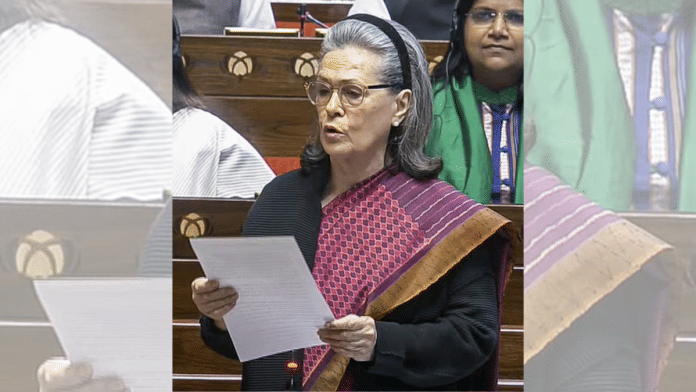
New Delhi: Sonia Gandhi never wanted to enter politics. But after Rajiv Gandhi’s assassination in 1991, she found it impossible to walk away from the Congress–a party her husband, mother in law Indira Gandhi and India’s first Prime Minister Jawaharlal Nehru had shaped, and two of them had died for.
In three television interviews between 1998 and 2004, Gandhi offered a rare glimpse into the fears, loyalties and three portraits that drew a reluctant outsider to politics and eventually made her the longest serving president of the Congress party.
“I could not walk past the portraits of my husband, my mother-in-law and her father and not feel that I had some responsibility to try and save the party they had given their lives to,” Gandhi said in her first full-length TV interview with journalist Vir Sanghvi on August 1999, reflecting on why she had entered public life after her husband’s assassination.
The seminal quote would go on to feature in countless articles about Gandhi. Sanghvi, writing for Forbes India, later described it as a statement that was “widely quoted in the years to come”.
She had initially withdrawn from politics, preferring to write and compile books about her husband. She also wanted to pursue interests of her own, including writing a book on the trees of India. But a steady stream of visitors and former colleagues of Rajiv began approaching her, warning that the Congress, then under Sitaram Kesri, was on the verge of political annihilation.
The portraits, she said, made it difficult to remain on the sidelines. She felt a responsibility to save the party to which her family had devoted their lives.
The woman who had once said her husband’s duty was to the country and hers to the family eventually became the Congress’s central political figure. She served as party president for a total of 22 years, navigating electoral defeats, internal dissent and repeated questions about her foreign origins.
Her memoir, which has already drawn considerable attention and controversy, was released on Tuesday.
Across her first three television interviews—with Arnab Goswami in 1998, Vir Sanghvi in 1999 and Shekhar Gupta in 2004—Sonia spoke about the family she had married into, her relationship with Indira Gandhi, the assassination of Rajiv Gandhi and the circumstances that eventually brought her into politics.
A reluctant politician
Gandhi’s reluctance to enter politics predated Rajiv’s assassination. She had been opposed to her husband’s entry into public life, fearing that he might meet the same fate as his mother in 1984. In her interview, she told Sanghvi that her apparently tense and unsmiling demeanour during Rajiv’s prime ministership had a simple explanation.
“You saw me when we were in public,” she said. “And every moment when we were in public, I thought Rajiv would be killed.”
That fear became reality in May 1991, when Rajiv was assassinated during an election campaign in Sriperumbudur, Tamil Nadu.
After his assassination, Sonia’s first television interview came in 1998, with Arnab Goswami, then a Star News correspondent. The chance encounter took place at Delhi airport, shortly after she formally entered active politics ahead of the 1998 general election.
Returning from Sriperumbudur, she described her visit to the place where her husband had been killed as “very sad and deeply painful”.
But the interview also had an unmistakably political purpose, offering a glimpse of her emerging political role. Amid speculation about her intentions within the Congress, Sonia sought to make her position clear.
“I have no problem with the Congress president and I have no intention of taking over the leadership of the Congress party,” she told Goswami.
Three months later, on 14 March 1998, she took charge as Congress president, after the Congress Working Committee replaced Kesri, beginning her first tenure as party president.
An ‘imperious’ outsider who surprised her interviewer
A year later, journalist Vir Sanghvi interviewed Sonia at 10 Janpath for Star Plus. It was her first full-length television conversation, and Sanghvi expected to encounter the inaccessible figure that many Congress politicians described.
The traditional image of Sonia, he wrote later, was of an “imperious woman” before whom people were admitted for brief and tense audiences. Among the complaints of disgruntled Congressmen, he recalled, was: “She never even offered me a glass of water.”
The woman he encountered was quite different.
Nearly 20 members of the television crew arrived at 10 Janpath hours before the interview, installing cameras, lights and reflectors, shifting furniture and disturbing the study. Sonia, along with Rahul and Priyanka, who sat through the conversation, remained hospitable, offering the crew food and drinks and posing for photographs.
She was, however, nervous in front of the cameras. Sanghvi suggested a dummy interview to help her get comfortable. But every time he began asking questions, Sonia burst into giggles, blaming her children for making her feel self-conscious.
“Finally, I said, “I am sorry if you giggle Mrs Gandhi but we’ll have to start after that.” She nodded glumly. I assumed my serious anchor-person expression and spoke to the camera, “My guest today is perhaps India’s most important woman. But she is also one of the most enigmatic…” Complete collapse. Now I had a bad case of the giggles”, Sanghvi added.
The conversation ranged across her accent, her perceived aloofness, her Italian origins and the controversy surrounding her claim, outside Rashtrapati Bhavan, that she had the support of 272 MPs.
Sanghvi also directly questioned her Italian origins, asking why India should accept an Italian in politics when an Indian could never become prime minister of Italy.
Sonia said she understood why people might feel that way, but insisted that India was her home.
She was also willing to acknowledge that people mocked her accent and considered her arrogant. She described herself as shy and said it took time for her to become comfortable with people.
“This is my home and I love it here,” she said, making clear that she had no intention of abandoning politics or returning to Italy if the Congress lost the election.
The most emotional part of the interview came when Sanghvi asked her about Rajiv’s assassination. She recalled seeing him shortly before he left for Sriperumbudur. He was exhausted and had a backache. She had wanted to accompany him but was told that the small aircraft he was taking had no additional seats.
When Priyanka informed her that Rajiv had been assassinated, Sonia remembered thinking: “I should have gone with him.”
Her eyes filled with tears and her voice began to crack. Sanghvi called for a commercial break.
Sanghvi later described her as having more in common with Rajiv’s straightforwardness than with the political manoeuvring often attributed to Indira Gandhi.
On a personal level, he concluded, she was “almost impossible to dislike”.
“Any unbiased person watching the interview may well conclude that contrary to what the press writes, she has less in common with her Machiavellian mother in law than she does with her essentially straightforward husband. My producer, who is not a Congress voter by any stretch of the imagination, came away with the feeling that the whole atmosphere in the house was almost endearingly naive – Sonia and her children, she felt, seemed too innocent to cope with Congress politics.”
The daughter-in-law who was loved
In 2004, Sonia spoke to Shekhar Gupta for NDTV’s Walk the Talk, in an interview recorded at Swaraj Bhavan in Allahabad, part of the larger Anand Bhavan complex associated with the Nehru family.
Wearing a white-and-blue saree, Sonia acknowledged that she had entered the family without fully understanding what lay ahead. She was still adjusting to India, its customs and its different ways of thinking.
But her relationship with Rajiv had made the transition easier. “I was madly in love with my husband and he was with me and so nothing else mattered,” she recalled.
She spoke about learning to cook from books, looking after her family and mother-in-law, and Indira’s occasional fondness for Western food, particularly pasta.
Her description of Indira was markedly different from the formidable public image of the former prime minister. She remembered a woman who was attentive to small gestures and sensitive to the emotions of those around her.
When Sonia’s mother left India after staying with the family following the wedding, Indira sent her daughter-in-law a short note: “Hi Sonia, this is just to tell you that we all love you.”
Sonia said the message had made her melt and feel loved and cared for.
Speaking about her interview for The Washington Post in 1985, she recalled how, as she was preparing to leave her first meeting with her future mother-in-law, “Indira Gandhi beckoned to her, took out a needle and thread, asked her to turn around, then mended a loose hem on her dress.”
The interview also touched on the Bangladesh Liberation War, which Sonia said the family had followed closely. She remembered the excitement surrounding Sheikh Mujibur Rahman’s arrival in Delhi from London on 10 January 1972. She had been due to give birth the following day but insisted on attending the airport reception.
“We lived every moment of that crisis in our family,” she said, recalling the reports of atrocities committed by the Pakistani Army against the people of Bangladesh.
Gupta also asked her about the Emergency. Sonia said Indira had acknowledged after losing the 1977 election that declaring the Emergency had been a mistake.
“I think she did think that it was a mistake,” Sonia said. “Don’t forget that the Indira Gandhi I knew was a Democrat at heart to the core.”
But it was her account of what eventually brought her into politics that gave the three interviews their clearest common thread. For Gandhi, the decision was inseparable from the losses her family had suffered.
“I was not ever keen to join politics. In fact, I didn’t even want my husband to join politics,” she said.
She had seen Indira endure rejection, criticism and ‘calumnies’ despite a life devoted to public service. “And then she was killed,” she said bluntly.
Long before she chose to write about her life and address the speculation that had followed her for decades, Gandhi had offered an explanation in those early interviews for the decision that would shape her public life: she felt she owed something to the people whose portraits she could not walk past.
“Power has many definitions. In Sonia Gandhi’s case, her power comes from seeking no position for herself, from focussing on her true constituency—India’s poor—and from winning a resounding mandate based on the votes of those who do not read English newspapers or watch TV channels,” Sanghvi wrote. “It is a power that comes from the heart of our society. And that makes it the kind of power that is difficult to ignore.”
(Edited By Raunaq Lekhi)