


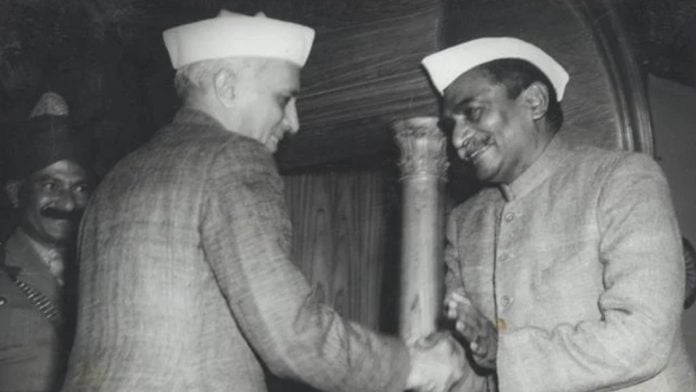
I desire to congratulate the Assembly on accomplishing a task of such tremendous magnitude. It is not my purpose to appraise the value of the work that the Assembly has done or the merits or demerits of the Constitution which it has framed. I am content to leave that to others and to posterity. I shall attempt only to point out some of its salient features and the method which we have pursued in framing the Constitution.
Before I do that, I would like to mention some facts which will show the tremendousness of the task which we undertook some three years ago. If you consider the population with which the Assembly has had to deal, you will find that it is more than the population of the whole of Europe minus Russia, being 319 millions as against 317 millions. The countries of Europe have never been able to join together or coalesce even in a Confederacy, much less under one unitary Government. Here, in spite of the size of the population and the country, we have succeeded in framing a Constitution which covers the whole of it.
Apart from the size, there were other difficulties which were inherent in the problem itself. We have got many communities living in this country. We have got many languages prevalent in different parts of it. We have got other kinds of differences dividing the people in the different parts from one another. We had to make provision not only for areas which are advanced educationally and economically; we had also to make provision for backward people like the Tribes and for backward areas like the Tribal areas. The communal problem had been one of the knottiest problems which the country has had before it for a pretty long time. The Second Round Table Conference which was attended by Mahatma Gandhi failed because the communal problem could not be solved. The subsequent history of the country is too recent to require narration here; but we know this that as a result, the country has had to be divided and we have lost two big portions in the north-east and north-west.
Another problem of great magnitude was the problem of the Indian States. When the British came to India, they did not conquer the country as a whole or at one stroke. They got bits of it from time to time. The bits which came into their direct possession and control came to be known as British India; but a considerable portion remained under the rule and control of the Indian Princes. The British thought at the time that it was not necessary or profitable for them to take direct control of those territories, and they allowed the old Rulers to continue subject to their suzerainty. But they entered into various kinds of treaties and engagements with them. We had something near six hundred States covering more than one-third of the territory of India and one-fourth of the population of the country. They varied in size from small tiny principalities to big States like Mysore, Hyderabad, Kashmir, etc. When the British decided to leave this country, they transferred power to us; but at the same time, they also declared that all the treaties and engagements they had with the Princes had lapsed. The paramountcy which they had so long exercised and by which they could keep the Princes in order also lapsed. The Indian Government was them faced with the problem of tackling these States which had different traditions of rule, some of them having some form of popular representation in Assemblies and some having no semblance of anything like that, and governing completely autocratically.
***
It has undoubtedly taken us three years to complete this work, but when we consider the work that has been accomplished and the number of days that we have spent in framing this Constitution, the details of which were given by the Honourable Dr. B. R. Ambedkar, yesterday, we have no reason to be sorry for the time spent.
It has enabled the apparently intractable problem of the States and the communal problem to be solved. What had proved insoluble at the Round Table Conference and had resulted in the division of the country has been solved with the consent of all parties concerned, and again under the wise guidance of Honourable Sardar Vallabhbhai Patel.
At first we were able to get rid of separate electorates which had poisoned our political life for so many years, but reservation of seats for the communities which enjoyed separate electorates before had to be conceded, although on the basis of their population and not as had been done in the Act of 1919 and the Act of 1935 of giving additional representation on account of the so-called historical and other superiority claimed by some of the communities. It has become possible only because the Constitution was not passed earlier that even reservation of seats has been given up by the communities concerned and so our Constitution does not provide for reservation of seats on communal basis, but for reservation only in favour of two classes of people in our population, namely, the depressed classes who are Hindus and the tribal people, on account of their backwardness in education and in other respects. I therefore see no reason to be apologetic about the delay.
The cost too which the Assembly has had to incur during its three year’s existence is not too high when you take into consideration the factors going to constitute it. I understand that the expenses up to the 22nd of November come to Rs. 63,96,729/-.
***
We have now to consider the salient features of the Constitution. The first question which arises and which has been mooted is as to the category to which this Constitution belongs. Personally, I do not attach any importance to the label which may be attached to it – whether you call it Federal Constitution or Unitary Constitution or by any other name. It makes no difference so long as the Constitution serves our purpose. We are not bound to have a constitution which completely and fully falls in line with known categories of constitutions in the world. We have to take certain facts of history in our own country and the Constitution has not to an inconsiderable extent been influenced by such realities as facts of history.
You are all aware that until the Round Table conference of 1930, India was completely a Unitary Government, and the provinces derived whatever power they possessed from the Government of India. It was there for the first time that the question of Federation in a practical form arose which would include not only the provinces but also the many States that were in existence. The Constitution of 1935 provided for a Federation in which both the provinces of India and the States were asked to join. But the federal part of it could not be brought into operation, because terms on which the Princes could agree to join it could not be in settled in spite of prolonged negotiation. And, when the war broke out, that part of the Constitution had practically to be abrogated.
In the present Constitution it has been possible not only to bring in practically all the States which fell within our geographical limits, but to integrate the largest majority of them in India, and the Constitution as it stands practically makes no difference so far as the administration and the distribution of powers among the various organs of the State are concerned between what were the Provinces and what were Indian States before. They are all now more or less on the same footing and, as time passes, whatever little distinction still exists is bound to disappear. Therefore, so far as labellingis concerned, we need not be troubled by it.
Well, the first and the most obvious fact which will attract any observer is the fact that we are going to have a Republic. India knew republics in the past olden days, but that was 2,000 years ago or more and those republics were small republics. We never had anything like the Republic which we are going to have now, although there were empires in those days as well as during the Mughal period which covered very large parts of the country. The President of the Republic will be an elected President. We never have had an elected Head of the State which covered such a large area of India. And it is for the first time that it becomes open to the humblest and the lowliest citizens of the country to deserve and become the President or the Head of this big State which counts among the biggest States of the world today. This is not a small matter. But because we have an elected President, some of the problems which are of a very difficult nature have arisen. We have provided for the election of the President. We have provided for an elected legislature which is going to have supreme authority. In America, the legislature and the President are both elected and, there both have more or less equal powers – each in its or his own sphere, the President in the executive sphere and the legislature in the legislative sphere.
We considered whether we should adopt the American model or the British model where we have a hereditary king who is the fountain of all honour and power, but who does not actually enjoy any power. All the power rests in the Legislature to which the Ministers are responsible. We have had to reconcile the position of an elected President with an elected Legislature and, in doing so, we have adopted more or less the position of the British Monarch for the President. This may or may not be satisfactory. Some people think too much power has been given to the President; others think that the President, being an elected President, should have even more powers than are given to him.
If you look at it from the point of view of the electorate which elects the Parliament and which elects the President, you will find that practically the entire adult population of the country joins in electing this Parliament and it is not only the Members of the Parliament of India but also the Members of the Legislative Assemblies of the States who join in electing the President. It thus comes about that, while the Parliament and Legislative Assemblies are elected by the adult population of the country as a whole, the President is elected by representatives who represent the entire population twice over, once as representatives of the States and again as their representatives in the Central Parliament of the country. But although the President is elected by the same electorate as the Central and State Legislatures, it is as well that his position is that of a Constitutional President.
Then we come to the Ministers. They are of course responsible to the Legislature and tender advice to the President who is bound to act according to that advice. Although there are no specific provisions, so far as I know, in the Constitution itself making it binding on the President to accept the advice of his Ministers, it is hoped that the convention under which in England the King acts always on the advice of his Ministers will be established in this country also and, the president, not so much on account of the written word in the Constitution, but as the result of this very healthy convention, will become a Constitutional President in all matters.
***
Some people have doubted the wisdom of adult franchise. Personally, although I look upon it as an experiment the result of which no one will be able to forecast today, I am not dismayed by it. I am a man of the village and although I have had to live in cities for a pretty long time, on account of my work, my roots are still there. I, therefore, know the village people who will constitute the bulk of this vast electorate. In my opinion, our people possess intelligence and common sense. They also have a culture which the sophisticated people of today many not appreciate, but which is solid. They are not literate and do not possess the mechanical skill of reading and writing. But, I have no doubt in my mind that they are able to take measure of their own interest and also of the interests of the country at large if things are explained to them. In fact, in some respects, I consider them to be even more intelligent than many a worker in a factory, who loses his individuality and becomes more or less a part of the machine which he has to work.
I have, therefore, no doubt in my mind that if things are explained to them, they will not only be able to pick up the technique of election, but will be able to cast their votes in an intelligent manner and I have, therefore, no misgivings about the future, on their account. I cannot say the same thing about the other people who may try to influence them by slogans and by placing before them beautiful pictures of impracticable programmes. Nevertheless, I think their sturdy commonsense will enable them to see things in the right perspective. We can, therefore, reasonably hope that we shall have legislatures composed of members who shall have their feet on the ground and who will take a realistic view of things.
***
We have provided in the Constitution for a judiciary which will be independent. It is difficult to suggest anything more to make the Supreme Court and the High Courts independent of the influence of the Executive. There is an attempt made in the Constitution to make even the lower judiciary independent of any outside or extraneous influence. One of our articles makes it easy for the State Governments to introduce separation of Executive from Judicial functions and placing the magistracy which deals with criminal cases on similar footing as Civil Courts. I can only express the hope that this long overdue reform will soon be introduced in the States.
Our Constitution has devised certain independent agencies to deal with particular matters. Thus, it has provided for Public Service Commission both for the Union and for the States and placed such Commission on an independent footing so that they may discharge their duties without being influenced by the Executive. One of the things against which we have to guard is that there should be no room as far as it is humanly possible for jobbery, nepotism and favouritism. I think the provisions which we have introduced into our Constitution will be very helpful in this direction.
Another independent authority is the Comptroller and Auditor-General who will watch our finances and see to it that no part of the revenues of India or of any of the States is used for purposes and on items without due authority and whose duty it will be otherwise to keep our accounts in order. When we consider that our Governments will have to deal with hundreds of crores, it becomes clear how important and vital this Department will be. We have provided another important authority, i.e., the Election Commissioner whose function it will be to conduct and supervise the elections to the Legislatures and to take all other necessary action and connection with them. One of the dangers which we have to face arises out of any corruption which parties, candidates or the Government in power may practise. We have had no experience of democratic elections for a long time except during the last few years and now that we have got real power, the danger of corruption is not only imaginary. It is therefore as well that our Constitution guards against this danger and makes provision for an honest and straightforward election by the voters. In the case of the Legislature, the High Courts, the Public Services Commission, the Comptroller and Auditor-General and the Election Commissioner, the Staff which will assist them in their work has also been placed under their control and in most of these cases their appointment, promotion and discipline vest in the particular institution to which they belong thus giving additional safeguards about their independence.
***
The Constitution has gone into great detail regarding the distribution of power and functions between the Union and the States in all aspects of their administrative and other activities. It has been said by some that the powers given to the Centre are too many and too extensive and the States have been deprived of power which should really belong to them in their own fields. I do not wish to pass any judgment on this criticism and can only say that we cannot be too cautious about our future, particularly when we remember the history of this country extending over many centuries. But such powers as have been given to the Centre to act within the sphere of the States relate only to emergencies, whether political or financial and economic, and I do not anticipate that there will be any tendency on the part of the Centre to grab more power than is necessary for good administration of the country as a whole. In any case the Central Legislature consists of representatives from the States and unless they are convinced of their over-riding necessity, they are not likely to consent to the use of any such powers by the Central executive as against the States whose people they represent. I do not attach much importance to the complaint that residuary powers have been vested in the Union. Powers have been very meticulously and elaborately defined and demarcated in the three lists of Schedule Seven, and the residue whatever it may be, is not likely to cover any large field, and, therefore, the vesting of such residuary powers does not mean any very serious derogation in fact from the power which ought to belong to the States.
One of the problems which the Constituent Assembly took considerable time in solving relates to the language for official purposes of the country. There is a natural desire that we should have our own language, and in spite of the difficulties on account of the multiplicity of languages prevalent in the country, we have been able to adopt Hindi which is the language that is understood by the largest number of people in the country as our official language. I look upon this as a decision of very great importance when we consider that in a small country like Switzerland they have no less than three official languages and in South Africa two official languages. It shows a spirit of accommodation and a determination to organize the country as one nation that those whose language is not Hindi have voluntarily accepted it as the official language. (Cheers).
There is no question of imposition now. English during the period of British rule, Persian during the period of the Muslim Empire were Court and official languages. Although people have studied them and have acquired proficiency in them, nobody can claim that they were voluntarily adopted by the people of the country at large. Now for the first time in our history we have accepted one language which will be the language to be used all over the country for all official purposes, and let me hope that it will develop into a national language in which all will feel equal pride while each area will be not only free, but also encouraged to develop its own peculiar language in which its culture and its traditions are enshrined. The use of English during the period of transition was considered inevitable for practical reasons and no one need be despondent over this decision, which has been dictated purely by practical considerations. It is the duty of the country as a whole now and especially of those whose language is Hindi to so shape and develop it as to make it the language in which the composite culture of India can find its expression adequately and nobly.
Another important feature of our Constitution is that it enables amendments to be made without much difficulty. Even the constitutional amendments are not as difficult as in the case of some other countries, but many of the provisions in the Constitution are capable of being amended by the Parliament by ordinary acts and do not require the procedure laid down for constitutional amendments to be followed. There was a provision at one time which proposed that amendments should be made easy for the first five years after the Constitution comes into force, but such a provision has become unnecessary on account of the numerous exceptions which have been made in the Constitution itself for amendments without the procedure laid down for constitutional amendments. On the whole, therefore, we have been able to draft a Constitution which I trust will serve the country well.
***
There are only two regrets which I must share with the honourable Members I would have liked to have some qualifications laid down for members of the Legislatures. It is anomalous that we should insist upon high qualifications for those who administer or help in administering the law but none for those who made it except that they are elected. A law giver requires intellectual equipment but even more than that capacity to take a balanced view of things to act independently and above all to be true to those fundamental things of life – in one word – to have character (Hear, hear). It is not possible to devise any yardstick for measuring the moral qualities of a man and so long as that is not possible, our Constitution will remain defective. The other regret is that we have not been able to draw up our first Constitution of a free Bharat in an Indian language. The difficulties in both cases were practical and proved insurmountable. But that does not make the regret any the less poignant.
We have prepared a democratic Constitution. But successful working of democratic institutions requires in those who have to work them willingness to respect the view points of others, capacity for compromise and accommodation. Many things which cannot be written in a Constitution are done by conventions. Let me hope that we shall show those capacities and develop those conventions. The way in which we have been able to draw this Constitution without taking recourse to voting and to divisions in Lobbies strengthens that hope.
Whatever the Constitution may or may not provide, the welfare of the country will depend upon the way in which the country is administered. That will depend upon the men who administer it. It is a trite saying that a country can have only the Government it deserves. Our Constitution has provision in it which appear to some to be objectionable from one point or another. We must admit that the defects are inherent in the situation in the country and the people at large. If the people who are elected are capable and men of character and integrity, they would be able to make the best even of a defective Constitution. If they are lacking in these, the Constitution cannot help the country. After all, a Constitution like a machine is a lifeless thing. It acquires life because of the men who control it and operate it, and India needs today nothing more than a set of honest men who will have the interest of the country before them. There is a fissiparous tendency arising out of various elements in our life. We have communal differences, caste differences, language differences, provincial differences and so forth. It requires men of strong character, men of vision, men who will not sacrifice the interests of the country at large for the sake of smaller groups and areas and who will rise over the prejudices which are born of these differences. We can only hope that the country will throw up such men in abundance.
I can say this from the experience of the struggle that we have had during the period of the freedom movement that new occasions throw up new men; not once but almost on every occasion when all leading men in the Congress were clapped into prison suddenly without having the time to leave instructions to others and even to make plans for carrying on their campaigns, people arose from amongst the masses who were able to continue and conduct the campaigns with intelligence, with initiative, with capacity for organization which nobody suspected they possessed. I have no doubt that when the country needs men of character, they will be coming up and the masses will throw them up. Let not those who have served in the past therefore rest on their oars, saying that they have done their part and now has come the time for them to enjoy the fruits of their labours. No such time comes to anyone who is really earnest about his work. In India today I feel that the work that confronts us is even more difficult than the work which we had when we were engaged in the struggle. We did not have then any conflicting claims to reconcile, no loaves and fishes to distribute, no powers to share. We have all these now, and the temptations are really great. Would to God that we shall have the wisdom and the strength to rise above them, and to serve the country which we have succeeded in liberating.
Mahatma Gandhi laid stress on the purity of the methods which had to be pursued for attaining our ends. Let us not forget that this teaching has eternal value and was not intended only for the period of stress and struggle but has as much authority and value today as it ever had before. We have a tendency to blame others for everything that goes wrong and not to introspect and try to see if we have any share in it or not. It is very much easier to scan one’s own actions and motives if one is inclined to do so than to appraise correctly the actions and motives of others. I shall only hope that all those whose good fortune it may be to work this Constitution in future will remember that it was a unique victory which we achieved by the unique method taught to us by the Father of the Nation, and it is up to us to preserve and protect the independence that we have won and to make it really bear fruit for the man in the street. Let us launch on this new enterprise of running our Independent Republic with confidence, with truth and non-violence and above all with heart within and God overhead.
This is part of ThePrint’s Great Speeches series. It features speeches and debates that shaped modern India.