


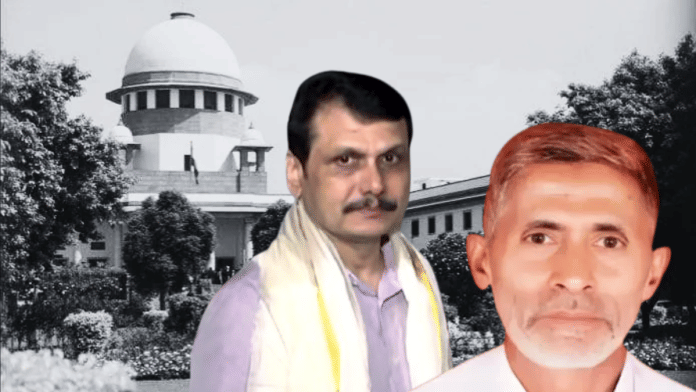
New Delhi: The course of a criminal prosecution should not depend on which political party is in power, the Supreme Court said this week, directing the trial court in Tamil Nadu to defer proceedings in the corruption case over the ‘cash-for-jobs’ scam involving former Tamil Nadu minister V Senthil Balaji.
Justice Joymalya Bagchi, adding to CJI Surya Kant’s observations, said: “The worst aspect of the administration of criminal justice is that the texture of prosecution changes with political structure. One government drags its feet, another goes post-haste. Any sanity in prosecution? We are expecting reasonable sense from the prosecutor.”
The Balaji case is not the first time the top court has confronted concerns over political influence in criminal prosecution. Over the years, it has examined attempts by state governments to withdraw cases against political leaders, stalled investigations and allegations of selective action following changes in political power.
ThePrint looks at some of these cases and how courts have dealt with questions of prosecutorial independence and political influence.
Cases withdrawn, decisions challenged
In Himachal Pradesh, the Supreme Court in September this year allowed the Congress-led state government to withdraw prosecution against sitting and former MLAs in several cases registered during the COVID-19 pandemic, modifying a Himachal Pradesh High Court order of April 2024 that had permitted withdrawal in only 15 cases.
The cases arose from protests, including effigy-burning and highway demonstrations, and involved charges under the IPC relating to negligent acts likely to spread infection, assault or criminal force against public servants and criminal intimidation, as well as provisions of the Disaster Management Act and the National Highways Act.
The withdrawal initiative followed a December 2022 Home Department directive issued after the Congress, led by Chief Minister Sukhvinder Singh Sukhu, came to power in Himachal Pradesh, replacing the BJP government headed by Jai Ram Thakur. The state had sought withdrawal of prosecution in 65 cases. Five cases were disposed of while the matter was pending before the High Court, which in April 2024 allowed withdrawal in 15 cases.
Of the remaining cases, four had already resulted in acquittal or discharge and two were repeated entries, leaving 39 cases contested before the courts.
The Supreme Court noted that the incidents alleged in these cases pertained to the COVID-19 pandemic, an exceptional situation in which people, including public representatives, were in distress. It also held that withdrawing prosecution under Section 321 CrPC requires independent application of mind by the public prosecutor and judicial consent, rather than being treated as a purely political or executive directive.
A similar issue arose in Karnataka, where the High Court in May 2025 set aside a Congress government order directing the withdrawal of 43 criminal cases under Section 321 CrPC. These included cases linked to the 2022 Hubballi riots and involving politicians, influential persons and activists.
The October 2024 government order had directed prosecutors to initiate withdrawal proceedings despite objections from the police, prosecution and law departments over the suitability of several cases. The decision came after the Congress returned to power in May 2023, replacing the BJP government led by Basavaraj Bommai.
The High Court held that the government order was contrary to the object and spirit of Section 321, which allows a public prosecutor to withdraw from prosecution, with the court’s consent, before judgment is pronounced.
The issue resurfaced in May 2026, when the Siddaramaiah-led Congress government issued another order seeking withdrawal of 52 criminal cases, including seven linked to the 2022 Aland communal violence and cases involving pro-Kannada organisations and Dalit activists. The Karnataka High Court stayed the order in July 2026, citing its earlier ruling setting aside the 43-case withdrawal order.
In Uttar Pradesh, too, the withdrawal of prosecution against BJP MLA Ram Chander in a 2012 idol immersion riot case in Ayodhya faced judicial scrutiny. The trial court twice rejected the state government’s move to drop rioting and assault charges after a charge sheet had been filed. In May 2026, the Lucknow bench of the Allahabad High Court set aside a trial court order and allowed the withdrawal of prosecution against him.
In another case, the BJP government in Uttar Pradesh in 2025 proposed withdrawing murder and rioting charges against the accused in the 2015 lynching of Mohammad Akhlaq in Dadri, years into the trial. Akhlaq’s family challenged the proposal, and a court in Greater Noida rejected it as “baseless” and ordered day-to-day hearings.
Judicial scrutiny of prosecutorial discretion
The legal framework governing withdrawal of prosecution requires public prosecutors to exercise independent judgment, while allowing courts to scrutinise whether such withdrawals serve the administration of justice.
In Sheonandan Paswan v. State of Bihar (1982) and its five-judge Constitution Bench review judgment in 1986, the Supreme Court examined a proposed withdrawal of vigilance cases following a change in Bihar’s political leadership. The cases concerned allegations against former Bihar chief minister Jagannath Mishra and others.
After a change in government, the state took a policy decision to withdraw cases described as arising from political vendetta or political agitation. A prosecutor subsequently moved for withdrawal. The case became an important part of the jurisprudence on Section 321 CrPC and the limits of prosecutorial discretion when withdrawal decisions are linked to political circumstances.
In S.K. Shukla v. State of UP (2005), the Supreme Court held that a public prosecutor cannot function like a “post box” and must act objectively as an officer of the court. It also said that courts can reject a request for withdrawal if it is not guided by the interests of the administration of justice.
Also Read: ‘Operation successful, patient dead’: When time rendered Supreme Court judgment purely academic
Selective prosecution and political expediency
In Rajender Kumar Jain v. State (1980), the Supreme Court examined the withdrawal of cases against political figures, including George Fernandes in the Baroda Dynamite case, following the end of the Emergency and the change in government in 1977.
While the court upheld the withdrawal on grounds of broader public interest and political reconciliation, it laid down that the government could only suggest withdrawal and could not compel a prosecutor to seek it.
When investigations stall or gather pace after political changes
The Supreme Court also examined concerns over the functioning of investigative agencies and the influence of the political executive on investigations.
Following the 1991 seizure of the ‘Jain Diaries’, which recorded alleged illegal hawala payments to prominent politicians across party lines and senior bureaucrats, investigating agencies failed to act for years. Journalist Vineet Narain filed a public interest litigation in 1993 challenging the inaction.
In 1997, the Supreme Court found that executive control had affected the functional autonomy of investigative agencies, with investigations progressing or stalling depending on who held power. The court struck down the government’s ‘Single Directive’, which required the CBI to seek prior ministerial permission before initiating an inquiry against senior decision-making officials.
Invoking the principle that “be you ever so high, the law is above you”, the court issued guidelines under Articles 32 and 142 to protect the CBI and ED from political interference.
The Supreme Court has also rejected attempts to withdraw cases against elected representatives on the ground that the alleged offences arose during political protests.
In State of Kerala v. K. Ajith (2021), the court rejected a move to withdraw prosecution against six legislators accused of vandalising property inside the Kerala Legislative Assembly during a protest in 2015.
The case arose after opposition legislators disrupted the presentation of the state budget and damaged furniture and other property. The state sought to withdraw the proceedings under Section 321 CrPC.
The Supreme Court upheld the refusal of the trial court and the Kerala High Court to permit withdrawal, holding that legislative privileges could not be invoked to exempt legislators from the application of criminal law for acts of vandalism. It also examined the role of the public prosecutor in deciding whether withdrawal would serve the administration of justice.
Back to the Senthil Balaji case
The case involving former minister Balaji centres primarily on an alleged ‘cash-for-jobs’ scam from his tenure as transport minister between 2011 and 2016, along with related Enforcement Directorate (ED) money-laundering proceedings under the Prevention of Money Laundering Act (PMLA).
Arrested by the ED in June 2023, Balaji was granted bail by the Supreme Court on 26 September 2024, after spending over 15 months in custody without a completed trial, subject to conditions. After Balaji resigned as minister and the Tamil Nadu Governor accepted his resignation in April 2025, the Supreme Court disposed of pleas seeking cancellation of his bail while noting that the ED or witnesses could seek cancellation again if he returned to public office during the trial.
During the 25 November 2026 hearing, Justice Joymalya Bagchi noted that the underlying cases were registered in 2021 and 2022, yet the matter was still pending in 2026. Senior advocate Rajiv Shakhder, appearing for the Tamil Nadu’s TVK government, argued that there was new urgency in the matter.
The three-judge bench of CJI Surya Kant and Justices Joymalya Bagchi and V Mohana directed the trial court to adjourn the proceedings to a date during the week commencing 14 December, with the matter scheduled for further hearing on 11 December.
(Edited by Anupama Yadav)
Also Read: Adjudicating Authority under PMLA must have judicial member to confirm property attachment, rules SC