



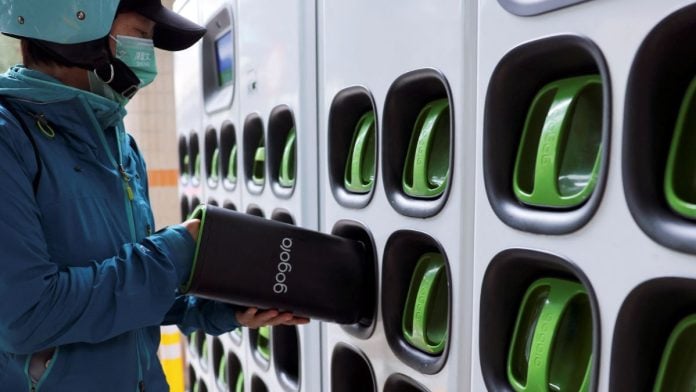
There is one debate in the world of electric vehicles, hot in manufacturer circles, but rarely featured in columns like these — the debate around fixed and swappable batteries. While passenger vehicles have been relatively immune to this debate in India, there are strong opinions when it comes to two or three-wheelers and for commercial vehicles.
Looking at global trends, in China, the undisputed technological leader in mobility electrification, both solutions are being worked on. In Europe on the other hand, while there have been a few pilots with battery swapping, most are now being shut down. India is, as I noted above, in a strange place. Manufacturers on both sides of the debate have some strong points.
If you drive across Delhi right now, you will probably see large blue boxes wearing the ‘Vinfast’ logo on the pavements of several major streets. The Vietnamese manufacturer intends to launch their electric scooters in India in January 2027, and their strategy is completely around swappable batteries.
I was speaking with Anurag Saxena, Chief Executive Officer, Vinfast Two-Wheelers India along with several other motoring journalists and they all came back to one major point. There is no doubt that home-charging is the best solution but a vast majority of two-wheelers in India, particularly in urban areas, have no access to a fixed parking spot.
“Without access to a fixed parking spot, where can you charge?” Saxena asked me.
He added that a high density of swapping stations also allows for manufacturers to offer ‘Battery-as-a-Service’ (BaaS) schemes where owners can lease batteries. Thanks to telematic solutions, where the vehicle and battery communicate back to the company at all times, these can enable innovative subscription solutions. You can pay as you go, that is for a fully-charged battery each time you swap, or you can pay for a certain number of kilometers every month and the permutations and combinations are literally endless. Of course, you can also remove the battery from your scooter and charge it at home.
Problems and solutions
It all sounds great, until you look at a rather simple problem. While Lithium might be the lightest metal, a standard one to one and a half kilowatt-hour Lithium Ferro-Phosphate (LFP) battery, which is the normal size fitted on an electric scooter with swappable batteries, comes in at 10-12 kilograms. Not something that everyone will find easy to pick and swap. Sure, a standard scooter with a total of three kilowatt-hours of electrical energy with two batteries can easily manage 125-150 kilometers on a single charge, and according to data released by Ather at their community day earlier this year, the average electric scooterist used their Ather scooter at a shade under 30 kilometers every day.
Ather is very clear about their strategy of having fixed batteries. At the Ather Community Day 26 held in Bengaluru a few months ago, I was chatting with Swapnil Jain, Co-Founder and Chief Technology Officer of Ather Energy and he explained that fixed batteries gave Ather a lot more flexibility in design — Ather batteries are underfloor, allowing them to use the same frame for a sporty product like the 450 or the family-oriented Rizta.
The secret Jain told me was the strength of the ‘Ather Grid’, the company’s charging network. There are over 6100 chargers today in over 370 Indian cities and towns. The other aspect is the ability to ‘fast’ charge.
“If you are getting thirty kilometers of range in ten minutes, that is usually more than enough for the average scooterist”, Jain had told me. The new ‘Konarc’ scooter from Ather also has an onboard charger solution that sits in the front storage compartment that can be plugged into a regular five-ampere three-pin plug.
Also read: Can an EV win Indian Car of the Year 2027?
A large market
Given that India is the world’s largest two-wheeler market, there is potentially space for every solution. The same debate holds true for three-wheelers as well — the ‘Rapid Charging’ solution offered by Bengaluru-based start-up Exponent Energy allows a three-wheeler to fully-charge in fifteen minutes. This dramatically reduces charging downtime and interestingly, as founder and CEO, Arun Vinayak told me, also allows three-wheelers to operate with smaller, ergo cheaper, batteries thus further reducing the cost of acquisition.
I will get to the ‘swappable versus fixed’ debate on trucks and buses in another column but what about cars — Why haven’t swappable batteries really taken off in cars? On an electric scooter, if you are fit, you can swap out a battery in a couple of minutes by yourself and be on your way. Swappable batteries on cars are far more complicated but fascinating at the same time.
The largest Lithium-Ion battery manufacturer in the world, China’s CATL has a solution called the Choco-SEB (Swapping Electric Block, and Choco because it looks like a giant bar of chocolate) that can be swapped in and out of a car in just about 90 seconds though a robotic swapping station. I would highly recommend that you watch the video of the swapping rather than me explaining it, but suffice to say it is fascinating.
No Indian manufacturer has thought of such a solution until now. However, while CATL’s swappable batteries might be smaller than fixed batteries, they are still large and heavy. The question also remains — how many batteries should be bought per vehicle? Is 1.2 a good ratio or would you need 1.5 or even two?
In addition, the robotic swapping station is also a challenge. While public infrastructure isn’t always safe from miscreants in India, such swapping stations can be placed at more secure locations like near malls or multi-level parking. It does work for taxi operators though and such swapping stations could also provide an elegant battery-energy storage solution.
But CATL themselves could make swappable systems redundant with their ‘megawatt’ charging solutions that allow cars to get 500 kilometers of range in six-seven minutes. At the launch of BYD’s Denza luxury brand, the company said that their new vehicles could get from 10-90 per cent in nine minutes — over 600 kilometers of range.
Personally, I don’t think swapping stations are a viable solution unless they come from a large electric taxi provider but in the two and three wheeler space, swapping could become quite big indeed.
Kushan Mitra is an automotive journalist based in New Delhi. He tweets @kushanmitra. Views are personal.
(Edited by Janaki Pande)