





Foreign hand,” screamed the headline on one Karachi magazine in 1952: Like the fruit-and-vegetable vendors, minibus owners, drug addicts, and homeless people who would later colonise Khan Bahadur Behramjee Jehangirjee Rajkotwala Park, the crowd which trampled over the flower-beds and lawns was actually drawn from the nearby lanes of the Saddar market. The mob had tried to burn down the Shezan Hotel, Shahnawaz Motors, and a community library before throwing stones at Chaudhuri Sir Muhammad Zafrullah Khan, Pakistan’s foreign minister, who was delivering a learned lecture on the theological traditions of his heterodox Ahmadi faith.
The eminent police officer and spy Qurban Ali Khan snorted dismissively when he was told of the magazine’s claim: “I do not think any Foreign Power would attach, or has any need to attach, so much importance to Pakistan.”
For once, Ali was wrong. Weeks earlier, in March 1952, Zafrullah had secretly pushed for a meeting of a dozen prime ministers in Karachi to discuss setting up a Muslim security bloc to resist Communism. The meeting was never held. The divergent security interests of the countries led some to hold back. The savage anti-Ahmadi communal violence in Pakistan, which ran from 1952 to 1953, demonstrated the considerable gap between the idea of Muslim unity and the thing itself.
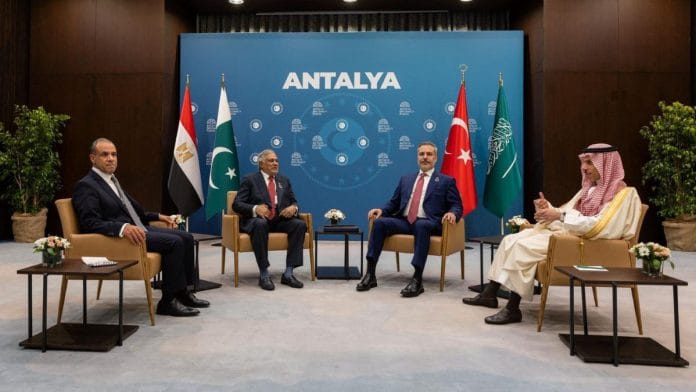
This week, the same countries at the heart of the 1952 effort have again been pushing for a security alliance. Led by Türkiye and Saudi Arabia, and with Pakistan and Egypt as its providers of hard military power, the group has held a succession of meetings through March and April. It seeks to push back against Iran’s power in the Persian Gulf, but also resist the growth of Israeli and United Arab Emirates influence around the Red Sea and the Horn of Africa.
As in 1952, the project has the enthusiastic support of the United States, which sees such a bloc as a tool to mitigate its military commitments in the Middle East. There is a difference, though, between hopeful desires and the realities of strategic policy.
England’s Islamic bloc
The idea of a post-colonial Muslim security bloc was not crafted in Islamabad or Istanbul. Liaquat Ali, Pakistan’s first prime minister, was approached by British diplomats in late 1949 to discuss security cooperation. The prime minister rejected the dialogue, though, after he was told the United Kingdom was not ready to include the status of Kashmir in the dialogue. Emmanuel Shinwell, who served as Britain’s defence minister in 1950-1951, brought up the idea again in 1950 and 1951. Liaquat, the diplomat Stephen Olver recorded in a top-secret note, replied that “it would be easy enough to raise Pakistan divisions—but he could do nothing until Kashmir was solved.”
Little imagination was needed to understand why these ideas had surfaced. The British Indian Army had long been the backbone that upheld England’s Empire in the Middle East: A half-million Indian soldiers served in Iraq alone during the First World War, while several cavalry and infantry units fought in Suez, Palestine, and Gallipoli. Following independence, though, India made clear it no longer wanted its troops fighting foreign wars.
Francis Tuker, the last commander-in-chief of the British Indian Army, was among many colonial officers who saw Pakistan shoring up an Empire almost bled dry by the Second World War. “With a northern Indian Islamic State of several millions it would be reasonable to expect that Russia would not care to provoke them too far,” Tuker mused in his memoirs. “There was much therefore to be said for the introduction of a new Muslim power supported by the science of Britain.”
Turkish and Iranian troops, a top secret National Security Council note circulated by US Assistant Secretary of State George McGhee in December 1950 recorded, would work with the UK to hold the Soviet Union back from Persia. The note flagged the problem of low human capital in Arab states, which would guard the inner ring of Persian Gulf oilfields. Yet, there was just one passing reference to Pakistan, and none to its military potential.
Less than three months passed before Islamabad moved from the footnotes to centre-stage. America’s ambassadors in the Middle East met in February 1951 and concluded that Islamabad was the sole credible security partner in South Asia. McGhee was particularly taken by Pakistan’s Generals: “They openly sought aid on our terms, promising support in our efforts to build a defense against the Communist threat. Compared with the wishy-washy neutralist Indians they were a breath of fresh air.”
The construction of the Cold War seemed to be running to plan—and then suddenly, it wasn’t.
Also read: Lessons from Op Sindoor—Pakistan spent on building, and India spent on deliberating
Things fall apart
Like a jigsaw puzzle in a nightmare, the pieces US diplomats slotted just wouldn’t stay put. For one, violence erupted along the Kashmir Cease Fire Line in the summer of 1951. Two Indian soldiers were ambushed, and their bodies dragged into Pakistan-occupied territory. Three more Indian troops were killed days later. Troops from the Indian Army’s 1 Armoured Division were moved forward from Meerut to Punjab, together with the 4 Infantry Division and 2 Independent Armoured Brigade. Further troops were positioned along the border with the erstwhile East Pakistan.
The war to come, Nehru brooded, would be “neither brief nor gentlemanly”. He predicted, instead, “a bitter conflict full of suppressed hatreds”.
At a meeting in the autumn of 1951, former Foreign Secretary of Pakistan Mohammad Ikramullah arrived in Washington, seeking military aid. America’s failure to resolve the Kashmir crisis, Ikramullah argued, would mean the end of “those who had tried to work with the West”. The Director of the State Department’s South Asia desk, Donald Kennedy, later circulated a note arguing that Pakistan would be more secure if it became a member of the new Middle East defence organisation.
Foreign Office officials in London, though, soon saw through these claims. Liaquat had encouraged the Islamist project after taking power, as a means to give the regime legitimacy and marginalise the clerics.
“We have not created Pakistan to spread some more colour on the map of the world, but to serve Islam and Muslims and strengthen the bonds of world Muslim unity,” he said in a speech.
This project, the diplomat BAB Burrows noted, constrained the Generals from seeming to act in alliance with the West—even if they were only too willing to do so in private. The “Islamic feeling” gaining influence in Pakistan, Burrows concluded, supported its involvement in the defence of the Middle East—but not on Western terms. The new Islamic state could act to defend Islam in the Middle East against the West, but not as an ally of infidels.
Months after the meeting between Ikramullah and Kennedy in Washington, the dominoes began to fall—but not in the way Americans had expected. King Farouk bin Ahmed’s monarchy in Egypt was overthrown in 1952, in a coup by nationalist military officers. This would lead to the Suez crisis, and the humiliation of the UK. There would be a crisis in the Persian Gulf, unleashed by an Iran seeking to become the regional hegemon. The Saudi monarchy would seek to seize territory from Oman as the sun finally set over the Empire.
Also read: America’s new energy frontier runs through baroque Balkans. New Delhi must know why
The end of illusions
Even in 1954, it was clear to the Central Intelligence Agency (CIA) analysts that America’s Middle-East plans were going nowhere: The emergence of nationalist movements, post-colonial border conflicts, and ideological suspicions rendered the idea of an Islamic grand alliance absurd. Turkey, Iraq, and Pakistan signed on to a treaty in 1954, raising hopes that it might one day turn into a kind of eastern version of the North Atlantic Treaty Organisation. Iran later joined the organisation, which was called the Central Treaty Organisation.
The new group proved ineffectual, just like the old one, and was dissolved in 1979. The Pakistan Army played a role in regime protection, notably in Saudi Arabia and Jordan. However, it stayed out of the Middle East’s more consequential crisis.
Another learning was to prove even more painful. Soon after the Second World War, the CIA and the UK’s intelligence services had reached out to jihadists, seeing them as allies against communism. The patronage led Islamist organisations to flower in many parts of the world, from Europe to Pakistan. The road from those efforts, though, inexorably led to 9/11, and the many horrors which have followed it.
For all the polemics about a new axis emerging in the Middle East, the ends the four-nation alliance seeks are far from clear. Egypt and Türkiye have proved unable to bring even minimum security to Libya; Saudi Arabia is deeply hostile to the Muslim Brotherhood, which Türkiye sees as a partner in the Middle East.
And Pakistan still remains mired in the confrontation with India, which it was engaged in back in 1947.
Praveen Swami is Contributing Editor at ThePrint. His X handle is @praveenswami. Views are personal.
(Edited by Prasanna Bachchhav)
Middle East alliance ❌
Global Ummah* ✅
*From Daraz/Temu though