





The soldiers landed on the blood-red cliffs under the light of the setting sun: Less than two kilometres across, the island of Tunb-e Kuchak was only home to saw-scaled vipers and cobras, living under the dense saltwort undergrowth. Things went less well on Tunb-e Bozorg, the larger of the twin islands. The Emir of soon-to-be-an-Emirate Ras-al-Khaimah, Saqr Bin Mohammed al-Qasimi, had been notified of the Iranian landing in advance, but neglected to inform the six-man police contingent on the island. Firing broke out, killing three Iranian soldiers. The survivors retaliated, mowing down four police officers, then demolishing their building, the local school, and several homes.
Late on the morning of 30 November 1971, Imperial Iran’s troops completed their operation, taking charge of a third island, Abu Musa, as part of a British-negotiated deal with Sharjah. The 150-odd people on Tunb-e Bozorg, who made a living from fishing and smuggling, were ordered off the island, after the dead had been buried. Tehran concluded agreements to share the gas and oil revenues from the Pars gasfield; the Emirates had no choice but to sign.
For Indians seeking to make sense of the military influence Pakistan exercises in Saudi Arabia and the Persian Gulf, the events on the tiny islands in the middle of the Hormuz strait are key to getting a little-understood story right. The crisis in the Persian Gulf didn’t begin with the Iranian revolution in 1979; nor was Tehran’s nuclear programme the problem.
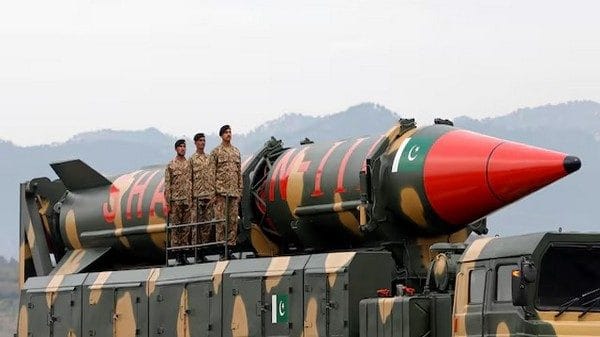
As British control began to dissolve from 1971, the monarchies on the Persian Gulf rim suddenly began realising that their oil wealth wouldn’t guarantee their survival. And that’s where Pakistan stepped in, offering its military to a staggering 22 countries, involving some 30,000 personnel, gaining millions of dollars in compensation as well as funding for its nuclear programme.
Also read: Pakistan fighter jets & support aircraft reach Saudi Arabia as part of mutual defence pact
The city in the stones
From tens of thousands of metres above the rock inscriptions, where great trade caravans from the Nile once brought incense, copper and gold, a CIA spy-plane discovered its own treasure: Eight battalion-sized unit areas had been erected, enough to house a brigade-sized armoured formation in Tabuk. The CIA’s image analysts confirmed separate intelligence that had begun arriving from around 1980. The Saudis had raised their first armoured unit, the 4th Armoured Brigade, in the late 1970s. The French had supplied AMX-30S main battle tanks and AMX-10P infantry fighting vehicles. The arms, though, didn’t address the real problem: Chronic manpower shortages compelled the Saudi army to operate at only 30–40 per cent of authorised strength.
Wearing Saudi uniforms and designated the 12th Khalid bin Walid Armoured Brigade, the Pakistani troops led by Brigadier Mehboob Alam included three tank battalions, one mechanised infantry battalion, one self-propelled artillery battalion, and supporting air defence and engineer units. Alam came from a family of nine sons, all of whom served in the wars of 1965 or 1971, two killed in action. The force saw no significant combat in Saudi Arabia, sitting on the sidelines during the First Gulf War—but that wasn’t the point.
To protect itself against India, Pakistan joined the anti-Communist Baghdad Pact, which evolved into the Central Treaty Organisation, CENTO. The organisation achieved little, but gave Pakistan’s military an opportunity to market its services in the Middle East.
Even though it had begun to emerge as one of the critical gears of the global economy, the Saudi monarchy knew it was negotiating troubled waters.
Egyptian President Gamal Abdel Nasser’s charismatic Arab nationalism ensured the market was a good one. Arab nationalism had energised a generation of young people. The overthrowing of Egypt’s own monarchy led, in quick order, to the collapse of kings in Yemen and Iraq. The pro-Soviet Union government in Yemen promptly attacked Saudi Arabia, in an assertion of long-standing territorial claims.
Struggling to repel the attack, Saudi commanders turned to Pakistan. Fighter jets flown by Pakistan Air Force pilots beat back the Yemeni intrusion—but the real lessons of the crisis weren’t lost on the Gulf monarchies.
The British had ruled over the Gulf for more than a century, guiding the destinies of the so-called Trucial states—Abu Dhabi, Ajman, Dubai, Fujairah, Ras Al-Khaimah, Sharjah and Umm al-Quwain—as well as Iran, Iraq and Yemen. That power was receding, though. The British warships HMS Eagle and HMS Albion observed the invasion of the Tunbs, choosing not to intervene, even though the islands were part of the colonial protectorates which would soon become the United Arab Emirates. The reasons weren’t hard to understand: Iran had committed to purchasing hundreds of millions of pounds of UK-made weapons.
Emirs and kings thus found themselves evicted from the closeted gardens of the Empire into a world full of predators. The emirate of Sharjah saw a coup attempt in 1965, followed by Abu Dhabi in 1966, and Oman in 1969. The Saudi monarchy had struggled to push back the Free Princes Movement in 1958 and faced a succession of plots by Air Force officers in 1969. The outcomes, as scholar Abdel Razzak Takriti has shown, often went down to the wire.
The Shah of Iran, Mohammad Reza Pahlavi, watched the liberation of Bangladesh with particular concern, worried that the Americans were willing to abandon their allies in the face of a serious crisis. Following the Indian nuclear tests in 1974, the Shah made clear he was considering a strategic weapons programme. To ensure Tehran did not emerge as a regional hegemon, Saudi Arabia had meanwhile begun working to hammer down oil prices and the Shah’s revenues.
Evidence began to surface from 1981 of large Saudi grants to Islamabad’s nuclear weapons programme. The garrison at Tabuk began blossoming from the stones—not to defend any particular border, but to protect the House of Saud from destruction.
Also read: Pakistan is fighting a two-front war. I saw it coming 15 yrs ago
The wars in the shadows
From early in their Middle East deployments, Pakistani soldiers found themselves sucked into frontline warfare. Even though the historical record is thin, the military ruler General Muhammad Zia-ul-Haq is known to have participated in crushing the Palestine Liberation Organisation when it tried to seize Jordan in 1970. Fighter pilots of the PAF also participated in combat operations against Israel in April 1973. Air Commodore Sattar Alvi was honoured by Syria’s government thirty years after the war for shooting down an Israeli Mirage 3—while flying an aircraft well known to the Indian Air Force, the MiG21.
The case for ensuring that large numbers of low-cost Pakistani troops were garrisoned in the Middle-East, was simple. From the first hand of their own tribal militia in the First World War, Arab Bedouin had learned how irregular forces could tie down and cripple far larger adversaries. The insurgent warfare seen in the Hejaz did not win the Middle East for Britain—but the incessant attacks on railways and civic infrastructure hollowed out Turkish rule.
Praveen Swami is contributing editor at ThePrint. His X handle is @praveenswami. Views are personal.
(Edited by Theres Sudeep)
Some indications that Saudi Arabia may play a constructive role in starting a dialogue between India and Pakistan. 2. Speak in a completely unemotional, unsentimental voice. The decade long rupture in diplomacy cannot be considered a foreign policy success or achievement. There is no way to destroy a nuclear armed adversary without inviting an unacceptable response. 3. SAARC has been mothballed for a decade. No comparable lack of regional cooperation and connectivity anywhere else in the world. In a world where so many certainties and alliances are breaking down, India’s prosperity and advancement must be anchored in a harmonious South Asia.
Pakistan is like a school boy who was bad at studies, got bullied for being unintelligent, got into a college through the backdoor, graduated without any skills, changed jobs or got fired because of incompetence, but still lives to see another day by hook or crook.