








The first week of June witnessed two major events in the country. The momentum of both, and the discussion around them, continues in one form or another.
First, news came of the regular theft of offerings at the Ram Janmabhoomi Temple in Ayodhya. A most senior office-holder of the Vishwa Hindu Parishad, Champat Rai, was in the line of fire, and had to step down ultimately from his position in the temple trust. Second, the youth movement led by the satirical Cockroach Janta Party (CJP) resulted in the resignation of Dharmendra Pradhan—also from the Sangh Parivar—as Union education minister.
What is noteworthy is that in both cases, the Sangh leaders opened their mouths only weeks later. And in neither case did they accept any fault of their own. The RSS mouthpiece Organiser even called the Gen Z movement ‘anti-India’ and ‘anarchic madness’. In fact, throughout June and July, the social media handles that support RSS-BJP were engaged only in pouring dirt upon the CJP and Gen Z. It would be naive to believe that the leaders of the RSS had a sudden change of heart.
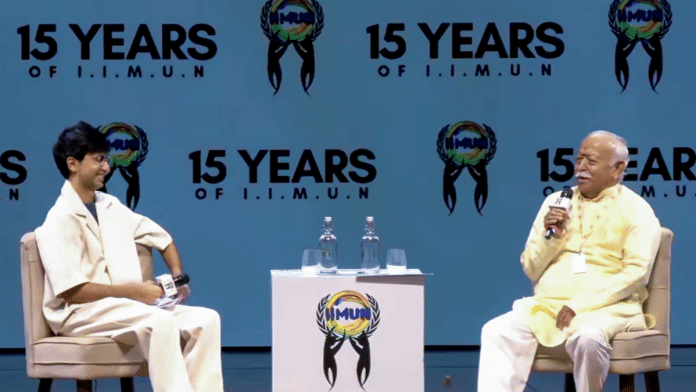
That is why the statement made by Sarsanghchalak Mohan Bhagwat in Mumbai on 6 August is, in a way, newspeak.
“The grievances of Gen Z are justified. If they had been spoken to earlier, there would have been no need for the movement. We should listen to what they have to say… When other avenues do not work, one has to protest. Protest is a legitimate method,“ Bhagwat said.
He added that “young people who launch a movement over their demands cannot be called anti-national.”
Thus, Bhagwat tangentially criticised the BJP leadership for not having engaged the young protesters earlier. That is, the task that Prime Minister Narendra Modi assigned to his trusted ministers, JP Nadda and Jitendra Singh, six weeks later should have been done much sooner.
What does Bhagwat’s criticism show, coming an entire two months after the Gen Z movement began? Most political folks regard it as good politics. When the ruling Sangh Parivar leaders failed to bend the movement, other faces from the ecosystem are now trying to make it their own, so that the Opposition cannot derive any benefit from it.
But there is another aspect to the criticism. It is an old tendency of the RSS that it wants to have a space, possibly controlling space, in every sphere of the society: every institution, every governing entity. Occasionally criticising a government run by its own trained folks is a part of this strategy. It ensures that the role of the ‘Opposition’ too remains to the possible extent in its own hands.
The criticism always arrives late
It has been observed since the time of the Vajpayee government that senior RSS leaders occasionally criticise the rulers on some or the other issue. But such criticisms appear to lack any principle or seriousness. They are made only when the government has already suffered complete humiliation over something. But while those actions are taking place or policies being announced and implemented—even when they are contrary to the declared position of the Sangh Parivar—RSS leaders keep mum. A case in point is the duties of the Government of India toward the Hindus of Bangladesh. RSS leaders had a long list of big demands, including ‘raising the issue in the UN’ when Congress was in power. Now, it has none.
The present critical position over Gen Z is posture alone. A similar posture appeared after the results of the last Lok Sabha elections, too. When the BJP won 240 seats instead of crossing 400, RSS leaders took jibes at the party leadership’s intemperate language and arrogant manner during the election campaign.
This gives the impression that occasional criticisms by Sangh leaders are merely a tactic. First, it is a damage-control activity so that Sangh-BJP supporters do not become disappointed and may not look elsewhere for leadership—and that the Opposition does not gain. Second, it pressures BJP rulers to offer the Sangh a greater share in power, indirectly. The RSS wants to increase its direct and indirect hold over various fields—particularly in education and culture. In the words of a senior Sangh leader, it doesn’t want the BJP to ‘neglect its own people’.
Therefore, the Sangh’s occasional criticism of or jibes at BJP leaders inspire no confidence for betterment. The talk of respect for dissent and toward the Opposition also appears contrived. It is not only the Opposition but also independent critics who have been subjected to verbal attacks and insinuations by Sangh Parivar leaders and activists. After all, was the slogan of ‘Congress-free India’ a mark of respect for the Opposition?
Also read: Who is the voting Gen Z? The Kanwariyas or the Jantar Mantar youth
An old pattern
Foul statements by those in the Sangh ecosystem include calling Opposition leaders a ‘Jersey cow’ or a ‘hybrid calf’, describing someone as having a ‘fifty-crore girlfriend’, and alleging that the people of Bihar have a ‘defect in their DNA’. RSS leaders have silently watched all this. Rather, they rejoiced discreetly so long as it worked in gaining numbers in the political field.
Indeed, had the BJP crossed 400 seats in 2024, Sangh leaders would certainly not have criticised its ‘intemperate language’ and ‘arrogance’. Similarly, if the CJP had ended up as a damp squib, we would not have heard these changed statements from the RSS chief either.
If crude statements, arrogance, and big lies produce electoral gains, or if the authority and clout of those in power remain intact, then everything is fine. In such an event, even when questioned, only explanations are offered: ‘Politics is such a business, you can’t help it’, one hears. This is done to satisfy the uncomfortable supporters.
This has been the pattern for a long time. Over the past 25 years, the RSS has continued to offer apologies for one bizarre and improper act after another by BJP leaders. Sometimes, its middle rung itself levels false allegations and engages in mud-slinging against critics. This displays the same arrogance and bad language, even though it is not as public.
Thus, one finds no principle behind the periodic criticism of the BJP by Sangh leaders. It has been more a tactic to manage their position and readjust it to whichever way the wind is blowing.
It somewhat also resembles the Hollywood trick of ‘good cop, bad cop’. The objective of both remains the same; only the methods are different. The RSS-BJP leaders have been playing a similar game for decades with ordinary supporters and with their own workers.
On the one hand, responsible people in both the RSS and the BJP remain closely involved in every stratagem serving partisan interests. This can be seen, with little observation, in the education arena at present. But instead of stopping unscrupulous practices, the two organisations mislead supporters by presenting it as ‘helplessness’ or a ‘temporary necessity’. When a matter becomes completely exposed, or when a leader or high office-holder gets thoroughly beaten, they wash their hands off it. As if they are not responsible for such choices.
Also read: CJP protest is a turning point for Indian Muslims. Speak as citizens, not as a religious bloc
Diversion tactic
Even a cursory assessment shows that talk of any ‘difference’ between the RSS and the BJP is exaggerated. The so-called tension between the two is largely a thing to feed the media and gullible supporters. One purpose of it is also for Sangh leaders to present themselves as holier than the BJP ones. At the same time, it is a means of diverting and suppressing the discontent of simple and decent workers within the Sangh. It’s a useful technique for diverting attention from genuine questions.
After all, it is a normal practice throughout the world that when leadership has made mistakes, caused harm—including electoral loss—that leadership is replaced. In Europe, leaders resign on their own, without any demand being raised. This is both ethical and necessary. It is also good for the health of an organisation and a party, so that new ideas and energy can continually find a place. But here, among Hindus generally, and in the Sangh-BJP particularly, there has been a tendency to reject this altogether.
Therefore, the periodic talk of ‘tension’ appears merely to be an old ploy to make the RSS and the BJP appear separate from each other. Although fundamentally, both are the same Parivar. They merely wear two outfits so that if one gets splashed, the other can declare itself spotless. The essential political project, to capture maximum space, can continue. In the general condition of the country’s intellectual decline, the project has succeeded, and the likelihood is that it will continue to do so.
Shankar Sharan is a columnist and professor of political science. Views are personal.
(Edited by Prasanna Bachchhav)