






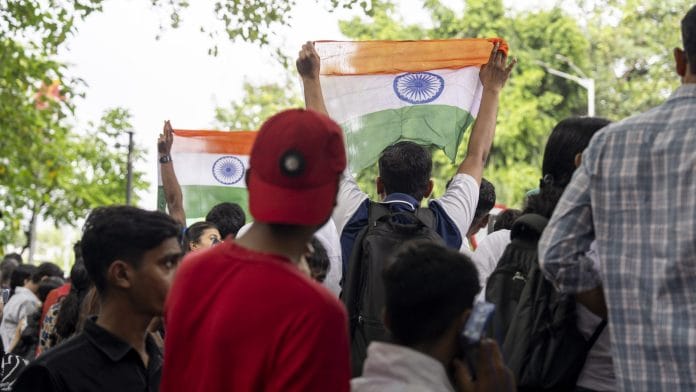


The recent protests led by Generation Z in India, following similar youth-led movements in neighbouring countries, have reminded everyone of one simple fact: young people are no longer just the future of politics; they are becoming its present.
More importantly, they have reminded political parties of something they can no longer afford to ignore. By the time India votes in the 2029 Lok Sabha election, Gen Z is expected to be the country’s largest adult group. Any party hoping to govern India will also have to win the confidence of a generation that thinks, communicates and mobilises very differently from those before it.
It is also the first generation that has never really known life without the internet. They grew up with smartphones, cheap mobile data, social media and intense economic competition. They are true digital natives, connected to the world in ways previous generations never were.
But growing up in the same digital world does not mean they all think alike – how they see that world, and how they react to it, differs sharply depending on their background.
Gen Z is not a monolith
When people talk about Gen Z in India today, many immediately think of the students who protested over examination reforms and accountability; a generation that used digital platforms to organise, mobilise, and put pressure on institutions. Their demands were largely civic, academic, and economic: transparent examinations, ministerial accountability, and meaningful reforms.
But they forget that the Indian Gen Z is not a monolith, and treating it as one is a mistake. Just like every generation before it, this one is also diverse, fragmented, and often full of contradictions. The same generation using social media to demand institutional reforms is also using those very platforms to create nationalist content, share hyper-local news, and celebrate religious identity.
Just as India cannot be understood through one story, neither can its Generation Z – the country is simply too large and too diverse for that.
A young person growing up in Mumbai or Bengaluru may spend more time talking about climate change, mental health, gender equality, or global pop culture. For many young people in smaller towns and villages, however, the priorities are very different – finding a stable job, clearing a government examination, financial family support, and improving their economic future often come first.
That same divide runs across class lines, too. A Gen Z graduate from an English-medium, private-school background may have better access to global opportunities, remote work, and international education. Millions of others who lack that access are trying to survive in the gig economy, preparing for competitive examinations, or struggling to find their first stable job after college.
And then, on the other side, there are the young Kanwariyas. Every Shravan, millions of young people, many from rural India and small towns, walk hundreds of kilometres carrying holy water for Lord Shiva. For many outside India, and even for some urban Indians, this is probably the last place they would expect to find Gen Z. Yet it is impossible to miss them as they document their journey through platforms like Instagram Reels and YouTube Shorts.
They all belong to the same generation. They all use the same internet. But they do not experience the same India. And that difference shapes the politics they care about, the leaders they follow, and the future they hope to build.
All of this makes the picture far more complicated than it first appears. It also explains why there is so much debate about Gen Z. The young Kanwariya is often seen as naturally leaning towards the BJP, while many urban voters from this generation are increasingly viewed as anti-establishment.
A challenge for all parties
So, can the BJP succeed by satisfying only one section of Generation Z? And even if it does, what guarantees that those same young voters will remain loyal tomorrow if they continue to struggle with jobs, rising competition and economic uncertainty?
That is why the BJP should be paying close attention. Gen Z is transactional and less patient than previous generations. Cultural pride and identity may attract young voters, but they cannot permanently replace opportunities, secure employment and economic mobility.
The BJP can rightly point to its achievements in building infrastructure, expanding digital services and modernising public systems. Young Indians benefit from these changes every day as citizens and consumers. But many of them still feel that these achievements have not translated into what they need most: stable, formal employment and a clearer path towards a secure future.
That does not mean other political parties have nothing to worry about. While the BJP, as the party in power, may be affected the most, winning the trust of a generation that is increasingly sceptical of traditional politics will be a challenge for every political party.
Who the “real” Gen Z is, and what it truly wants, will remain a matter of debate. But one lesson is already clear: every political party will have to rethink its approach towards young voters.
Even the way they consume politics is changing. Gen Z increasingly gets its information through short videos, Instagram reels, and digital creators, unlike previous generations, who spent more time on television debates, newspapers, or WhatsApp. Politics is adapting to this new reality, and parties are changing how they communicate because they know the next election will be fought as much on smartphone screens as on the ground.
The biggest lesson for India’s political class is that Gen Z is not waiting for politicians to define it. It is defining itself – in classrooms, on pilgrimage routes, in coaching centres, on reels and on the streets.
The party that understands this diversity will have a far better chance of winning their trust than one that assumes a single message can speak to nearly 380 million young Indians.
Amana Begam Ansari is a columnist, writer, and TV news panellist. She runs a weekly YouTube show called ‘India This Week by Amana and Khalid’. She tweets @Amana_Ansari. Views are personal.
(Edited by Maryam Hassan)