





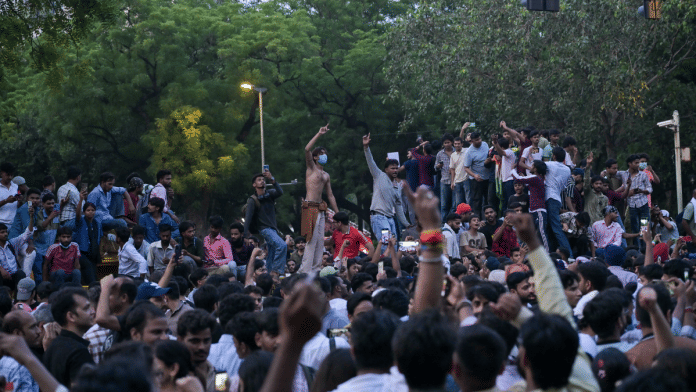

So, what’s next? This question has been posed by more than one political commentator on the Cockroach Janta Party protest, even as they delighted at the irrepressible energy and the subversive wit, while decrying, and very rightly, the police excesses.
If the answers were vague and conditional, it is essentially because there is fundamental lack of clarity about what will happen next. With the CJP declaring that it will remain, at least for now, a political pressure group, will its next protest have the same traction? Since the CJP hasn’t been categorically ruled out, will it morph into a recognised political party? If it remains a political collective, can it impact the 2029 Lok Sabha election or the Assembly elections that precede it?
Rather than address such questions with speculative guesses, it is more rewarding to ask a somewhat broader one. How could the youth vote impact India’s electoral future? We don’t need to look very far to see that it could do so considerably.
Gen Z and the broader youth cohort have altered the very political landscape of our neighbourhood. In Nepal, where over 42 per cent of the population is aged between 18 and 40, a massive anti-establishment uprising forced a Prime Minister out of office and saw a youth-led Rastriya Swatantra Party (RSP) win by a historic landslide in a snap election earlier this year.
In Bangladesh, Prime Minister Sheikh Hasina was forced to flee following a student revolt. The National Citizen Party (NCP), birthed by the movement, may have failed to do well in the ensuing election in February. But this was, and in no small measure, because of its decision to ally with the Islamist Jamaat-e-Islami, which sharply polarised the youth. This regional blueprint was drafted earlier in Sri Lanka, where the aragalaya or struggle forced President Mahinda Rajapaksa out, setting the stage for an election in which the traditional political players were routed, and the Marxist-leaning outsider Anura Dissanayake swept to power in late 2024.
Also Read: Modi govt response to Gen Z protest shows a rare vulnerability. It’s an opportunity for Opposition
India and the Tamil Nadu example
There is no reason to believe that India is immune to the power of generational discontent to herald political change. India’s voter roll in 2024 recorded 210 million voters aged between 18 and 29, almost 22 per cent of the electorate. If the definition of the young is extended to all those below 40, which is reasonable given shared economic anxieties and similar patterns of digital news consumption, then the figure goes up sizeably. About 41.5 per cent of Tamil Nadu’s 5.73 crore electorate in the recent Assembly election were aged between 18 and 40.
To ask whether this demographic cohort can critically influence an election is to miss the fact that it already has. Chief Minister Vijay’s victory in Tamil Nadu is easily the most persuasive example of this in India’s electoral history. The post-poll data, collected by Pradeep Gupta’s Axis My India, whose anomalous but accurate exit poll earned him well-deserved praise, is extremely revealing.
Among first-time voters, Vijay’s TVK secured 68 per cent of the vote, 59 per cent among those aged between 20 and 29 and 45 per cent among those between 30 and 39. It fared considerably worse than the DMK and the AIADMK among voters above 40 years, a segment that constituted 58 per cent of the electorate.
If this was not a generational wave, then what is?
As an aside, Gupta’s data shows up the smug and supercilious fatuity of those who suggested that Vijay’s victory was propelled by the great unwashed, illiterate and semi-literate cinemaniacs, or mere tharkuris (to use the dismissive Tamil slang for foolish people). The data shows this up as sheer nonsense.
The TVK easily bested the DMK and AIADMK in every educational segment from Class 10 pass to graduate, post-graduate and professional degree holders. The only segments where the two Dravidian majors performed better than the TVK are among those who never went to school and those who studied up to Class 9.
Vijay’s victory has drawn nationwide attention to the capacity of the digitally wired youth-centric voting bloc to disrupt traditional political arithmetic and upend established parties. In Tamil Nadu, the lessons have forced the two defeated Dravidian majors to pivot to appeal to youth. The overhaul of IT cells, the sudden reliance on memes, and the launch of youth outreach programmes, such as ‘Gen Z DMK’, are examples of this.
The CJP-led movement will force all political parties to restructure their policies and campaigns to address the frustrations and anxieties of young voters. Prime Minister Narendra Modi urging his ministers to scale up their Instagram presence and post more engaging reels is the most recent sign of this shift.
Challenge to the BJP after a decade
Among all the political parties, the BJP has the biggest reason to worry about the impact of the youth vote. Although the new generation’s voting patterns are influenced by a general suspicion of traditional political parties, they are pointedly opposed to the establishment. a space the BJP occupies.
The 2024 Lok Sabha election offers a small but relevant data point. The Lokniti survey showed the BJP slipping by a couple of percentage points among those aged between 18 and 25 and those aged between 26 and 35. At the same time, the Congress increased its vote share by two percentage points among these cohorts.
In 2014, Modi came to power riding on the support of this very demographic. It hasn’t abandoned them yet, but as The Hindu’s Varghese George pointed out in a perceptive column, while WhatsApp may have helped the rise of Modi’s BJP in 2014, Instagram is challenging it a decade later.
It is a reminder that what we are seeing now is not only a new generation of voters, but a change in the very architecture of persuasion itself.
Mukund Padmanabhan is a professor of philosophy at Krea University and former Editor of The Hindu. Views are personal.
(Edited by Maryam Hassan)