






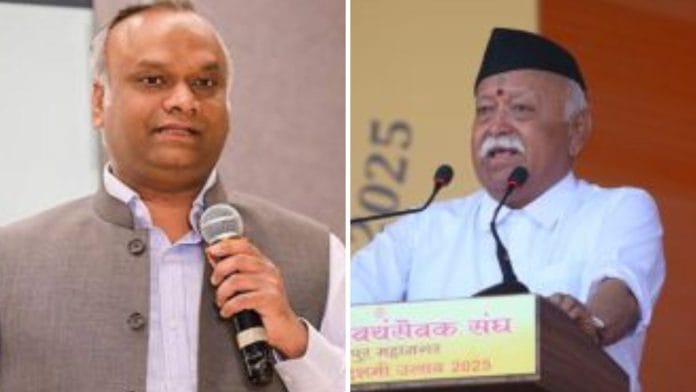


Priyank Kharge, Karnataka’s Home and IT Minister, believes that he has the Rashtriya Swayamsevak Sangh (RSS) on the ropes with his letter dated 13 June addressed to Mohan Bhagwat. In his letter, Kharge asked for the registration details of what is widely touted as the world’s largest NGO. In a politely-drafted letter to the RSS chief, a letter that had undertones of political menace, he requested “the RSS to depute its authorised office bearers to explain the legal grounds on which an organisation of such magnitude continues to function with anonymity and without being formally registered as a legal entity.”
One need not go into the politics of it too much. It is obvious that the dynast, son of Congress chief Mallikarjun Kharge, believes that he can open up new pathways for political progress by taking on the RSS – a project with which Rahul Gandhi too may agree. In fact, Rahul has repeatedly talked about the RSS as the ideological enemy to defeat, and even compared it to the Muslim Brotherhood. The BJP could well say that the Congress appears to be the new Muslim League.
The choice of Priyank Kharge – assuming he has Gandhi’s blessings – to lead the attack on the RSS is significant, for it automatically ensures two things for the Congress. It solidifies its support among the minorities, and simultaneously prevents the BJP from targeting Kharge personally, for then it could be claimed that he was being attacked for being a Dalit. This would serve to solidify the Congress’ support among Dalits, many of whom have drifted towards the BJP and regional parties.
However, leaving aside Kharge Jr’s political intentions, the bigger question to ask is why the state needs to spread its tentacles into every civil society organisation, small or big. It is one thing to ask an organisation to register when it solicits public funds, but why would an ideological organisation need to register itself? The RSS currently operates as a “body of individuals”, a form that is legally recognised as valid. All of RSS’s front organisations, including the Vishva Hindu Parishad and the various social organisations which raise public funds, are registered.
If ideas have to have impact, they must, by definition, need to find some traction among the people. The RSS is what it is because of the ideas it espouses, not because it is (or is not) a registered organisation.
An organisation which seeks to primarily influence individual and group behaviour can theoretically exist without being formally recognised by the state. The funds that may be required for the functioning of this “body of individuals” can, again in theory at least, be provided by well-wishers. The office-bearers and organisation itself can operate out of properties owned by its front entities, or facilities provided by private individuals. The RSS leadership famously receives “guru dakshina” on Guru Purnima, which may or may not be disclosed as income by the individuals concerned, but existing laws are enough to exempt gifts up to Rs 50,000 annually from tax, and gifts given by, say, blood relations, are also untaxed. If my brother gifts me a large property, or gives me a large sum out of love and affection, it is tax-free.
Most RSS karyakartas do not depend on the organisation to earn a living. Otherwise they won’t be giving “guru dakshina”. Only those office-bearers who have full-time duties and cannot work full-time in regular corporate or government jobs may need financial support. And these people may be very few in number.
It is my guess that the RSS’s top people who may need some form of personal income are either supported by its front organisations, or by individuals who believe in the RSS, but are not officially a part of it.
One must also question whether every organisation must indeed be registered, when its work may be ideological, or even focused on achieving specific goals. On a smaller scale, a group of volunteers who work to clean our beaches may not need to be registered, and they can be informally funded by the community or well-wishers to do its work. The logic applies even if the group of volunteers happens to be collectively called the RSS. The middle word, swayamsevak, is important. It is about self-help, self-motivation to work for others.
A functioning society needs many people and organisations to work for it without necessarily being paid a formal salary, and this means the sources of income support can be informal.
One can prosecute an individual for doing harm – say, if an RSS worker is found to have organised a riot or hurt someone – but not for doing what he believes is good for society, even if you do not agree with that aim. The law operates when someone else’s freedom is impacted, not when it doesn’t.
Kharge is barking up the wrong tree. He has every right to oppose the RSS ideologically, but trying to hold it to account for not being registered is not a good enough reason. He is more likely to end up with egg on his face. His party knows that he may be handing the RSS a free victim card. Not one senior leader in Karnataka has spoken up in his favour.
R Jagannathan is an editor and the former editorial director at Swarajya magazine. He tweets @TheJaggi. Views are personal.
This article has been republished from the author’s personal blog. Read the original article here.