




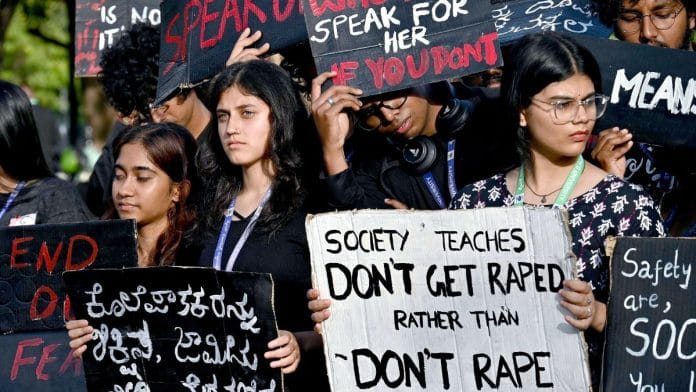

Where is your outrage, India? Where is the fury that once drove thousands of you onto Delhi’s streets, that made India Gate a sea of candles and anger, that made a young woman’s rape and murder feel like a national wound rather than another item in the crime bulletin? Fourteen years after the 2012 Delhi bus gang rape and murder, women and girls continue to be raped, assaulted, and murdered with a frequency that ought to make ordinary life feel intolerable. Yet, the country that once seemed incapable of looking away has become shockingly adept at looking elsewhere.
At least 13 cases of rape and sexual assault have been reported in Delhi NCR since September began. A 16-year-old was gangraped and murdered, her body left to be eaten by dogs, and yet no one in her area seemed to even know that one of their own was missing, not even her father. Many were quick to judge her character after the horrific assault instead of flooding the streets to demand justice. Days later, in another part of the city, a 17-year-old girl was gangraped in a public park. Many on social media questioned why she was out in the evening with a male friend in a park.
The violence has remained horrific, but our response to it has become fleeting. One case replaces another, one victim becomes another headline, and the sheer frequency of sexual violence has begun to dull the shock that once sent thousands of people into the streets.
The nauseating notion of ‘the ideal victim’
The 2012 Delhi bus gang rape victim was horrifyingly easy for a middle-class India to recognise as one of its own.
She was not alone, had taken public transport, and was returning home after an ordinary evening out with a friend. There was no convenient transgression around which the national imagination could build a justification for the brutality meted out to her.
But the moment a woman falls outside that imaginary perimeter, sympathy becomes negotiable. The entire architecture of victim-blaming depends on finding some behaviour that allows us to place her outside the category of the “ideal victim”.
Today, before we can express outrage, the questions almost immediately begin with the woman herself. Why was she there? Who was she with? Why was she out at that hour? Why did her parents not know? What was she wearing? Before we ask what a man did to a woman, we want to know what the woman did to invite it.
This is how a country slowly becomes inured to the unthinkable. The crime arrives, we recoil, we search for the circumstances that will allow us to place the victim at a safe moral distance from ourselves, and once we have decided that she was not quite the woman we would have wanted our daughter or sister to be, our horror begins to evaporate.
The girl who was in the wrong place, with the wrong people, at the wrong hour, wearing the wrong thing becomes somebody else’s tragedy; the respectable woman who obeyed all the invisible rules becomes the one we can imagine ourselves protecting. Compassion, which ought to be indivisible in the face of violence, acquires conditions, footnotes, and eligibility criteria.
The hierarchy of the crime itself also matters. Age matters. A child provokes a different kind of horror from a woman in her 30s; death produces a different response from survival; gang rape is treated as more monstrous than other forms of sexual assault, while the precise nature of penetration, the extent of physical torture, and the injuries left on the body can determine how much horror the public is willing to feel. We have, without admitting it, become connoisseurs of brutality.
Also read: Don’t restrict women’s entry into DDA parks after sunset. Stop men from committing crimes
Only new-age outrage
I shudder to think that this is what 14 years after the 2012 case looks like.
In December 2012, when a 23-year-old physiotherapy student was gangraped and brutally assaulted on a moving bus in Delhi, the country responded as though they were assaulted alongside her.
She was young, educated, working toward a profession, moving through the city in the way millions of women do every day, and yet the ordinary safeguards by which women are taught to navigate public life had proved worthless.
The streets answered for her. First Delhi, then all of India came out onto the streets. It made international headlines, and the protests forced the government to amend India’s criminal laws.
But outraging against future crimes did not become the norm. The cases that have subsequently broken through that noise have tended to carry another charge with them.
Unnao in 2017, Kathua in 2018, and Hathras in 2020 all provoked outrage, but largely through the screens rather than the kind of mass mobilisation the 2012 case had unleashed. In each case, the horror of the crime was quickly dissected, contested, and diluted by arguments over politics, caste, religion, identity, and competing versions of what had happened, until the victim herself became incidental.
Then came RG Kar in August 2024, when a 31-year-old trainee doctor was raped and murdered inside a government hospital in Kolkata. Doctors across the country went on strike, women protested in enormous numbers, and the “Reclaim the Night” demonstrations took place across the country. The victim’s profession and the location of the crime made institutional responsibility unavoidable and people were outraged that a woman who had again followed all the rules had to pay the price with her life.
The cases that sustain national attention often have something beyond the violence itself to rally around: a powerful accused, a political failure, a professional community, a caste or religious identity, an institution.
But what happens when there is no such convenient aperture? What happens to the girl who has no one to back her, sometimes not even her family? Too often, she becomes a statistic before she has even become a story.
Take the 2012 Park Street gang rape in Kolkata, which took place months before the Delhi case. The 38-year-old woman who had been gangraped in a moving car was publicly disbelieved and shamed, with questions raised about her character including from then CM Mamata Banerjee. Two women, two horrific crimes; yet one was far easier for the country to fold into its idea of an ideal victim than the other.
The Tarun Tejpal case showed how readily scrutiny can migrate from the accused to the complainant: why she did not scream, why she continued working, why she behaved as she did after the assault. If she was the ‘ideal victim’, she should have yelled and broken down in tears.
Then there is the peculiar exhaustion of the social media age. In 2012, social media existed, but it had not yet become the endless conveyor belt of catastrophe into which it has evolved. The country had time to sit with a heinous crime, argue about it, grieve over it, and finally take collective action.
Today, another rape arrives before the outrage over the previous one has even cooled. There is only the new-age outrage now: the fleeting indignation of a social-media post, the obligatory demand for the harshest possible punishment, another evening of television panels in which politicians trade accusations while a woman’s suffering is converted into partisan ammunition.
The quantity of information has become almost indistinguishable from the quantity of attention, although the two are very different things. We know about more cases than ever before, but knowing is not the same as caring, and caring is not the same as acting. Social media has made moral expression almost frictionless. It has made the older, slower work of collective action considerably harder even as the technology should, in theory, make mobilisation faster.
Now, we have seen enough, heard enough, read enough. So we just tweet, tag, and keep scrolling. The algorithm moves on.
Fourteen years ago, all of India was on the streets to fight for a woman we didn’t know. Today, before we decide whether to be horrified, we have a checklist for the victim and the brutality to calculate whether it deserves our outrage. The crimes keep coming; the crowds do not.
Views are personal.
(Edited by Aamaan Alam Khan)