






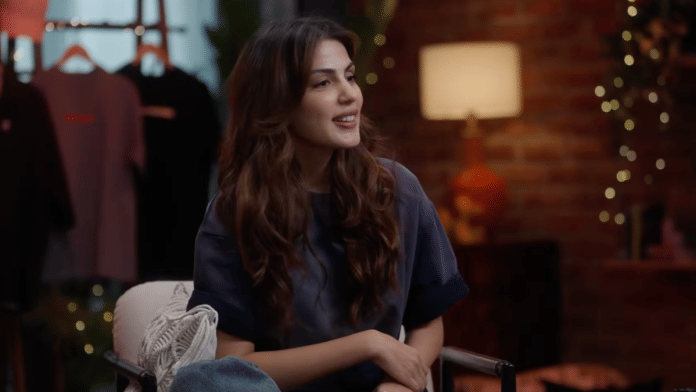


For nearly two years, Rhea Chakraborty was less a person than a verdict, delivered on television and social media, before any court had weighed in. In the aftermath of Sushant Singh Rajput’s death, she became the designated villain of a national tragedy. She was labelled the “witch.” Her social media was filled with abuse. The industry, which had until June 2020 considered her a promising young actor stepped back. But the promising young woman has since clawed her way back to the top, with no family dynasty smoothing the path, no godfather or godmother.
Chakraborty’s is an interesting story, and one that says as much about the country’s appetite for blaming women as it does about her own resilience.
In Bollywood, a female comeback usually follows the “marriage and baby” script. Marry well, have the baby, and return to the red carpet as a “settled” woman.
Aishwarya Rai Bachchan, Madhuri Dixit, Kajol and Rani Mukerji all followed the same pattern. Rai Bachchan stepped back from the limelight after her relationship with Salman Khan in the early 2000s became a prolonged public spectacle, including domestic abuse allegations. While Dixit’s rumoured relationship with co-star Sanjay Dutt was tabloid gold, things only got messier when Dutt was arrested in 1993. Once that relationship reportedly ended, the gossip mill simply found a new target, linking to cricketer Ajay Jadeja. It wasn’t until she married Dr Shriram Nene that the tabloids finally let the speculation go. But Dixit and Rai Bachchan’s comeback was built on domesticity.
Chakraborty followed no such script. To begin with, her story is a climb from somewhere far darker. A hole the entire country dug for her and then threw her into. There was no maternity shoot to gain the public’s affection. Honestly, I don’t think she was even seeking it.
Chakraborty re-stitching her life in an age when social media forgets nothing is a testament to the fact that women survive being disbelieved more often than they are given credit for.
The comeback
The road back started quietly, through Instagram captions remembering Rajput and, once in a while, musing on life. Her first real public reappearance came at Shibani Dandekar and Farhan Akhtar’s wedding in 2022, which also hinted that at least a corner of the industry hadn’t written her off. The real announcement, though, came on a reality show. In a clip from Roadies that aired in June 2023, her first television appearance since the controversy following Rajput’s death, Chakraborty looked into the camera and said: “Did you think I’d be too scared to come back?” More recently, the actor could be seen at Aamir Khan and Gauri Spratt’s intimate wedding ceremony in Bandra. An event that most industry insiders were not invited to.
She didn’t stop at television. In August 2024, Chakraborty and her brother, Showik, launched Chapter 2 Drip, a streetwear label. The seeds, however, were sown back in 2020 itself. On the day she was arrested, Chakraborty wore a t-shirt that read, “Roses are red, violets are blue, let’s smash the patriarchy, me and you,” and it shook the country. In fact, the NGO which had gifted her the t-shirt, as part of some awareness campaign around menstrual pain, sold 20,000 t-shirts after the actress wore it.
So, Chakraborty starting a unisex brand, with a viral white “Indifferent” t-shirt and a line of “Cancel” tees, was the ideal full-circle moment. The woman the country tried to erase is now literally putting words on people’s chests. If that isn’t the perfect comeback, I don’t know what is.
Chapter 2 Drip quickly scaled to a valuation of around Rs 40 crore, and has since expanded from its flagship store on Bandra’s Linking Road to a second location in Delhi’s Vasant Vihar, which opened last week.
Her podcast, which is also under the name of her clothing label, hosted industry biggies like Rana Daggubati, Arjun Rampal, Vijay Varma, Vikrant Massey, Tara Sutaria, and entrepreneur Ghazal Alagh, among others.
Even the comments on her Instagram have changed. Her posts now draw as much affection as they once drew criticism, and that shift in public mood appears to have given her the confidence to return to the one space she had avoided for seven years: acting. Her last screen outing, Chehre in 2021, arrived while the SSR case was still raw. The makers even had to remove her face from the film’s posters.
Now, Chakraborty is set to return with Hansal Mehta’s Family Business on Netflix, starring Anil Kapoor and Vijay Varma.
Also Read: ‘Toxic’ is living up to its name. ‘Ladies & Ladies’ teaser fails women
Weeding out the haters
Despite the 180, scroll past the goodwill, and one in 15 comments refuses to accept a closure report the CBI itself has signed off on. It’s worth sitting with the asymmetry here. Nana Patekar and Sajid Khan, both named in #MeToo allegations, kept working. Sanjay Dutt served five years in prison for the illegal possession of firearms in a case linked to the 1993 Mumbai bombings, and remains one of the industry’s most bankable stars. Salman Khan’s hit-and-run case barely dented his box office. Their comment section has clearly moved on, and so have they.
But for Chakraborty, it remains an uphill battle.
Indian public life has a long, well-worn habit of being harsher on women than on the men standing next to them. From Mamta Kulkarni, Riya Sen, to national-award-winning child star Shweta Basu and Mona Singh, their careers became dead meat after public controversies spanning from harassment allegations, leaked private content, and criminal cases.
A pattern across all these cases was that regardless of whether the allegation was against the actor or made by her, and regardless of how the legal process eventually concluded, the reputational cost landed disproportionately. Their directors and male co-stars named in the same controversies continued working.
Chakraborty is the odd one out. She has rebuilt her life bit by bit and is now set to return to the film world, which once erased her face from a poster. It takes a considerable amount of nerve to execute it. This is a rare kind of comeback. Something no man will ever have the courage to script or take on.
Views are personal.
(Edited by Insha Jalil Waziri)